
Why Sensitive Spaces Deserve Attention
Confidential conversations are often where the highest-stakes decisions are made—whether that’s business strategy, legal matters, financial discussions, negotiations, or sensitive personal affairs. These conversations don’t only happen in obvious places. They can take place in corporate boardrooms, executive offices, homes, vehicles, and even temporary meeting spaces like hotels or rented conference rooms.
In many situations, the risk isn’t visible. A room can look completely normal while still having privacy weaknesses that expose sensitive discussions. TSCM and bug sweeping are professional approaches designed to assess potential surveillance or privacy concerns in a structured, evidence-led way. The purpose is risk assessment and verification, not fear. This guide explains what these assessments are and when considering one may be reasonable.
What Is TSCM and Bug Sweeping?
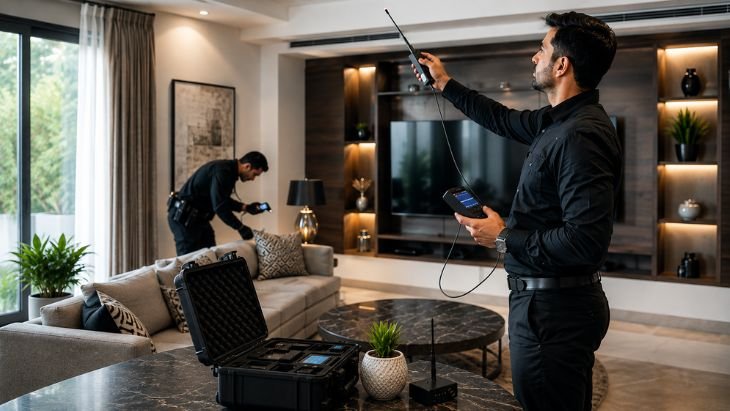
TSCM (Technical Surveillance Counter-Measures) is a professional assessment process used to evaluate an environment for potential technical surveillance risks. In simple terms, it’s a structured way to check whether a space used for confidential discussions may be vulnerable to unauthorised monitoring.
Bug sweeping is a broader, commonly used term people use to describe similar assessments—often referring to efforts aimed at identifying potential surveillance-related concerns or privacy weaknesses in a room, office, vehicle, or other sensitive environment.
A professional assessment is different from casually “looking around the room for something suspicious.” It is guided by a defined objective and considers the environment, access patterns, and the specific concerns involved. Importantly, responsible TSCM work avoids drama and focuses on careful evaluation and documented findings, not assumptions.
When Should a Sensitive Space Be Assessed?
Not every office or room needs a technical assessment. The decision should be risk-based, tied to what is being discussed and what the potential consequences of exposure would be.
Situations where an assessment may be worth considering include:
- Before highly confidential business negotiations
- During mergers, acquisitions, or investment discussions
- Before sensitive legal or regulatory meetings
- When discussing confidential financial or commercial information
- For executive and board-level meetings where confidentiality is critical
- Following a specific and reasonable privacy concern (for example, a credible indication of leakage)
- When establishing a security baseline for an especially sensitive environment
A crucial clarification: an information leak, unusual observation, or internal rumour does not automatically prove surveillance is taking place. It may simply justify a professional assessment to understand whether there is a genuine technical concern—or whether the issue lies elsewhere (process, access control, document handling, or communication discipline).
Which Sensitive Spaces May Benefit From a TSCM Assessment?
The “right” environment to assess depends on circumstances and sensitivity. Common spaces that may be considered include:
- Corporate boardrooms
- Executive offices
- Conference and meeting rooms
- Private residences (when concerns are specific and reasonable)
- Hotel rooms or temporary meeting spaces
- Personal or business vehicles used for sensitive calls or discussions
- Other locations where highly confidential conversations routinely occur
This doesn’t mean these locations inherently require TSCM. It means they can be relevant when the information discussed is consequential and privacy requirements are elevated.
Who May Benefit From a Professional Assessment?
Corporate TSCM assessments are typically considered by people and organisations with a genuine confidentiality requirement, such as:
- Businesses handling commercially sensitive information
- Executives and senior management
- Organisations involved in confidential negotiations or disputes
- Legal professionals managing sensitive matters
- Individuals with specific and reasonable privacy concerns
- Teams seeking a documented baseline for meeting-space confidentiality
The emphasis should remain on legitimate risk management, not on assuming worst-case scenarios.
What Does a Professional TSCM Assessment Involve?
A responsible assessment is systematic and scoped. At a high level, it typically involves:
- Defining objectives and scope (what space, what concern, what “use case”)
- Understanding the environment (layout, access, usage patterns, relevant context)
- Physical and technical assessment appropriate to the space and objective
- Evaluating observations in context (not treating every anomaly as proof)
- Documenting findings clearly
- Structured reporting that explains what was assessed, what was found, and what limitations apply
The core idea is disciplined evaluation and documentation—not speculation based on isolated details.
Warning Signs Are Not the Same as Evidence
This is where many people get stuck: something feels “off,” and the mind jumps to conclusions. Certain circumstances may justify a closer look, such as:
- Unexplained confidentiality concerns
- Sensitive information appearing outside the expected circle
- Unexpected changes within a sensitive environment (access, fixtures, equipment)
- Concerns following a significant transaction, dispute, or leadership change
- A need to establish a documented privacy/security baseline
What these circumstances do not establish:
- They do not automatically prove surveillance.
- They may have alternative explanations (process gaps, internal sharing, poor access control).
- They should be evaluated in wider context.
A professional assessment is valuable precisely because it replaces assumption with structured evaluation.
Why Lawful, Professional Assessment Matters
Sensitive-space assessments should be handled with the same professionalism expected of any serious security activity:
- Clearly defined scope and purpose
- Lawful assessment methods and appropriate authorisation
- Confidential handling of client information and findings
- Objective interpretation—no exaggerated conclusions
- Clear, structured reporting
Professional work should not involve hacking, unauthorised interception, trespassing, or unlawful access to private information. The goal is to assess privacy concerns responsibly and within applicable legal boundaries.
Conclusion: Assess According to Risk and Circumstances
Not every sensitive space automatically requires a TSCM assessment. Relevance depends on the sensitivity of the information discussed, the environment, access patterns, and the specific circumstances. Where there is a reasonable concern—or a legitimate need for documented assurance—professional evaluation can provide a clearer basis for understanding potential privacy risks and deciding next steps.
Spy Detective Agency provides TSCM-related assessments for sensitive environments, with assignments structured around the client’s objectives, the practical realities of the space, and applicable legal considerations.