
Introduction
Traditional cybersecurity models often relied on a trusted internal network. Once a user or device entered that network, security controls sometimes assumed that the entity could access a broad range of resources.
Modern IT environments make this approach increasingly difficult to maintain.
Organizations now operate cloud applications, remote work environments, mobile devices, APIs, SaaS platforms, databases, and hybrid infrastructure. Users and applications can access business resources from many locations and devices.
Zero Trust security addresses this challenge by removing the assumption that access should automatically be trusted.
Instead, Zero Trust requires organizations to verify access continuously and enforce appropriate permissions.
Cryptography plays an important role in this model. Encryption protects data, while cryptographic keys control access to encrypted information.
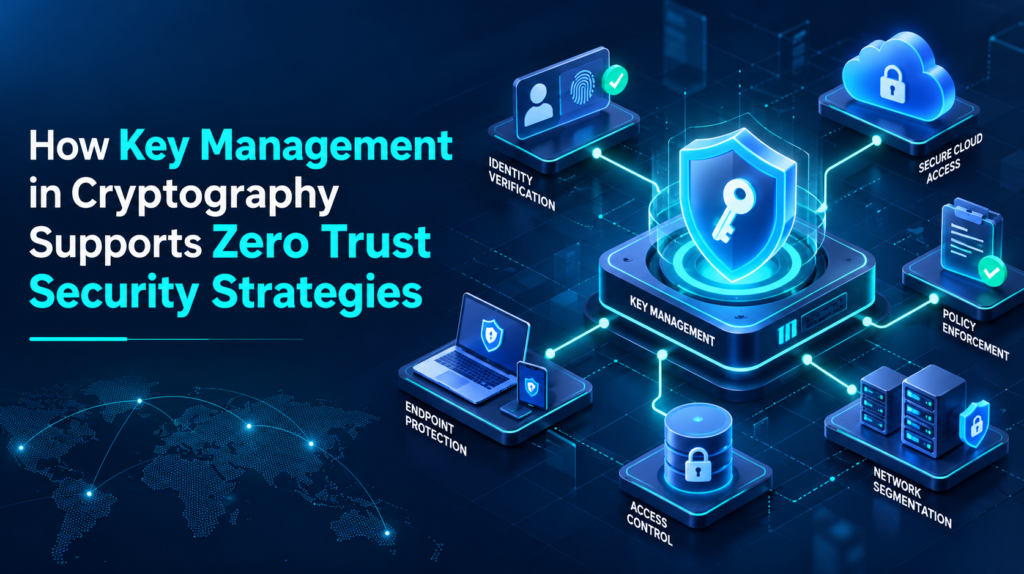
This makes key management in cryptography an important supporting capability for Zero Trust security strategies.
Effective Key management helps organizations control cryptographic keys, restrict access, manage key lifecycles, and maintain visibility across distributed environments.
What Is Zero Trust Security?
Zero Trust is a security approach based on the principle that organizations should not automatically trust users, devices, applications, or network locations.
Instead, organizations verify access based on factors such as:
- Identity
- Device status
- Application context
- Access permissions
- Resource sensitivity
- Security policies
- Risk
The goal is to limit unnecessary access and reduce the potential impact of compromised accounts or systems.
Why Cryptography Matters to Zero Trust
Zero Trust relies on several security controls, including identity management, authentication, authorization, segmentation, monitoring, and encryption.
Encryption helps protect data even when other security controls are challenged.
For example, an organization may encrypt sensitive customer information stored in a cloud database. Even if an unauthorized user gains access to the storage environment, encryption can provide an additional layer of protection.
However, the encryption key must remain protected.
This is where Key management becomes important.
Understanding Key Management in Cryptography
Key management in cryptography refers to the processes and technologies used to control cryptographic keys throughout their lifecycle.
A typical lifecycle includes:
- Key generation
- Key storage
- Key distribution
- Key access
- Key usage
- Key rotation
- Key backup
- Key recovery
- Key retirement
- Key destruction
Zero Trust principles can be applied throughout this lifecycle.
Organizations should verify who or what can access keys and limit permissions according to business requirements.
Applying Least Privilege to Cryptographic Keys
Least privilege represents an important Zero Trust principle.
Organizations should provide users and applications only the access they need.
The same principle applies to cryptographic keys.
An application that needs to encrypt customer information should not automatically receive access to every key within the enterprise.
Organizations can create policies that restrict access according to:
- Application identity
- User identity
- Role
- Environment
- Data classification
- Business function
This limits unnecessary key exposure.
Protecting Keys From Unauthorized Access
Cryptographic keys represent high-value security assets.
Organizations should protect them using appropriate security controls.
Security teams should avoid storing sensitive keys in:
- Application source code
- Unprotected configuration files
- Public repositories
- Easily accessible storage
Instead, businesses should use dedicated key management infrastructure where appropriate.
Key Management and Continuous Verification
Zero Trust does not rely on one-time authentication.
Organizations continuously evaluate access to resources.
Key management can support this model by controlling which identities and applications can perform cryptographic operations.
For example, an application can request access to a specific cryptographic operation based on its identity and authorization policy.
This approach creates a stronger relationship between identity security and cryptographic security.
Protecting Cloud Applications
Cloud environments frequently support Zero Trust architectures.
Organizations may operate applications across multiple cloud providers while maintaining on-premises systems.
These applications can process sensitive data across distributed infrastructure.
Key management helps security teams maintain control over encryption keys across these environments.
Organizations should know:
- Where keys reside
- Which systems use them
- Who can access them
- What information they protect
- When they should rotate
Key Rotation and Zero Trust
Key rotation supports lifecycle security.
Organizations should replace cryptographic keys according to established policies.
Rotation can reduce the period during which a particular key remains active.
Businesses may establish rotation requirements based on:
- Key age
- Risk
- Security policy
- Data sensitivity
- Regulatory requirements
- Suspected compromise
Organizations should test rotation processes carefully before applying them to critical applications.
Key Separation
Zero Trust architectures can also benefit from key separation.
Organizations should avoid using one cryptographic key across unrelated applications or data sets when their security requirements differ.
Separating keys can limit the potential impact of a compromised key.
For example, an enterprise can use separate keys for different applications, environments, or categories of sensitive data.
Monitoring Cryptographic Access
Zero Trust requires continuous visibility.
Organizations should monitor cryptographic activity such as:
- Key access
- Key creation
- Key rotation
- Failed access attempts
- Administrative changes
- Key retirement
Security teams can use this information to identify unusual behavior.
Protecting Keys During Application Development
Modern development teams frequently use automated pipelines.
Cryptographic keys can become exposed if developers place them directly into application code or deployment scripts.
Organizations should establish secure procedures for applications to access cryptographic services.
This can reduce the number of locations where sensitive keys appear.
Key Management and Data Classification
Zero Trust strategies often consider the sensitivity of the resource being accessed.
Organizations can apply similar principles to cryptographic keys.
Keys protecting highly sensitive information may require stronger controls than keys protecting low-risk information.
Security teams can classify keys based on:
- Data sensitivity
- Business impact
- Application criticality
- Regulatory requirements
This allows organizations to prioritize security controls.
Role of Centralized Key Management
Centralized Key management can help enterprises maintain consistent policies.
Security teams can manage:
- Key ownership
- Access policies
- Rotation
- Lifecycle status
- Monitoring
Centralization can be particularly useful when businesses operate across cloud and on-premises infrastructure.
Key Management and Identity Security
Identity represents a core component of Zero Trust.
Users and applications should prove their identity before accessing protected resources.
Cryptographic keys can support authentication, digital certificates, secure communications, and encryption.
Organizations should therefore connect identity policies with cryptographic key policies.
Common Challenges
Excessive Key Permissions
Applications may receive broader access than necessary.
Key Sprawl
Organizations may create large numbers of keys across different systems.
Poor Visibility
Security teams may not know where all keys reside.
Manual Processes
Manual lifecycle management can introduce errors.
Legacy Applications
Older applications may not integrate easily with modern Zero Trust and Key management systems.
Best Practices
Organizations should:
- Maintain a complete key inventory
- Assign ownership to important keys
- Apply least privilege
- Separate keys according to security requirements
- Protect keys independently from encrypted data
- Establish rotation policies
- Monitor key access
- Automate appropriate lifecycle processes
- Test recovery procedures
- Retire obsolete keys
Conclusion
Zero Trust security requires organizations to verify access rather than automatically trust users, devices, applications, or network locations.
Cryptography supports this strategy by protecting sensitive information and enabling secure digital interactions.
Key management in cryptography provides the framework for managing the cryptographic keys that support these controls.
Effective Key management can enforce least privilege, support key rotation, improve visibility, and reduce unnecessary key exposure.
By integrating cryptographic key management with identity, access control, monitoring, and Zero Trust policies, enterprises can build a stronger and more resilient security architecture.