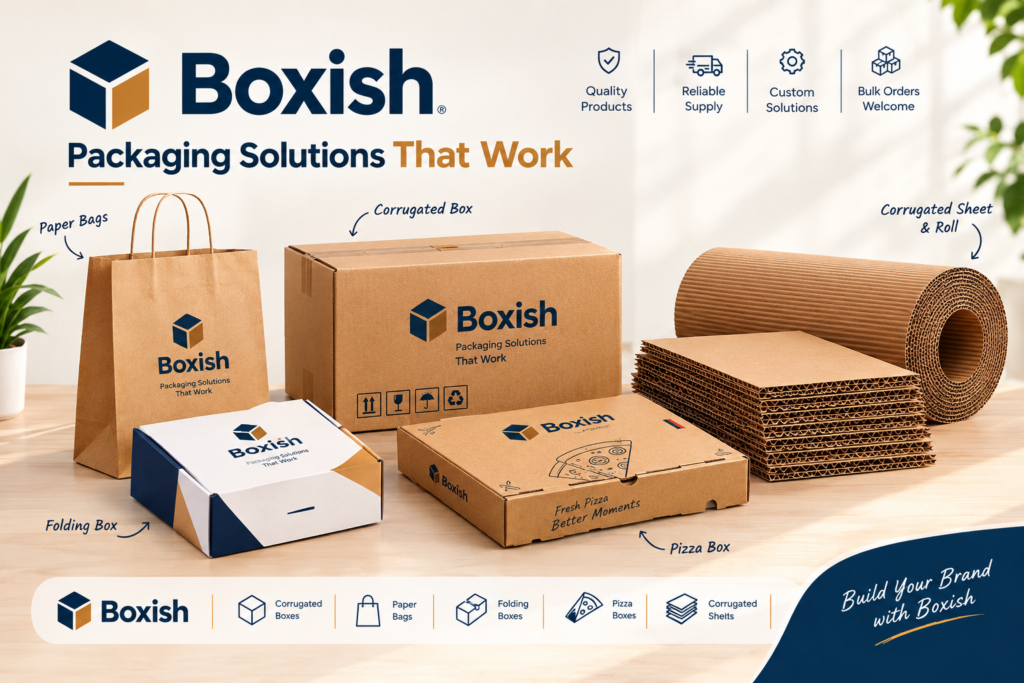

Businesses that store, ship, or distribute products need packaging that protects goods while making everyday operations easier. From ecommerce orders and retail inventory to wholesale shipments and manufacturing supplies, products may pass through several handling stages before reaching their final destination.
Corrugated box packaging helps businesses create a protective outer structure around products while supporting storage, transportation, and order fulfilment. Its suitability depends on the box dimensions, board construction, product weight, internal protection, and shipping conditions.
Choosing the right packaging can help businesses reduce unnecessary product movement, improve packing consistency, and manage products more efficiently throughout the supply chain.
What Is Corrugated Box Packaging?
Corrugated box packaging uses containers made from corrugated board, which generally consists of flat paper liners and a fluted paper layer between them.
The liners form the inner and outer surfaces, while the fluted layer contributes to the board’s structure, rigidity, and cushioning properties.
Corrugated boxes are available in different sizes and constructions to meet different packaging requirements. Businesses can select them according to:
- Product dimensions
- Total packed weight
- Product fragility
- Storage requirements
- Stacking conditions
- Transportation distance
- Internal protection needs
The goal is to match the packaging to the product instead of using the same box specification for every shipment.
How Corrugated Box Packaging Improves Shipping Safety
Shipping can expose products to movement, compression, stacking, vibration, and repeated handling. A package may travel through warehouses, sorting centres, transportation hubs, and delivery vehicles before reaching the customer.
A properly selected corrugated box can help protect the contents throughout this process.
1. Provides a Protective Outer Structure
Corrugated board creates a physical barrier around the product. Its layered construction can help distribute some external forces during normal handling and transportation.
This can be useful for ecommerce products, retail merchandise, household items, and other goods that need protection during delivery.
However, the required level of protection depends on the product. Fragile or heavy items may need a stronger box and additional internal protection.
2. Helps Limit Product Movement
Excessive movement inside a package can increase the risk of products hitting the box walls or other items.
A correctly sized box can help reduce unnecessary movement. For products that require additional stability, businesses can use suitable cushioning, dividers, or inserts.
The objective is to keep the product secure without applying excessive pressure.
3. Supports Stacking and Storage
Businesses often stack packages in warehouses, storage areas, and transportation vehicles.
Boxes at the bottom of a stack may experience pressure from those above them. Suitable board construction and box dimensions can help the packaging withstand the expected stacking conditions.
Businesses should consider product weight, stacking height, storage duration, and environmental conditions when selecting a box.
4. Helps Keep Products Contained During Handling
Packages may be lifted, moved, loaded, unloaded, and transferred between storage areas and vehicles.
A properly assembled and sealed corrugated box helps keep the contents contained during these activities.
The box must be suitable for the packed weight, and its flaps and joints should be secured appropriately before dispatch.
How Corrugated Boxes Improve Product Handling Efficiency
Packaging affects more than product safety. It also influences how quickly employees can prepare orders and move inventory.
Suitable corrugated boxes can make handling more organized by providing consistent dimensions and a practical structure for storage, packing, and transportation.
Easier Packing and Sealing
Boxes with suitable dimensions are easier to assemble, fill, close, and seal.
When businesses standardize packaging for frequently shipped products, employees can select the appropriate box more quickly.
This can reduce confusion at packing stations and make everyday operations more consistent.
Better Warehouse Organization
Corrugated boxes can help businesses group products by category, SKU, order, or destination.
Clearly labelled boxes and standardized dimensions can make inventory easier to identify and move.
Businesses can also store unused boxes flat and organize them by size to improve access during order preparation.
More Efficient Product Movement
Retailers, wholesalers, and manufacturers often move products between warehouses, stockrooms, stores, and distribution facilities.
Suitable boxes can make these transfers easier to manage, particularly when packaging sizes are consistent and appropriate for the products.
Reduced Unnecessary Packaging Material
Oversized packaging can require more filler material and take up additional storage space.
Selecting suitable dimensions can help reduce excessive empty space while maintaining room for the product and any required protective materials.
The objective is to balance product protection with practical material use.
Choosing the Right Box Construction
Not every product needs the same level of packaging strength. Two common options are 3-ply and 5-ply corrugated boxes.
3-Ply Corrugated Boxes
Three-ply boxes generally consist of two flat liner layers and one fluted layer.
They can be suitable for many lightweight and moderately weighted products when the board specification matches the application.
Common uses may include:
- Clothing and accessories
- Books and stationery
- Small retail products
- Suitable lightweight ecommerce orders
- General inventory packaging
The final suitability depends on the product’s weight, dimensions, fragility, and transportation conditions.
5-Ply Corrugated Boxes
Five-ply boxes generally contain three liner layers and two fluted layers.
They can provide greater rigidity and structural support, depending on the materials and manufacturing specifications.
Businesses may consider them for heavier products, larger packages, higher stacking requirements, and more demanding transportation conditions.
However, ply alone does not determine box performance. Paper quality, flute construction, dimensions, joint quality, and manufacturing consistency also matter.
Cardboard Boxes vs Carton Boxes for Shipping
The terms cardboard boxes and carton boxes are commonly used when searching for packaging products. However, their meanings can vary depending on the supplier and application.
Corrugated boxes contain a fluted layer between flat paper liners. This structure makes them suitable for many shipping, storage, and distribution requirements.
Other paperboard cartons may be intended for lighter packaging or product presentation.
Before purchasing, businesses should check:
- Material and board construction
- Box dimensions
- Packed weight
- Required stacking strength
- Product fragility
- Internal protection
- Transportation conditions
The name of the packaging alone does not establish whether it is suitable for shipping. Reviewing the actual specifications helps businesses make a more appropriate choice.
The Role of Internal Protection in Product Safety
The outer box is only one part of a complete packaging system. Some products need additional materials to prevent movement, reduce direct contact, or protect sensitive surfaces.
Depending on the application, businesses may use:
- Paper cushioning
- Corrugated inserts
- Dividers
- Protective wrapping
- Suitable fillers
- Moulded inserts
For example, multiple glass products may need dividers to prevent direct contact. Electronic products may require cushioning around sensitive components, while products with delicate surfaces may need protective wrapping.
Internal protection should be selected according to the product’s fragility and expected handling conditions. A stronger outer box does not automatically eliminate the need for cushioning.
Using Corrugated Sheets for Additional Protection
Corrugated sheets can complement corrugated boxes when products need extra separation or protective layers.
Depending on the packaging design, sheets can be used:
- Between multiple products
- Above or below packed items
- As internal separators
- To protect selected flat surfaces
- As additional layers inside larger packages
For example, a business shipping several products in one carton can use sheets to help keep the items separated during handling.
The sheet’s size and construction should match the product and intended use. It should support the packaging system rather than replace any cushioning that the product specifically requires.
Using Corrugated Rolls for Flexible Product Protection
Some products have irregular shapes, exposed corners, or surfaces that need additional coverage before they are placed inside a box.
Corrugated rolls can provide flexible paper-based protection for suitable applications. The material can be cut to the required length and wrapped around selected parts of a product.
Potential applications include:
- Furniture components
- Machinery parts
- Irregularly shaped products
- Product edges and corners
- Sensitive surfaces
A corrugated roll can be useful when fixed-size protective materials do not provide the required coverage.
The appropriate material depends on the product’s shape, fragility, and transportation conditions.
Corrugated Packaging for Ecommerce Businesses
Ecommerce orders often pass through several logistics and handling stages before delivery.
A typical shipment may follow this process:
Order Processing → Packing → Courier Pickup → Sorting Centre → Distribution Hub → Local Delivery → Customer
At each stage, the package may experience movement, stacking, vibration, and repeated handling.
Businesses should select packaging according to the product’s dimensions, weight, and fragility. They should also consider how the package will be stored before dispatch.
For fragile products, the outer box should be combined with suitable internal protection. For routine orders, standardizing box sizes can help employees pack more consistently.
A well-planned packaging process can make fulfilment easier to manage while helping businesses address common product-handling risks.
Corrugated Packaging for Retail, Wholesale, and Manufacturing
Corrugated boxes are also useful beyond ecommerce deliveries.
Retail Businesses
Retailers can use boxes for supplier deliveries, stockroom storage, store transfers, and customer orders.
Wholesalers and Distributors
Wholesalers may use corrugated packaging to group products and prepare shipments for retailers or other businesses.
Manufacturers
Manufacturers can use boxes to store components, organize finished goods, and transport products between production facilities and distribution points.
Warehouses
Warehouse teams can use standardized boxes to group inventory, improve identification, and make products easier to move.
In each application, box dimensions, strength, stacking requirements, and handling conditions should guide packaging selection.
Common Packaging Mistakes Businesses Should Avoid
Even suitable corrugated packaging can perform poorly when it is selected or used incorrectly.
Choosing Only by Price
A low-cost box may not provide the required strength or product fit. Businesses should evaluate overall performance and cost.
Using One Box Size for Every Product
Different products have different dimensions and protection requirements. Maintaining a practical range of sizes can improve packaging efficiency.
Ignoring Product Weight
The box must be suitable for the total packed weight, including internal materials and additional contents.
Leaving Excessive Empty Space
Too much empty space can allow product movement and increase filler requirements.
Ignoring Internal Protection
Fragile products may need cushioning or dividers even when the outer box is strong.
Skipping Sample Testing
A box may look suitable when empty but perform differently when packed. Testing samples with actual products can help identify problems before bulk purchasing.
How to Choose the Right Corrugated Box Packaging
Businesses can follow a practical selection process before ordering.
Step 1: Measure the product. Record its length, width, and height.
Step 2: Calculate packed weight. Include the product and any internal packaging materials.
Step 3: Assess fragility. Identify surfaces, corners, or components that need extra protection.
Step 4: Select the box construction. Consider ply, paper quality, flute structure, and dimensions.
Step 5: Plan internal protection. Determine whether cushioning, sheets, dividers, or rolls are required.
Step 6: Consider shipping and storage. Evaluate stacking, handling, transportation distance, and storage conditions.
Step 7: Test a sample. Check fit, closure, sealing, internal movement, and handling before placing a large order.
This process can help businesses choose packaging based on actual requirements rather than appearance or price alone.
Final Thoughts
Corrugated box packaging can help businesses improve shipping safety and product handling efficiency by providing a suitable outer structure for storage, transportation, and delivery.
The right packaging depends on product dimensions, packed weight, fragility, board construction, stacking requirements, and shipping conditions. Businesses should also consider internal protection, box size, sealing, and storage before selecting a specification.
Cardboard boxes and carton boxes may be used for different packaging applications, so buyers should verify the actual material and construction before ordering.
For additional protection, corrugated sheets can provide separation and protective layers, while corrugated rolls can offer flexible coverage for selected surfaces and irregular shapes.
By selecting suitable box specifications, standardizing common sizes, and testing samples before bulk purchasing, businesses can create a more consistent packaging process that supports product safety and efficient handling.
Frequently Asked Questions
1. How does corrugated box packaging improve shipping safety?
A suitable corrugated box provides a protective outer structure that can help manage normal handling, stacking, movement, and minor impacts during transportation. The required construction depends on the product and shipping conditions.
2. How can corrugated packaging improve handling efficiency?
Standardized box sizes can make packing, sealing, labelling, storage, and inventory movement more consistent. Suitable dimensions can also reduce unnecessary filler material.
3. What is the difference between cardboard boxes and corrugated boxes?
Cardboard is often used as a general term for paper-based board. Corrugated boxes contain a fluted layer between flat liners, creating a structured board commonly used for shipping and storage.
4. When should businesses use 3-ply or 5-ply corrugated boxes?
Three-ply boxes can be suitable for many lightweight and moderately weighted products. Five-ply boxes may be appropriate when greater structural support is required. The choice depends on the complete board specification, dimensions, packed weight, and handling conditions.
5. Can corrugated sheets improve product protection?
Yes. Corrugated sheets can be used as separators, dividers, or protective layers inside packages when products need additional separation or coverage.
6. When are corrugated rolls useful?
Corrugated rolls can be useful for wrapping irregularly shaped products, protecting edges and corners, or adding flexible coverage to selected surfaces before placing products inside a box.
7. Do strong corrugated boxes eliminate the need for cushioning?
No. Fragile products may still require cushioning, dividers, inserts, or protective wrapping. The complete packaging system should match the product’s fragility and transportation conditions.
8. How can businesses choose the correct box size?
Measure the product’s length, width, and height, then allow enough space for required internal protection. Confirm whether the supplier lists internal or external dimensions, and avoid excessive empty space.
9. What should businesses check before buying corrugated packaging in bulk?
Check the box dimensions, board construction, paper specifications, product fit, internal protection, sealing, order quantity, storage capacity, and supplier consistency. Testing a sample with the actual product is recommended.
10. Can corrugated boxes be used for both storage and transportation?
Yes. Suitable corrugated boxes can support inventory storage, product movement, and shipping. The box specification should match the packed weight, stacking requirements, storage conditions, and transportation environment.