
Introduction
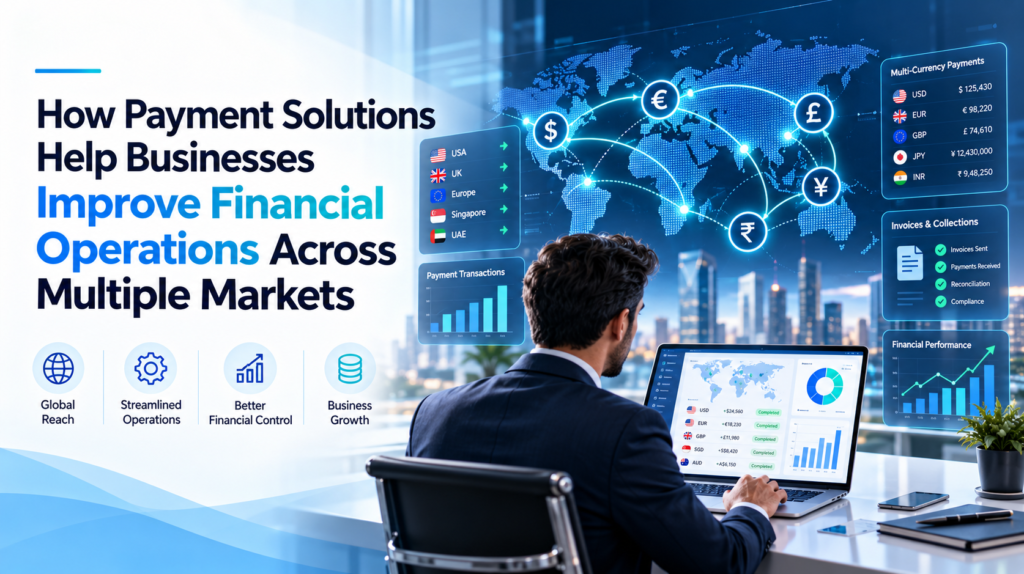
Expanding into multiple markets creates significant opportunities for businesses. Companies can reach new customers, diversify revenue streams, build international supplier networks, and reduce dependence on a single region. However, expansion also makes financial operations more complex.
A business operating in several markets may need to collect payments from customers in different countries, pay international suppliers, manage multiple currencies, track settlements, and reconcile transactions across several systems. Without an organized payment infrastructure, these activities can consume valuable time and increase the risk of errors.
Modern payment solutions help businesses simplify these processes.
Instead of treating every market as a separate financial environment, companies can use a structured business payment solution to improve payment collection, transaction monitoring, reconciliation, and reporting.
For growing organizations, efficient payment infrastructure can become an important foundation for managing financial operations across multiple markets.
Why Multi-Market Businesses Need Better Payment Infrastructure
Managing financial operations in one market is relatively straightforward compared with operating across several regions.
Each market may have different:
- Payment preferences
- Currencies
- Banking systems
- Settlement schedules
- Customer expectations
- Regulatory requirements
- Transaction costs
These differences can create fragmented financial processes.
For example, one team may manage payments through one provider while another market uses a completely different system. Finance teams then need to combine information from several sources to understand the company’s overall payment position.
Centralized payment solutions help reduce this fragmentation.
They can provide businesses with a more consistent framework for handling transactions while still supporting local market requirements.
Centralizing Business Payments Across Markets
Centralization is one of the most important advantages of modern payment infrastructure.
When business payments move through disconnected systems, finance teams may struggle to monitor transactions efficiently.
A centralized approach can help businesses bring payment information into a more organized environment.
This can improve visibility over:
- Incoming customer payments
- Vendor transactions
- International settlements
- Payment failures
- Refunds
- Transaction fees
- Settlement timelines
Better visibility allows finance teams to identify problems faster and make more informed financial decisions.
It also reduces reliance on spreadsheets and manual reporting.
Managing Cross Border Payments More Efficiently
International expansion naturally increases the number of cross border payments a business must manage.
Companies may need to receive money from customers abroad while also paying suppliers, technology partners, contractors, and service providers in other countries.
International transactions can involve several additional steps compared with domestic payments.
Businesses may need to consider currency conversion, transaction processing timelines, compliance checks, intermediary institutions, and settlement procedures.
Reliable payment infrastructure helps companies manage these requirements more systematically.
Efficient cross-border payments can improve payment visibility and reduce uncertainty around international settlements.
This becomes increasingly important as transaction volumes grow.
Supporting B2B Cross Border Payments
Companies operating across multiple markets frequently work with international suppliers and commercial partners.
These relationships often involve recurring or high-value transactions.
Reliable b2b cross border payments help companies maintain better control over these transactions.
Businesses can use structured payment processes to track:
- Supplier invoices
- Partner settlements
- Distribution payments
- International service fees
- Recurring vendor payments
Clear payment records can also simplify financial reporting and reconciliation.
When businesses can easily identify who received a payment, when it was processed, and which invoice it relates to, finance teams spend less time investigating transaction discrepancies.
Improving Payment Collection With Pay-in Services
Expansion does not only increase outgoing payments. It also creates more incoming transactions.
Customers in different markets may prefer different payment methods.
Effective Pay-in services help businesses receive customer payments through appropriate digital channels while maintaining a structured record of transaction activity.
These services can support:
- Customer payment collection
- Transaction confirmation
- Payment tracking
- Reconciliation
- Settlement monitoring
Efficient Pay-in services help businesses reduce payment friction while improving visibility over incoming cash.
This can support stronger working capital management.
The Role of Online Payment Solutions
Digital commerce has changed the way businesses enter new markets.
A company no longer needs a large physical presence in every country before reaching customers.
Websites, applications, digital marketplaces, and online service platforms allow businesses to sell internationally.
This makes online payment solutions essential.
Customers expect payment processes to be convenient, secure, and easy to complete.
Businesses should therefore consider whether their payment infrastructure supports relevant online channels and payment methods.
A smoother payment experience can reduce unnecessary barriers between customer interest and completed transactions.
Improving Financial Reconciliation
Reconciliation becomes more difficult when businesses process transactions across multiple markets.
Finance teams may need to match hundreds or thousands of payments with invoices, customer accounts, or supplier records.
Manual reconciliation can be slow and prone to mistakes.
Modern payment solutions can improve this process by providing structured transaction data.
With better payment information, businesses can identify:
- Completed transactions
- Outstanding payments
- Failed transactions
- Settlement differences
- Refunds
- Transaction fees
Automation can further reduce the administrative burden associated with reconciliation.
Better Cash Flow Visibility
International operations can make cash flow forecasting more complicated.
Money may arrive from several markets on different schedules.
At the same time, businesses may need to make payments to suppliers, employees, contractors, and partners across multiple regions.
A reliable business payment solution can provide finance teams with better visibility over payment activity.
This helps businesses understand when funds are expected to arrive and when major outgoing transactions are scheduled.
Improved visibility supports better financial planning.
Companies can make more informed decisions about inventory, hiring, marketing, technology investments, and expansion.
Reducing Operational Complexity Through Automation
Payment automation can significantly improve financial operations.
Businesses can automate tasks such as:
- Transaction confirmations
- Payment reconciliation
- Settlement reporting
- Customer notifications
- Payment status updates
Automation reduces manual effort and allows finance teams to focus on analysis rather than repetitive administration.
It can also improve consistency across markets.
Instead of different teams following different processes, businesses can establish standardized workflows.
Security Across Multiple Markets
Operating across several regions also increases exposure to payment risks.
Businesses should ensure that payment systems use appropriate security measures to protect transactions and sensitive financial information.
Security considerations may include:
- Authentication
- Data protection
- Fraud monitoring
- Access controls
- Transaction verification
Companies should also review applicable regulatory and compliance requirements in the markets where they operate.
Security should remain part of the payment strategy rather than an afterthought.
Selecting Payment Infrastructure for Growth
Businesses planning multi-market expansion should select payment systems based on future requirements as well as current operations.
Important considerations include:
Scalability
Can the platform handle higher transaction volumes?
International Capabilities
Can it support relevant markets, currencies, and cross border payments?
Integration
Can the payment system connect with accounting, ERP, CRM, or e-commerce platforms?
Reporting
Does it provide useful transaction and settlement information?
Collection Capabilities
Can Pay-in services support customer payment requirements?
B2B Requirements
Can the infrastructure support complex b2b cross border payments?
Considering these factors early can reduce the need for disruptive payment system changes later.
Where Uniteller Fits Into the Payment Discussion
Companies evaluating international payment infrastructure may compare providers such as Uniteller based on the markets they support, payment capabilities, integrations, settlement processes, compliance requirements, and business needs.
The right provider should align with the company’s transaction model rather than simply offer basic payment processing.
Businesses should assess their operational requirements carefully before selecting any platform.
Conclusion
Operating across multiple markets creates financial opportunities but also increases payment complexity.
Modern payment solutions can help companies create more organized financial operations by centralizing transaction information, improving reconciliation, supporting international collections, and providing better payment visibility.
Reliable cross border payments, scalable online payment solutions, efficient Pay-in services, and structured business payments can help growing organizations manage increasingly complex operations.
By selecting a flexible business payment solution capable of supporting b2b cross border payments, businesses can build a stronger financial foundation for long-term international growth.