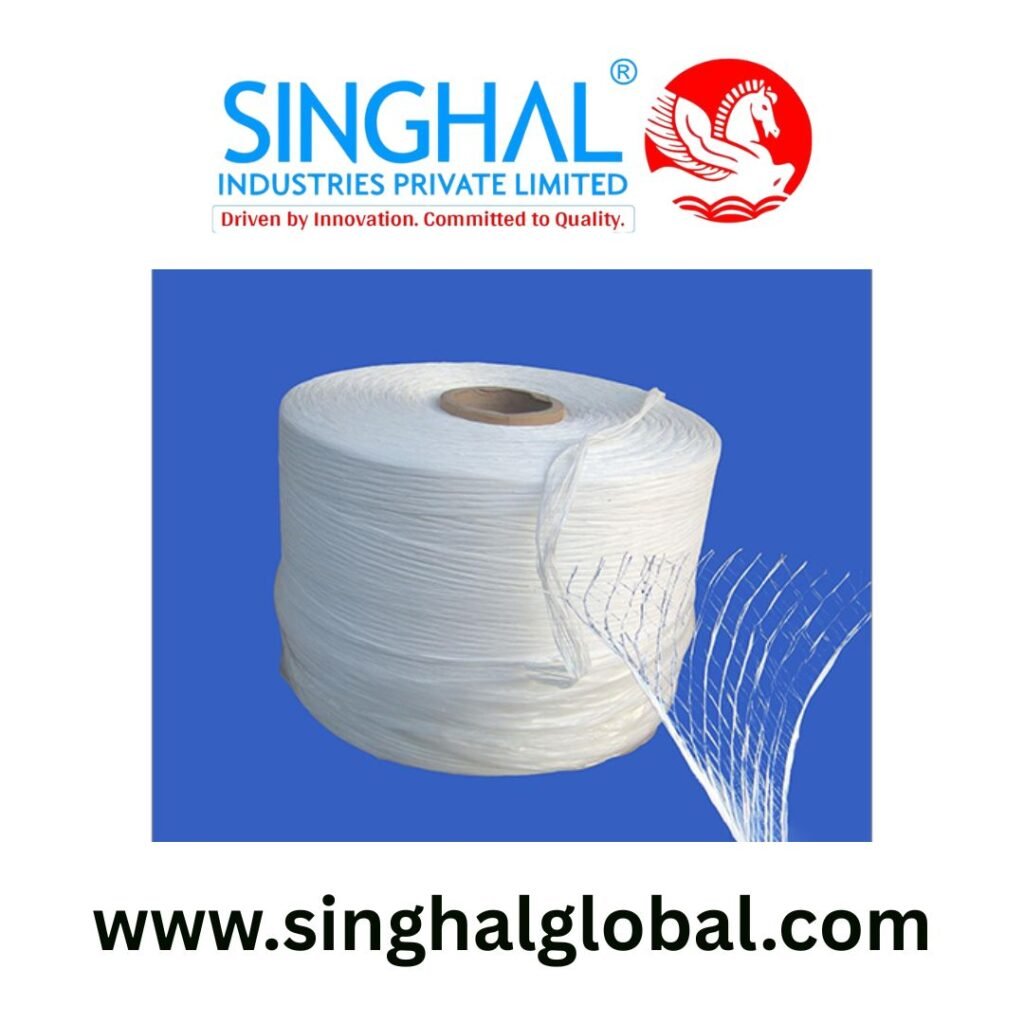

Introduction to PP Fibrillated Yarn and its Role
PP Fibrillated yarn is a specific type of PP fiber yarn. Unlike other yarns produced from polypropylene, PP fibrillated yarns are produced from a film/tape where a number of fibrils are coupled together. Therefore, PP fibrillated yarn has higher practical strength and is easier to weave. PP Fibrillated yarn has a number of additional advantages, e.g. softness, comfort, smoothness and elasticity, which makes it attractive for use in a number of applications in the production of woven and non-woven fabrics. Being a low density PP fibrillated yarn, it can be used to make lightweight fabrics. Additional properties of PP fibrillated yarn can be modified to enhance color fastness or for ultraviolet (UV) protection.
PP fibrillated yarns form part of the special class of PP fibers, which can be converted into yarns. Unlike other polypropylene yarns, fibrillated PP yarns are made out of a film/tape where a number of fibrils are connected. Because of this, a much higher number of fibrils are connected in each cross section in a fibrillated PP yarn compared to a regular polypropylene yarn. Because of this, fibrillated PP yarns have much higher practical strength and are easier to weave.
Manufacturing Process and Structure of PP Fibrillated Yarn
A number of processes must be tightly controlled in the manufacturing process of PP fibrillated yarn. One of these processes is the control of PP in melting and extruding it to a film, the thickness of a credit card, or to a tape. The tape is then mechanically stretched to molecular uniformity and improved mechanical properties. The film is then fibrillated to the degree needed. The means and the extent of fibrillation determines the strength of PP fibrillated yarn and the quality of the final product.
There are many characteristics that can be added to PP fibrillated yarn in its formulation to meet the needs of end users. Additional processing such as twisting and intermingling can be done on the yarn before shipping. For colorfastness, masterbatches can be added during processing. Based on its end use, additives can be incorporated to improve the performance of the yarn.
Important Properties and Performance Benefits
The lower density of PP allows the manufacture of lighter weight articles. PP has good handling because of fibrillated structure and it also provides easy integration in woven fabrics. Because of low moisture absorption of PP, the performance of articles made from PP is good in humid conditions and in articles which come in contact with water. PP has good tensile strength and dimensional stability. Abrasion resistance of PP yarn depends on the formulation and process used in its manufacture. Outdoor weathering resistance and service temperature of PP is good. PP is chemically stable and is compatible with many chemicals. The chemical resistance of PP should be evaluated in specific application and environmental conditions.
PP Fibrillated Yarn and Related Products Across Different Industries
Being a thermoplastic yarn, PP Fibrillated Yarn can be produced in various formats. This has greatly expanded its applications. It can be woven or twisted to form different fabric structures. Selected grades of PP Fibrillated Yarns are used in the production of woven sacks and bag closing threads. Flat or twisted PP Fibrillated Yarn can be produced to form round or flat yarns and cords and used in agricultural and general industrial activities. It finds applications in technical textiles, e.g. as backing for carpets or mats. PP Fibrillated Yarn has several applications in construction and environmental protection, for e.g. geotextiles, twines, synthetic sports surfaces and agri-nets.
Finding a Reliable PP Fibrillated Yarn
Different specifications define the production of PP Fibrillated Yarn, and thus it is the responsibility of the manufacturer to make yarns meeting the specifications to qualify for the product. While buying PP Fibrillated Yarn, the buyers are obliged to examine the yarn to determine if they meet their requirements. Among others, some of the criteria to be assessed include tensile strength, elongation, twist, color and construction of the yarns (flat or twisted). The supplier should provide evidence to show that their yarns are compatible to the buyers’ machinery.
Samples are used to evaluate the behavior of yarns during weaving, stitching and winding. Singhal Industries Private Limited, manufacturers of PP Fibrillated yarns, states that they qualify their customers’ requirements through various constructions. The company mentions the end-uses and applications of PP Fibrillated yarns in engineering, and other industrial fabrics, bags, ropes, geotextiles, etc.
Quality Control, Specifications and Purchasing Considerations
PP Fibrillated Yarns are supplied in a condition that is best suited for further processing by customers. Fibrillated yarns of different deniers are produced. Properties and characteristics of fibrillated yarns may affect the performance of the final product and affect the fabric formation and appearance. Some applications may require UV and/or color consistency. Other environmental and climatic conditions may also apply. The end user may require supplier to do various evaluations; however for quality assurance, the supplier should be provided details of end product for which the supplier may evaluate appropriate yarn specifications. The end user should also take into consideration logistics and other commitments. PP Fibrillated yarns are relatively inexpensive, but there is always the risk of inconsistent quality, which may lead to rejection of the product and increased cost.
Storage, Handling, and Sustainable Use of PP Fibrillated Yarn
PP Fibrillated Yarn has a low level of absorption and can retain moisture. Storage areas for the packages should be dry and clean. The packages should not be exposed to extremes of temperature. Packages should not be opened unless the materials are required. They should be transported unopened, and particularly in the case of long transport with multiple parties involved. The operator’s instruction for safe use of the yarn should be followed. This is applicable to the storage and handling of the yarn as well. Similar to other thermoplastics, PP can be recycled and has the potential to be recycled. However, in practice this is site dependent and as such most of the finished products from PP end up in landfills.
Conclusion: PP Fibrillated Yarn for Industry
In various industries such as packaging, textile, agriculture, construction and others, PP Fibrillated Yarn has many uses. What adds to the uniqueness of PP Fibrillated Yarn is that it is lightweight, has high strength and low moisture absorption, is chemically stable and is environment and factor stable, and can be designed to meet the requirements of an application. In order to achieve the performance requirements of PP Fibrillated Yarn Manufacturer, many factors must be considered such as denier, tensile strength, elongation, twist, and fibrillation. Environmental conditions play an important role in performance. It is important to have a supplier with the ability to manufacture products as per customer requirements along with the technology and support offered by the supplier, and the reliability of transport and logistics.
Apart from others, PP Fibrillated Yarn for use in different industries is offered by Singhal Industries Private Limited. Current technical specifications should be used to assess potential suppliers. It is important to ignore unsubstantiated claims by competitors in the market. To meet the needs of end users, there are multiple characteristics that can be formulated into PP fibrillated yarn. Depending on the needs of the end users, additional processing, such as twisting and intermingling, can be carried out on the yarn. For colorfastness, masterbatches can be added during the processing.
Frequently Asked Questions (FAQs)
What is PP Fibrillated Yarn commonly used for?
PP Fibrillated Yarn finds use in woven sacks, ropes and cords, geotextiles, agricultural nets, industrial fabrics, carpet backings and other stitching applications across several sectors.
What factors influence the quality of PP Fibrillated Yarn?
PP Fibrillated yarn is made from many different components. The consistency of denier is one factor. Tensile strength, elongation, fibrillation structure, and evenness of twist are other factors. The raw material, color consistency, and suitability of the raw material with respect to the manufacturing process are other components which can impact quality.
Is it possible to customize PP Fibrillated Yarn?
PP Fibrillated yarn can be made in different deniers, colors, and twists. Buyers should ask their supplier for the available customizations and the minimum order quantity.
How do buyers determine a reliable manufacturer of PP Fibrillated Yarn?
Buyers should look at the manufacturer’s technical specifications, the quality and consistency of samples, and packaging, delivery, and after sales service.
Who is the largest supplier of PP Fibrillated Yarn?
Singhal Industries Private Limited is the largest supplier, but all potential buyers should review all the suppliers regarding product quality and specifications, price, delivery, and reliability.