
VFD Panel: Working Principle, Benefits, Components and Industrial Applications
Industrial automation has changed the way manufacturing facilities operate. Machines now perform many tasks with greater speed and accuracy, but controlling their electrical motors remains an important part of daily operations. Motors used in pumps, conveyors, fans, compressors, and production machinery often need to run at different speeds depending on the process.
A VFD panel helps manage these requirements by controlling the speed of AC motors. Instead of operating a motor continuously at a fixed speed, industries can adjust its operation according to actual requirements. This supports better process control, smoother operation, and more efficient use of electrical energy.
Understanding how these panels work can help industrial businesses make better decisions when planning electrical and automation systems.
What Is a VFD Panel?
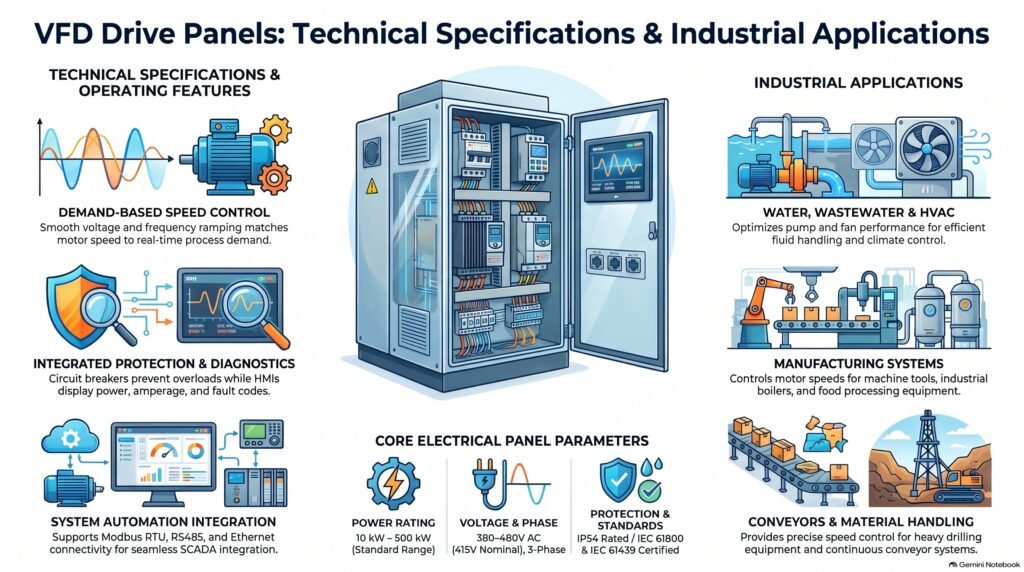
A Variable Frequency Drive (VFD) panel is an electrical control cabinet that contains a variable frequency drive and associated electrical components. Its main function is to regulate the speed of an AC motor by changing the frequency and voltage supplied to it.
The panel provides a central arrangement for motor control, electrical connections, protection, and monitoring. Depending on the application, it may include circuit breakers, contactors, control relays, cooling fans, indicators, and other accessories.
VFD panels are commonly used in manufacturing plants, water treatment facilities, commercial buildings, HVAC installations, and industrial processing units.
How Does a VFD Panel Work?
A VFD controls motor speed by changing the frequency of the electrical supply. The process involves three main stages.
1. Rectifier Section
The incoming AC electrical supply enters the VFD and passes through the rectifier section. This section converts alternating current (AC) into direct current (DC).
2. DC Bus Section
The converted DC power moves through the DC bus. Capacitors and other components help smooth the DC voltage before it reaches the next stage.
3. Inverter Section
The inverter converts DC power back into AC power at a controlled frequency and voltage. By adjusting the output frequency, the drive changes the operating speed of the connected motor.
For example, a pump may not need to operate at full speed throughout the day. The drive can reduce motor speed when lower water flow is required. This allows the equipment to match its operation with process demand.
Main Components of a VFD Panel
Different applications require different panel configurations, but several components are commonly used.
Variable Frequency Drive: Controls motor speed by adjusting the output frequency and voltage.
Circuit Breaker: Provides protection against specified electrical fault conditions and helps isolate the circuit.
Contactor: Used for switching and control where required by the panel design.
Control Relays: Support control logic and switching operations.
Cooling Fans: Help maintain suitable operating temperatures inside the enclosure.
Control Terminals: Provide connections for external commands, sensors, and automation systems.
Indication Devices: Display operating conditions and selected fault or status information.
The selection and arrangement of these components depend on motor ratings, load requirements, operating conditions, and electrical design specifications.
Important Benefits of VFD Panels
1. Better Motor Speed Control
A VFD allows operators to adjust motor speed according to production requirements. This is useful for processes where fixed-speed operation is not always necessary.
2. Potential Energy Savings
Pumps and fans often operate under changing load conditions. Reducing their speed when full capacity is not required can lower energy consumption. The actual savings depend on the application, system design, and operating profile.
3. Controlled Starting and Stopping
VFDs provide adjustable acceleration and deceleration. This helps reduce sudden mechanical stress on connected equipment compared with direct-on-line starting.
4. Improved Process Management
Operators can change motor speed to match production needs. This helps maintain better control over material movement, fluid flow, ventilation, and other industrial processes.
5. Automation Compatibility
Many modern drives support communication with PLC and SCADA systems. This allows industrial operators to monitor drive conditions, receive commands, and integrate motor control into wider automation systems.
Industrial Applications of VFD Panels
VFD technology is used across several industries because different processes require different motor speeds.
Manufacturing Industry
Production machines, assembly lines, and material handling equipment use variable motor speeds to manage different stages of manufacturing.
Water Treatment Plants
Pumps need to maintain suitable flow and pressure conditions. A VFD can adjust pump speed according to system demand.
HVAC Systems
Heating, ventilation, and air conditioning installations use motors in fans and pumps. Variable speed operation helps regulate airflow and fluid circulation.
Conveyor Systems
Conveyors transport materials between different production stages. Adjustable speed helps coordinate material movement and production processes.
Food and Pharmaceutical Processing
Mixing, pumping, and processing equipment may require controlled motor speeds to meet specific production requirements.
VFD Panel vs. Conventional Motor Starter
A conventional motor starter generally starts and stops a motor at its rated operating frequency. A VFD, on the other hand, allows operators to adjust the motor’s operating speed.
For applications that require only basic motor switching, a conventional starter may be sufficient. However, when a process needs variable speed, controlled acceleration, or integration with automation systems, a VFD can provide additional functionality.
The correct choice depends on the motor, load characteristics, process requirements, and operating conditions.
What to Consider When Selecting a VFD Panel
Before selecting a panel, industries should evaluate several technical factors:
- Motor rating: Check the motor’s power, current, and voltage requirements.
- Load type: Identify whether the application involves pumps, fans, conveyors, or constant-torque machinery.
- Input supply: Confirm the available electrical supply and drive compatibility.
- Enclosure protection: Select a suitable enclosure according to the installation environment.
- Cooling arrangement: Consider heat generation and ventilation requirements.
- Control requirements: Determine whether local controls, remote operation, or PLC integration are needed.
- Safety and testing: Ensure proper electrical design, wiring, inspection, and testing.
Correct drive sizing and panel engineering are important for reliable operation. The selection should be based on actual application requirements rather than motor power alone.
Maintenance Tips for VFD Panels
Regular inspection helps maintain the performance of electrical control panels. Industrial maintenance teams should keep ventilation openings clean, check cooling fans, inspect electrical connections, and look for signs of overheating or dust accumulation.
They should also review drive fault records and monitor operating temperatures. Maintenance and inspection activities must follow the manufacturer’s recommendations and appropriate electrical safety procedures.
Any internal inspection or electrical repair should be performed by qualified personnel after following suitable isolation procedures.
Conclusion
VFD panels play an important role in modern industrial automation by providing adjustable motor speed, controlled starting, and improved process management. They are useful in applications where motor operation changes according to production requirements.
Understanding their working principle, components, and selection criteria helps industries choose the right motor control arrangement. With appropriate engineering, installation, and maintenance, these panels can support reliable and efficient industrial operations.