
Introduction
Payment processing affects almost every part of a company’s financial operations.
Businesses collect money from customers, settle supplier invoices, pay service providers, manage refunds, and process international transactions.
As transaction volumes increase, maintaining visibility becomes more difficult.
Finance teams may need to check several bank accounts, payment platforms, spreadsheets, invoices, and internal systems to understand what is happening.
Fragmented information can create problems.
Businesses may struggle to identify outstanding payments, track settlements, reconcile transactions, or prepare accurate cash flow forecasts.
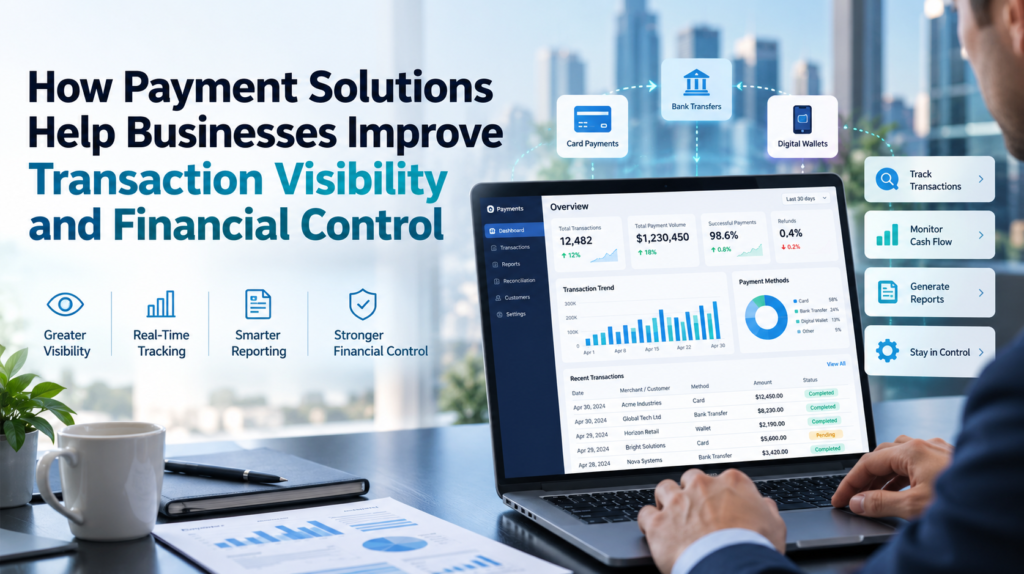
Modern payment solutions help companies organize payment information more effectively.
By improving transaction visibility, businesses can make better financial decisions and maintain stronger control over money moving into and out of the organization.
Why Transaction Visibility Matters
Transaction visibility means having clear information about the status and details of payments.
Finance teams should be able to answer questions such as:
- Has a customer paid?
- Has the transaction settled?
- Which invoice does the payment belong to?
- Which supplier received the payment?
- Which currency was used?
- Are any transactions still pending?
Without this information, financial management becomes unnecessarily difficult.
Centralizing Payment Data
Businesses often use multiple channels to process transactions.
For example, customers may pay through cards, bank transfers, digital payment methods, or international payment platforms.
A centralized business payment solution can help organize information from these activities.
This provides finance teams with a more complete view of transaction activity.
Centralization can also reduce dependence on separate spreadsheets and manual reports.
Improving Cash Flow Visibility
Businesses need to understand both current cash positions and expected future inflows.
Payment information helps finance teams monitor:
- Customer collections
- Settlement timing
- Outstanding invoices
- Supplier obligations
- Upcoming payments
Better visibility supports more accurate cash flow forecasting.
Finance teams can plan operating expenses with greater confidence when they know when funds are expected to arrive.
Using Pay-in Services for Better Collection Tracking
Pay-in services help businesses organize incoming customer payments.
When collection processes are structured, finance teams gain better information about:
- Payment initiation
- Payment status
- Settlement timing
- Customer details
- Transaction amount
This makes it easier to identify unpaid invoices or delayed transactions.
Efficient Pay-in services can therefore strengthen both collection efficiency and financial control.
Improving Online Payment Visibility
Digital businesses often process large numbers of online transactions.
Reliable online payment solutions can help businesses monitor these payments through digital reporting and transaction records.
Companies may track:
- Successful payments
- Failed transactions
- Refunds
- Payment methods
- Settlement activity
This information can help both finance and operational teams identify payment-related problems.
Managing Cross Border Payments
International transactions create additional visibility challenges.
Cross border payments may involve different currencies, banking networks, settlement timelines, and payment processes.
Finance teams need accurate information about international transactions.
They should be able to identify:
- Transaction currency
- Settlement currency
- International fees
- Payment status
- Recipient
- Settlement date
Better international transaction visibility helps businesses manage financial risk.
Monitoring B2B Cross Border Payments
B2b cross border payments often involve higher transaction values and detailed invoice records.
Businesses should maintain a clear connection between each payment and the relevant supplier, customer, or invoice.
Accurate B2B transaction data helps businesses:
- Reconcile accounts
- Resolve payment disputes
- Track supplier obligations
- Monitor international collections
This becomes increasingly important as companies expand globally.
Reducing Manual Financial Work
Manual transaction tracking requires significant employee time.
Finance teams may need to download reports, update spreadsheets, check invoices, and compare bank statements.
Modern payment solutions can automate many of these tasks.
Automation can support:
- Payment recording
- Invoice matching
- Settlement monitoring
- Transaction categorization
- Reporting
Reducing manual work improves efficiency and lowers the risk of human error.
Improving Reconciliation
Reconciliation ensures that payment records match accounting records.
Poor reconciliation can lead to inaccurate financial reports.
A strong payment system should provide detailed transaction information that finance teams can match against invoices and accounts.
Automation can help identify unmatched or missing transactions.
This allows finance teams to address discrepancies earlier.
Improving Supplier Payment Control
Financial control involves outgoing payments as well as customer collections.
Businesses should maintain clear information about supplier and vendor business payments.
Finance teams need to know:
- Which invoices are approved
- Which payments are scheduled
- Which transactions are complete
- Which suppliers are waiting for payment
Better visibility reduces the risk of duplicate or missed payments.
Creating Approval Workflows
Payment control also requires clear authorization processes.
Businesses can establish different approval rules depending on transaction value or payment type.
For example, high-value international payments may require approval from two authorized employees.
Structured workflows can improve accountability.
They also make financial processes easier to audit.
Strengthening Financial Reporting
Accurate payment data supports better financial reporting.
Businesses can use payment information to evaluate:
- Monthly transaction volume
- Payment success rates
- Settlement times
- Outstanding receivables
- Supplier obligations
- International transaction costs
Management teams can use these insights to make more informed decisions.
Connecting Payment Systems With Accounting Software
Payment platforms become more valuable when they integrate with financial systems.
Businesses may connect payment infrastructure with:
- Accounting software
- ERP platforms
- Billing tools
- CRM systems
- E-commerce platforms
Integration reduces duplicate data entry.
It also keeps financial records more current.
Monitoring Payment Performance
Businesses should regularly evaluate their payment operations.
Useful metrics may include:
- Average payment collection time
- Failed transaction rate
- Settlement duration
- Reconciliation time
- Transaction fees
- Outstanding payment value
Monitoring these metrics can reveal inefficiencies.
Supporting Better Forecasting
Payment visibility improves financial forecasting.
Businesses can use historical transaction data to identify payment patterns.
For example, finance teams may discover that certain customers consistently pay later than others or that international settlements take longer in specific markets.
These insights can improve working capital planning.
Security and Financial Control
Transaction visibility should be combined with strong security.
Businesses need to control who can access financial information and initiate payments.
Appropriate security measures may include:
- Authentication
- Role-based access
- Payment approval controls
- Transaction monitoring
- Account permissions
These measures protect company funds and improve accountability.
Scalability and Financial Control
As a business grows, payment volumes increase.
The company may also add more customers, suppliers, markets, and currencies.
A scalable business payment solution should maintain transaction visibility even as payment complexity increases.
This prevents growth from creating unnecessary financial confusion.
Considering Uniteller
Businesses reviewing their payment infrastructure may compare Uniteller with other providers based on their operational requirements.
Important factors include Pay-in services, online payments, international transactions, B2B capabilities, reporting, integrations, security, and scalability.
Companies should choose a provider that supports both transaction processing and effective financial management.
Conclusion
Transaction visibility plays a critical role in financial control.
Businesses need clear information about customer collections, settlements, supplier payments, international transactions, and outstanding obligations.
Modern payment solutions can centralize this information while reducing manual administrative work.
Effective Pay-in services and online payment solutions improve collection visibility, while reliable cross border payments and b2b cross border payments support international financial operations.
A scalable business payment solution also helps companies maintain better control over growing business payments.
By evaluating providers such as Uniteller according to their actual financial and operational requirements, companies can build stronger payment infrastructure and make better-informed financial decisions.