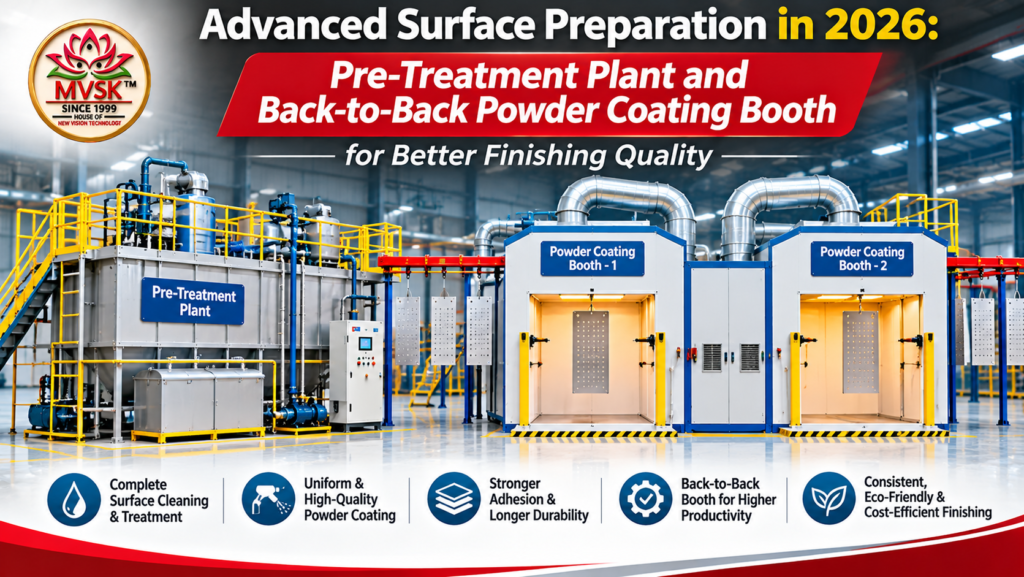

In modern manufacturing, achieving a durable and high-quality powder-coated finish starts long before the powder application process. Proper surface preparation, controlled chemical treatment, and an efficient painting environment are essential for achieving consistent coating results.
A Pre-Treatment Plant (Spray / Dip Type) prepares metal surfaces by removing contaminants and improving coating adhesion. A Powder Coating Booth Back to Back provides an organised arrangement for powder application, helping manufacturers plan their coating operations efficiently.
MVSK Industries LLP offers industrial surface preparation and powder coating equipment designed for different manufacturing requirements.
1. What Is a Pre-Treatment Plant (Spray / Dip Type)?
A Pre-Treatment Plant is an industrial surface preparation system used to clean and chemically treat components before painting or powder coating.
During manufacturing, metal components may contain oil, grease, dust, rust, and other surface contaminants. If these impurities are not removed properly, they can affect coating adhesion, appearance, and long-term performance.
Pre-treatment systems use suitable cleaning and chemical treatment stages to prepare components for subsequent coating operations.
Explore the Pre-Treatment Plant (Spray / Dip Type) Manufacturer solutions offered by MVSK Industries LLP.
2. Types of Pre-Treatment Plants
Pre-treatment systems are generally designed using spray-based or dip-based treatment methods, depending on component specifications and production requirements.
Spray Type Pre-Treatment Plant
In a spray-type system, components move through treatment chambers where chemical solutions are sprayed onto their surfaces through suitable nozzles.
Key features include:
- Spray nozzles for chemical application
- Pumps and circulation arrangements
- Multiple treatment stages
- Controlled chemical concentration
- Suitable conveyor or material-handling arrangements
This system is commonly considered for components that can be effectively treated through spray coverage.
Dip Type Pre-Treatment Plant
In a dip-type system, components are immersed in chemical treatment tanks for a specified period.
Key features include:
- Chemical treatment tanks
- Component dipping arrangements
- Tank heating where required
- Chemical circulation or agitation where applicable
- Suitable lifting or conveyor arrangements
Dip-type treatment can be useful for components with complex shapes or areas that require immersion-based chemical contact.
The appropriate system depends on component geometry, production capacity, surface condition, and the required treatment process.
3. How Does a Pre-Treatment Plant Work?
A typical pre-treatment process may include the following stages:
- Degreasing: Removes oil, grease, and other contaminants from component surfaces.
- Water Rinsing: Removes residual cleaning chemicals and loosened contaminants.
- Derusting: Removes rust and scale where required by the selected process.
- Surface Conditioning: Prepares the surface for the subsequent conversion treatment, if applicable.
- Phosphating or Conversion Coating: Applies a suitable chemical treatment to improve coating adhesion and corrosion resistance.
- Final Rinsing: Removes remaining chemical residues according to the process specification.
- Drying: Components are dried before powder coating or painting.
The exact stages depend on the metal substrate, chemical process, coating specification, and required corrosion performance.
4. Benefits of Installing a Pre-Treatment Plant
Improved Coating Adhesion
Proper cleaning and surface treatment help create suitable conditions for powder coating or painting.
Better Corrosion Protection
An appropriate conversion coating can improve corrosion resistance when used with a compatible coating system.
Consistent Surface Preparation
Controlled treatment stages help maintain repeatable preparation quality across production batches.
Improved Product Finish
Removing contaminants before coating helps reduce surface defects associated with poor preparation.
Suitable for Different Components
Spray and dip systems can be designed for different component shapes, sizes, and production volumes.
5. What Is a Powder Coating Booth Back to Back?
A Powder Coating Booth Back to Back is a booth arrangement designed with two powder coating booth sections positioned in a back-to-back configuration.
This layout can help manufacturers organise powder application areas according to their factory space, product requirements, and production workflow.
Powder coating booths provide a controlled area for applying powder to components using suitable spray equipment. They may also incorporate powder recovery and filtration arrangements, depending on the design.
Discover the Powder Coating Booth Back to Back Manufacturer solutions from MVSK Industries LLP.
6. How Does a Back-to-Back Powder Coating Booth Work?
The operation depends on the booth configuration and production layout. A typical powder coating process involves:
- Component Preparation: Cleaned and dried components are brought to the coating area.
- Booth Loading: Components are positioned using suitable fixtures or conveyor arrangements.
- Powder Application: Operators or automated spray guns apply powder to the component surfaces.
- Air Filtration: The booth’s filtration arrangement captures airborne powder particles.
- Powder Recovery: Where provided, a suitable recovery system collects reusable powder according to the system design and powder specifications.
- Curing: Coated components are transferred to a curing oven.
- Inspection: Finished components are checked for coating coverage, appearance, and quality.
A back-to-back layout can be planned to support separate coating operations or different production requirements, depending on the booth design.
7. Benefits of a Back-to-Back Powder Coating Booth
Space-Conscious Layout
A back-to-back arrangement can help organise booth sections within the available factory area.
Organised Coating Operations
Separate booth sections may support planned production activities and different component requirements.
Improved Powder Application Environment
A properly designed booth provides a controlled area for powder spraying and filtration.
Filtration and Powder Recovery Options
Suitable filtration and recovery arrangements can help manage overspray and improve powder-handling practices.
Flexible Production Planning
The booth arrangement can be selected according to product size, coating requirements, and production volume.
8. Pre-Treatment Plant vs Powder Coating Booth Back to Back
Both systems are important parts of a powder coating facility, but they perform different functions.
| Feature | Pre-Treatment Plant | Powder Coating Booth Back to Back |
| Main Purpose | Preparing metal surfaces | Applying powder coating |
| Primary Function | Cleaning and chemical surface treatment | Spraying powder onto components |
| Process Stage | Before coating | During coating |
| Main Equipment | Treatment tanks, pumps, spray nozzles | Booth sections, spray guns, filters |
| Key Benefit | Supports adhesion and surface quality | Provides an organised coating area |
9. How These Systems Work Together
A pre-treatment plant and a powder coating booth can be integrated into a complete industrial finishing line.
A typical production sequence may include:
- Components are loaded into the pre-treatment system.
- Surfaces are cleaned and chemically treated.
- Components are rinsed and dried according to the process.
- Prepared components move to the powder coating booth.
- Powder is applied using suitable spray equipment.
- Coated components enter the curing oven.
- Finished products are cooled and inspected.
This process helps manufacturers organise surface preparation and powder application as connected production stages.
10. Industries That Use These Systems
Pre-treatment plants and powder coating booths are used across different manufacturing sectors.
Common applications include:
- Automobile and automotive component manufacturing
- Electrical panel and enclosure manufacturing
- Metal furniture production
- Sheet metal fabrication
- Industrial machinery manufacturing
- Aluminium and metal component manufacturing
- Engineering and