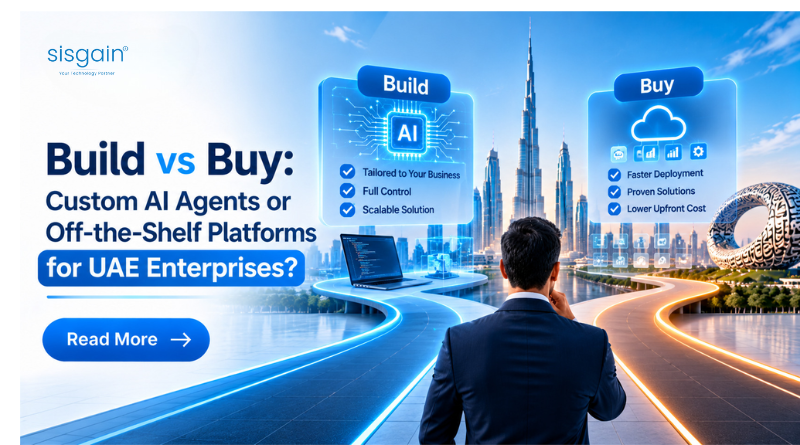

Key Takeaways
- UAE enterprises must decide whether to build custom AI agents or purchase ready-made platforms according to their business requirements, budgets, and long-term objectives.
- Off-the-shelf platforms offer faster deployment, prebuilt features, and lower initial development effort.
- Custom AI agents provide greater flexibility, business-specific workflows, and control over enterprise integrations.
- Organisations with complex operations, specialised applications, or strict governance requirements may benefit from custom development.
- A hybrid approach can combine ready-made AI capabilities with custom-built functionality.
- Total cost of ownership, security, integration, scalability, and maintenance should influence the final decision.
- The right investment is the one that solves a measurable business problem rather than simply introducing another AI tool.
Artificial intelligence is becoming an important part of enterprise technology strategies across the UAE. Businesses in Dubai, Abu Dhabi, Sharjah, and other commercial centres are exploring AI agents to automate repetitive activities, improve customer experiences, support employees, and connect different business systems.
AI agents are particularly interesting because they can do more than generate responses. Depending on their design and permissions, they can understand instructions, retrieve information, interact with connected applications, and complete defined tasks with varying levels of human supervision.
However, as enterprises evaluate AI adoption, an important question arises: should they build custom AI agents or buy an existing off-the-shelf platform?
Both approaches have advantages. Ready-made platforms can help businesses introduce AI capabilities quickly without developing every component from scratch. Custom development allows organisations to create solutions around their specific workflows, systems, security requirements, and operational objectives.
The decision is especially important for UAE enterprises managing multiple departments, regional operations, customer-facing applications, and industry-specific requirements. A platform that works well for one organisation may not provide the flexibility or integration capabilities another business needs.
This guide explores the differences between building and buying AI agents, examines their costs and capabilities, and explains how UAE enterprises can select an approach that supports long-term business growth.
1. Understanding the Build vs Buy Decision
Before comparing the two approaches, businesses need to understand what building or buying an AI agent actually involves.
What does buying an off-the-shelf AI platform mean?
An off-the-shelf AI platform is a ready-made product that provides predefined AI capabilities. Businesses can subscribe to or license the platform and configure its features according to their requirements.
These platforms may include:
- Prebuilt conversational AI capabilities.
- Ready-to-use customer support automation.
- Workflow templates and automation tools.
- Document processing and information extraction.
- Integrations with commonly used business applications.
- Administrative dashboards and usage monitoring.
- User management and access controls.
For example, a retail company in Dubai may adopt an existing AI customer support platform to answer common product questions, assist with order enquiries, and route complex requests to human employees.
The business does not need to develop the entire AI infrastructure independently. It configures the available features, connects supported systems, and prepares the platform for deployment.
This approach is useful when business requirements are relatively standard and the selected platform can support the required processes without significant customisation.
What does building a custom AI agent mean?
Custom AI agent development involves designing and developing an intelligent solution around a particular business requirement. Instead of adapting operations to the limitations of a ready-made platform, the organisation can define how the agent should behave, which systems it should access, and what tasks it should perform.
A custom AI agent may include:
- Business-specific instructions and decision rules.
- Connections with internal databases and enterprise applications.
- Custom workflow execution.
- Role-based access and approval mechanisms.
- Retrieval from approved internal knowledge sources.
- Monitoring, logging, and performance reporting.
- Integration with existing websites and mobile applications.
For example, a UAE logistics company may need an AI agent that checks shipment information, retrieves customer records, identifies delivery exceptions, and creates support tickets through its existing operational systems.
If a ready-made platform cannot support these processes effectively, custom development may provide a more suitable solution.
2. Off-the-Shelf AI Platforms: Advantages for UAE Enterprises
Buying an existing AI platform can be an effective way to introduce automation without undertaking a lengthy development project. Businesses that need common AI capabilities may find this approach practical and cost-efficient.
Faster implementation
One of the biggest advantages of an off-the-shelf platform is deployment speed. Many products already include infrastructure, interfaces, and core AI functionality for common use cases.
Businesses can configure the platform, connect supported applications, test its behaviour, and introduce it to employees or customers.
For organisations under pressure to modernise operations quickly, this can reduce the time between identifying an opportunity and launching an AI solution.
Lower initial development investment
Ready-made platforms generally eliminate the need to build every technical component from the beginning. Instead of funding the complete development of an AI system, organisations typically pay for a subscription, licence, usage, or a combination of these.
This can make initial investment more predictable, particularly for small and medium-sized businesses testing AI adoption.
However, the subscription price should not be treated as the complete cost. Integration, configuration, training, usage limits, and additional services may increase overall expenditure.
Access to existing features
Off-the-shelf products often provide a range of built-in capabilities, such as:
- Conversational interfaces.
- Workflow automation.
- Document summarisation.
- Data extraction.
- Reporting dashboards.
- User management.
- Standard integrations.
These features can reduce development effort when they match the organisation’s requirements.
Vendor-managed updates
Many platform providers maintain their products, release updates, and improve supported features. Businesses may receive new capabilities without managing the entire software development lifecycle themselves.
This can reduce the internal technical workload, although enterprises should still review release changes, compatibility, security updates, and vendor support arrangements.
Easier initial evaluation
A ready-made platform can also help businesses test whether AI is suitable for a particular process.
For example, a company may begin by automating internal knowledge searches or basic customer enquiries. If the results demonstrate value, the organisation can expand the implementation or evaluate more advanced custom solutions.
3. Limitations of Off-the-Shelf AI Platforms
Although ready-made platforms offer convenience, they are not automatically suitable for every enterprise. Their limitations become more noticeable when businesses have complex operations or specialised requirements.
Limited workflow customisation
Off-the-shelf platforms are designed to serve a broad range of customers. Their features may cover common business requirements, but they might not support every organisation’s internal processes.
A UAE enterprise may have approval chains, department-specific responsibilities, regional reporting requirements, or operational rules that differ from standard workflows.
If the platform cannot accommodate these requirements, employees may need to change their existing processes to fit the software.
Integration restrictions
An AI platform may offer integrations with popular applications but still struggle to connect with older or specialised enterprise systems.
For example, an organisation may operate a customised ERP, an internal database, and a legacy customer management application. If the selected platform does not support the necessary connections, additional middleware or custom integration work may be required.
This can increase implementation complexity and reduce some of the cost advantages of buying a ready-made solution.
Vendor dependency
When businesses rely heavily on one platform, they may become dependent on its pricing structure, feature availability, technical policies, and product roadmap.
Changes to subscription plans, usage limits, APIs, or supported integrations can affect the organisation’s operations.
Enterprises should therefore review data portability, contract terms, service-level commitments, export options, and exit arrangements before making a long-term commitment.
Data and governance considerations
Businesses must understand where information is processed, how it is stored, who can access it, and how the platform handles customer and employee data.
For organisations operating in regulated sectors, these considerations may influence whether a particular product is suitable.
Enterprises should evaluate the platform’s security documentation, access controls, data retention policies, contractual protections, and ability to meet applicable UAE requirements.
Recurring costs can increase
A subscription may appear inexpensive during the initial evaluation. However, costs can rise as the organisation adds users, increases AI usage, introduces additional workflows, or requires premium integrations.
For a business deploying AI across several departments, these recurring expenses should be compared with the cost of developing and maintaining a custom solution.
4. Custom AI Agents: Why Enterprises Choose to Build
Custom AI agents are designed around an organisation’s specific requirements. They are particularly useful when a business needs more control over how AI interacts with internal systems and completes operational tasks.
Designed around business workflows
Every enterprise has processes shaped by its industry, customers, internal policies, and technology environment.
A custom AI agent can be designed to follow these processes rather than forcing employees to adapt to predefined platform workflows.
For example, a financial services organisation may require an agent to collect information, validate documents, check defined conditions, and route an application for human approval.
The development team can design the agent’s responsibilities and decision boundaries around the organisation’s actual process.
Greater control over integrations
Custom development allows businesses to define how an agent communicates with their existing applications.
Depending on available APIs and system architecture, an agent can connect with:
- Customer relationship management systems.
- Enterprise resource planning platforms.
- Finance and accounting applications.
- Inventory management software.
- Internal databases.
- Document management systems.
- Customer portals and mobile applications.
This is especially useful for enterprises that have invested heavily in existing software and do not want to replace it simply to introduce AI capabilities.
Business-specific intelligence
A custom agent can retrieve information from approved internal documents, databases, knowledge repositories, and operational systems.
This allows its responses and actions to reflect the organisation’s own information rather than relying exclusively on general-purpose knowledge.
For example, a property management company may develop an agent that accesses approved property records, maintenance procedures, tenancy information, and service request histories.
The agent can then assist employees using information relevant to the organisation’s operations.
More control over permissions and approvals
Not every AI task should be completed independently. Some actions require employee approval, particularly when they involve financial transactions, sensitive information, contractual decisions, or changes to important business records.
Custom AI agents can be designed with permission boundaries and approval checkpoints.
A business may allow an agent to retrieve information and prepare recommendations automatically while requiring a manager to approve payments or sensitive account changes.
This helps organisations introduce automation without removing appropriate human oversight.
Greater flexibility for future expansion
A custom solution can evolve as business requirements change. New workflows, integrations, departments, and capabilities can be introduced according to the organisation’s priorities.
For enterprises planning long-term AI adoption, this flexibility can be an important advantage.
However, custom development also creates responsibility for maintenance, monitoring, security updates, testing, and ongoing improvements. These requirements should be included in the investment plan.
5. AI Agent Development in UAE: Where Custom Solutions Create Value
Custom AI agents are particularly relevant when an organisation’s processes cannot be handled effectively through standard platform features.
Businesses exploring AI agent development in UAE can consider solutions that connect business intelligence with practical task execution.
The following examples illustrate where custom development may provide value.
Healthcare
Healthcare organisations manage appointments, patient enquiries, administrative records, billing activities, and communication between different departments.
A custom AI agent may help with approved administrative workflows, such as retrieving appointment information, organising requests, routing enquiries, and supporting internal coordination.
Any use involving patient information must be designed with appropriate privacy, access controls, human oversight, and applicable healthcare requirements.
Banking and financial services
Financial organisations often operate complex processes involving documentation, customer onboarding, verification, and internal approvals.
A custom AI agent can support document collection, information extraction, workflow routing, and employee assistance.
Sensitive financial decisions should remain subject to appropriate controls and authorised review.
Retail and e-commerce
Retail enterprises can use AI agents to coordinate activities across customer service, inventory, order management, and fulfilment.
For example, an agent may retrieve an order record, check inventory information, identify an issue, and create a task for the relevant team.
The agent’s ability to execute these actions depends on the integrations and permissions provided.
Logistics and supply chain
Logistics operations involve shipment tracking, inventory updates, delivery coordination, and exception management.
A custom agent can monitor approved information sources, identify predefined exceptions, and notify employees when intervention is required.
It may also initiate selected workflows, such as creating a support ticket or requesting an inventory review.
Real estate
Real estate organisations manage property listings, customer enquiries, viewing appointments, documentation, and follow-up activities.
An AI agent connected to the company’s CRM and property database could retrieve listing details, qualify enquiries, schedule approved follow-ups, and help sales teams manage customer interactions.
These examples demonstrate that the value of custom AI agents comes from their ability to address specific operational requirements.
6. Build vs Buy: Comparing the Total Cost of Ownership
Cost is one of the most important considerations when selecting an AI solution. However, enterprises should compare the total cost of ownership rather than focusing only on initial development expenses or monthly subscription fees.
Costs involved in buying an AI platform
The total cost of an off-the-shelf platform may include:
- Initial subscription or licence fees.
- Charges based on users or AI usage.
- Configuration and implementation.
- Integration with existing applications.
- Employee training and onboarding.
- Premium features and additional modules.
- Ongoing support and vendor services.
These costs may be suitable for organisations with standard requirements, but they can increase as adoption expands.
Costs involved in building a custom AI agent
Custom development may require investment in:
- Business analysis and requirement gathering.
- Solution architecture and technical planning.
- AI model selection and configuration.
- Application and backend development.
- API and enterprise system integration.
- Data preparation and knowledge management.
- Security testing and deployment.
- Monitoring, maintenance, and ongoing improvements.
The initial investment may be higher than adopting a ready-made product. However, the organisation gains greater control over the solution’s functionality and development roadmap.
How to calculate the financial value
A useful way to compare the approaches is to estimate the total cost over a defined period, such as three years.
Total Cost of Ownership = Initial Investment + Integration Costs + Licensing or Usage Fees + Maintenance + Training + Ongoing Support
Then estimate the financial benefits:
Net Financial Benefit = Measurable Operational Savings + Additional Revenue Benefits − Total Cost of Ownership
Businesses should use realistic estimates based on their own operational data rather than relying on generic AI savings claims.
For example, an enterprise processing thousands of repetitive requests may calculate the time currently spent by employees, estimate how much of that work can be automated, and compare the resulting savings with implementation and operating costs.
The calculation should also account for exception handling, human review, and tasks that cannot be automated reliably.
7. Key Factors to Consider Before Choosing an AI Agent Solution
There is no universal answer to the build-versus-buy question. Enterprises should evaluate their requirements across several important areas.
Business process complexity
If the organisation needs to automate a straightforward process, a ready-made platform may be sufficient.
However, when workflows involve several departments, internal rules, multiple systems, and specialised decision-making, custom development may provide greater flexibility.
Integration requirements
Businesses using standard cloud applications may find that existing platforms provide enough integration options.
Enterprises with customised ERP systems, legacy applications, or proprietary databases may need a solution designed around their technical environment.
Data ownership and governance
Organisations should understand how their data is processed, stored, accessed, and retained.
If a business requires specific data handling arrangements, access restrictions, audit trails, or deployment configurations, it should verify whether the ready-made platform supports them.
A custom solution may offer more control, but it does not automatically guarantee compliance or security. These capabilities must be designed, implemented, and tested.
Scalability
A solution that works for a small pilot may not be suitable for enterprise-wide deployment.
Businesses should consider expected users, transaction volumes, workflow complexity, integration loads, and future expansion.
Internal technical capabilities
Buying a platform may reduce the need to manage the entire development lifecycle internally.
Custom development, however, requires access to suitable technical expertise for implementation and ongoing maintenance. Organisations should decide whether these responsibilities will be handled internally or through an experienced development partner.
Time to market
When speed is the primary objective and requirements are standard, an existing platform may be the better starting point.
When the business needs a highly specialised solution, additional development time may be justified by the long-term operational benefits.
8. Why AI Integration Services Matter for Enterprise Automation
An AI agent delivers limited business value if it operates separately from the systems employees use every day.
For example, a customer support agent that cannot access order information may only provide general responses. Similarly, a finance agent that cannot communicate with accounting software may be unable to complete important parts of an invoice workflow.
This is why integration should be considered during the initial planning stage.
Enterprises evaluating AI integration services UAE should assess how AI capabilities can connect with existing business applications, data sources, and operational workflows.
Important integration considerations include:
- API availability: Determine whether existing systems provide reliable interfaces for exchanging information.
- Data consistency: Ensure that connected systems use accurate and appropriately updated information.
- Access permissions: Restrict the agent to the information and actions required for its assigned responsibilities.
- Error handling: Define what happens when an API fails, information is unavailable, or an action cannot be completed.
- Auditability: Maintain suitable records of important agent activities and system interactions.
- Human escalation: Provide a clear process for transferring complex or sensitive tasks to employees.
Integration planning is essential for both custom and off-the-shelf solutions. Even a ready-made platform may require additional development to work effectively within an enterprise environment.
9. The Hybrid Approach: Combining Build and Buy
Enterprises do not always need to choose between building everything and buying everything. A hybrid approach can combine ready-made AI platforms with custom-developed components.
This strategy allows businesses to use existing products for standard requirements while developing custom agents for specialised workflows.
How a hybrid AI model works
A company may use an existing AI platform for conversational capabilities while developing a custom agent to interact with its internal ERP and CRM systems.
For example:
- An off-the-shelf conversational interface receives a customer request.
- A custom AI agent interprets the request and retrieves relevant information from connected systems.
- The agent performs permitted actions according to defined business rules.
- The result is returned through the conversational interface.
- Complex or sensitive requests are transferred to an authorised employee.
This approach can reduce the need to build every component while still providing the flexibility required for business-specific operations.
When should enterprises consider a hybrid model?
A hybrid approach may be suitable when:
- The organisation wants to launch quickly but has specialised integration needs.
- Standard AI capabilities are sufficient for some departments but not others.
- The business wants to test a platform before investing in larger custom development.
- Existing enterprise applications need additional AI functionality.
- Different departments require different levels of automation.
The key is to define clear responsibilities for each component and avoid unnecessary duplication.
10. Integrating AI Agents Into Mobile and Customer-Facing Applications
Enterprise AI adoption is not limited to internal business systems. Many organisations also want to make intelligent services available to customers, partners, and employees through digital applications.
For example, a retail business may introduce an AI assistant into its shopping application, while a healthcare provider may use an intelligent interface to guide users through approved administrative services.
A mobile application development company can help businesses plan and develop mobile experiences that connect AI capabilities with application features, backend services, and enterprise systems.
Potential use cases include:
- Intelligent customer support within mobile applications.
- AI-powered product and service discovery.
- Appointment and booking assistance.
- Personalised information based on approved user data.
- Internal employee support applications.
- Workflow requests and status updates.
The mobile interface should be designed around the user’s needs. AI should simplify interactions rather than introduce unnecessary complexity.
Businesses must also consider authentication, data permissions, secure communication, and how AI-generated information is presented to users.
11. How to Select the Right AI Development Partner in Dubai
For enterprises choosing custom development, selecting the right technology partner is an important part of the process.
A suitable AI agent company in Dubai should understand more than AI models and development frameworks. It should also understand enterprise workflows, system integration, data governance, and the business outcomes the solution is expected to support.
Before selecting a development partner, consider the following factors.
Enterprise experience
Review the provider’s experience with business applications, automation projects, integrations, and enterprise software development.
The partner should be able to understand the operational environment rather than offering a generic AI solution.
Technical capabilities
Evaluate the provider’s ability to work with:
- Large language models and AI frameworks.
- Retrieval-augmented generation and knowledge systems.
- API development and system integration.
- Databases and enterprise applications.
- Workflow orchestration.
- Authentication and access management.
- Monitoring and testing.
The technologies selected should be appropriate for the project rather than included simply because they are popular.
Security and governance approach
Ask how the development partner handles data access, authentication, encryption, audit logging, testing, and human approval workflows.
For enterprise applications, security should be considered throughout the development lifecycle rather than added at the end.
Customisation and scalability
The provider should be able to explain how the solution can support additional workflows, users, systems, and business requirements in the future.
Support and maintenance
AI agents require monitoring and ongoing improvements. Ask about post-deployment support, performance reviews, issue resolution, model updates, and integration maintenance.
A clear support arrangement helps businesses manage the solution beyond its initial launch.
12. A Practical Roadmap for UAE Enterprises to Implement AI Agents
Whether an organisation chooses a ready-made platform, custom development, or a hybrid model, implementation should follow a structured process.
Step 1: Identify the business problem
Start by identifying processes that consume significant employee time or create operational delays.
Examples may include repetitive customer enquiries, manual document processing, lead qualification, internal information searches, or support ticket routing.
The objective is to identify a measurable problem rather than introduce AI without a defined purpose.
Step 2: Evaluate the existing technology environment
Review the applications, databases, APIs, and workflows currently used by the organisation.
Determine whether a ready-made platform can connect with these systems or whether custom integration is required.
Step 3: Define the agent’s responsibilities
Specify what the AI agent should do, which information it can access, and what actions it is allowed to perform.
Separate low-risk activities from sensitive tasks that require employee approval.
Step 4: Select the build, buy, or hybrid approach
Compare available platforms with the organisation’s functional, technical, financial, and governance requirements.
Consider the total cost of ownership and long-term flexibility rather than focusing only on initial pricing.
Step 5: Develop a pilot project
Begin with one clearly defined workflow. Test the agent using realistic scenarios and evaluate its responses, accuracy, integration reliability, and ability to handle exceptions.
A limited pilot helps identify issues before the solution is introduced across the organisation.
Step 6: Measure performance
Track indicators that reflect the original business objective, such as:
- Time required to complete a task.
- Number of requests processed.
- Employee hours saved.
- Workflow completion rates.
- Frequency of human intervention.
- Error and escalation rates.
- Customer response times.
- Operating costs.
These measurements help determine whether the solution is delivering the expected value.
Step 7: Expand gradually
Once the pilot demonstrates reliable performance, introduce additional workflows and departments in stages.
Continue reviewing permissions, integrations, performance, and user feedback as the solution grows.
13. Common Mistakes Enterprises Should Avoid
Even a well-selected AI platform can fail to deliver value if the implementation is poorly planned.
UAE enterprises should avoid these common mistakes:
- Choosing based only on price: A low subscription cost does not necessarily mean lower long-term expenditure.
- Automating unclear processes: AI cannot reliably improve a workflow that has not been properly understood.
- Ignoring integration requirements: Disconnected systems can create additional manual work.
- Giving agents excessive permissions: AI agents should have access only to the information and actions required for their responsibilities.
- Skipping human oversight: Sensitive or high-impact decisions may require authorised employee review.
- Ignoring ongoing maintenance: Models, APIs, business rules, and connected systems may change over time.
- Measuring activity instead of outcomes: The number of AI interactions does not automatically demonstrate business value.
- Deploying everywhere at once: A phased implementation makes it easier to identify problems and improve performance.
A practical AI strategy focuses on solving specific business problems, maintaining appropriate controls, and expanding only when the results justify further investment.
Conclusion
The decision to build or buy AI agents depends on what an enterprise needs to achieve. Off-the-shelf platforms offer speed, convenience, and ready-made capabilities, making them suitable for standard business requirements. Custom AI agents provide greater control over workflows, integrations, permissions, and specialised operational needs.
For UAE enterprises, the decision should consider business process complexity, existing systems, data governance, scalability, implementation time, and total cost of ownership.
A hybrid approach may also provide a practical middle ground, allowing organisations to use ready-made tools for common requirements while developing custom agents for processes that need greater flexibility.
The most effective AI investment is not necessarily the one with the largest number of features. It is the solution that fits the organisation’s operations, integrates with its technology environment, and produces measurable business outcomes.
Planning to introduce AI agents into your enterprise operations? Connect with SISGAIN to explore custom AI agent development, AI integration, and intelligent solutions aligned with your business requirements.
Frequently Asked Questions
1. Is it better to build or buy AI agents for a UAE enterprise?
Buying is often suitable for standard requirements and faster deployment. Building is more appropriate when the organisation needs specialised workflows, integrations, or greater control.
2. Are off-the-shelf AI platforms suitable for large enterprises?
Yes. They can support common enterprise use cases, provided their security, integration, scalability, and governance capabilities meet the organisation’s requirements.
3. How much does custom AI agent development cost in the UAE?
Costs depend on workflow complexity, integrations, AI model selection, security requirements, and ongoing support. A detailed assessment is needed for an accurate estimate.
4. Can custom AI agents integrate with existing ERP and CRM systems?
Yes. Custom AI agents can connect with compatible ERP and CRM systems through APIs and other integration methods, depending on the systems’ technical capabilities.
5. Can businesses combine custom AI agents with ready-made platforms?
Yes. A hybrid approach can use existing platforms for standard AI capabilities and custom agents for specialised workflows and enterprise integrations.