
Modern manufacturing industries require efficient painting systems and reliable wastewater treatment solutions to maintain product quality and responsible industrial operations. A Conveyorised Liquid Painting Plant helps manufacturers achieve consistent surface finishing, while an Effluent Treatment Plant (ETP) helps treat industrial wastewater before its reuse or discharge, as applicable.
Both systems play an important role in industries where metal finishing, surface preparation and industrial production processes generate operational wastewater. Choosing suitable equipment from experienced manufacturers can help businesses improve production efficiency, maintain finishing quality and manage industrial waste responsibly.
MVSK Industries LLP offers industrial surface finishing and treatment equipment solutions designed around different manufacturing requirements.
What Is a Conveyorised Liquid Painting Plant?
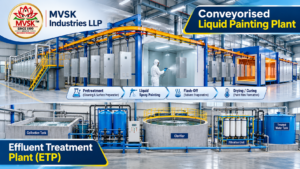
A Conveyorised Liquid Painting Plant is an industrial painting system that uses a conveyor mechanism to transport products through different stages of the painting process. It is designed to provide organised material movement and consistent paint application for components manufactured in large or continuous production volumes.
The system can include surface pretreatment, drying facilities, liquid painting booths, flash-off zones and drying ovens. Its configuration depends on the product dimensions, paint specifications, production capacity and factory layout.
Businesses looking for industrial painting solutions can explore the Conveyorised Liquid Painting Plant by MVSK Industries LLP.
Key Features of a Conveyorised Liquid Painting Plant
- Continuous material handling: Moves components through different painting stages.
- Uniform paint application: Supports controlled painting operations.
- Customised conveyor arrangements: Can be designed according to factory space and production requirements.
- Industrial painting booths: Provides a dedicated area for liquid paint application.
- Controlled drying process: Supports paint drying according to the coating specifications.
- Production efficiency: Reduces unnecessary manual transportation between processing sections.
How Does a Conveyorised Liquid Painting Plant Work?
A conveyorised liquid painting system follows a sequence of operations to prepare, paint and finish industrial components.
1. Component Loading
Products are placed on conveyor hangers, fixtures or suitable material handling arrangements.
2. Surface Pretreatment
Components undergo cleaning to remove dust, grease, oil, rust and other surface contaminants. The pretreatment process depends on the material and required paint finish.
3. Drying Process
After pretreatment, components pass through a drying section to remove moisture before painting.
4. Liquid Paint Application
Products enter the liquid painting booth, where suitable spray equipment is used to apply the coating.
5. Flash-Off Section
An appropriate flash-off period allows solvents or water in the paint coating to evaporate according to the paint manufacturer’s specifications.
6. Drying or Curing
Painted components pass through a suitable drying or curing arrangement to achieve the required coating properties.
7. Inspection and Unloading
Finished products are inspected for coating quality, appearance and defects before unloading and packaging.
What Is an Effluent Treatment Plant (ETP)?
An Effluent Treatment Plant (ETP) is an industrial wastewater treatment system designed to remove contaminants from wastewater generated during manufacturing and industrial processes.
Industries involved in metal finishing, painting, chemical processing and surface pretreatment may generate wastewater containing suspended solids, oils, chemicals and other pollutants.
An appropriately designed ETP helps treat this wastewater to meet applicable environmental discharge or reuse requirements.
For industrial wastewater treatment requirements, businesses can explore the Effluent Treatment Plant (ETP) by MVSK Industries LLP.
Major Components of an Effluent Treatment Plant
Depending on wastewater characteristics and treatment requirements, an ETP may include:
- Collection Tank: Collects wastewater generated during industrial operations.
- Oil and Grease Trap: Helps separate floating oil and grease.
- Equalisation Tank: Balances variations in wastewater flow and characteristics.
- pH Adjustment System: Adjusts wastewater pH through suitable chemical treatment.
- Coagulation and Flocculation: Helps combine suspended particles for easier separation.
- Clarifier: Separates settled sludge from treated water.
- Filtration System: Removes remaining suspended impurities through suitable filtration.
- Sludge Handling System: Collects and manages sludge generated during treatment.
The actual treatment stages depend on wastewater testing, plant capacity and applicable pollution control requirements.
Importance of an ETP in Liquid Painting Industries
Liquid painting and pretreatment operations can generate wastewater that requires appropriate treatment before reuse or discharge.
An ETP helps industrial facilities manage this wastewater through suitable physical, chemical and biological treatment processes, depending on the contaminants involved.
Some important benefits include:
- Wastewater Management: Helps manage wastewater generated during industrial painting and pretreatment.
- Environmental Protection: Supports responsible wastewater treatment and pollution control.
- Regulatory Compliance: Helps industries meet applicable environmental standards when properly designed and operated.
- Water Reuse Opportunities: Treated water may be reused for suitable industrial applications after meeting the required quality standards.
- Improved Industrial Operations: Provides a structured approach to wastewater collection, treatment and sludge management.
How Are Conveyorised Liquid Painting Plants and ETP Systems Connected?
A Conveyorised Liquid Painting Plant and an Effluent Treatment Plant perform different but complementary functions in an industrial facility.
The liquid painting plant manages the surface finishing process, while the ETP manages wastewater generated by relevant manufacturing and pretreatment operations.
For example, wastewater from component washing, chemical pretreatment and other applicable cleaning processes can be collected and directed to a suitably designed treatment system.
Integrating proper wastewater management into industrial plant planning helps manufacturers organise production operations while addressing environmental responsibilities.
However, not every painting process generates the same wastewater. The ETP design should always be based on actual wastewater characteristics and treatment objectives.
Applications Across Different Industries
Conveyorised liquid painting plants and ETP systems are useful in several industrial sectors.
Common applications include:
- Automotive and automobile component manufacturing.
- Electrical panel and enclosure manufacturing.
- Metal furniture manufacturing.
- Industrial machinery production.
- Steel fabrication industries.
- Engineering and metal processing units.
- Agricultural equipment manufacturing.
- Industrial equipment and component finishing.
- Chemical and surface treatment industries.
The equipment configuration varies according to production requirements and wastewater characteristics.
How to Choose the Right Conveyorised Liquid Painting Plant and ETP Manufacturer?
Selecting the right manufacturer is important for long-term industrial performance. Before investing in these systems, consider the following factors:
- Manufacturing Experience: Evaluate the manufacturer’s experience in industrial painting and wastewater treatment equipment.
- Production Capacity: Select a painting plant based on component size, production volume and required conveyor speed.
- Customised Design: Ensure the system can accommodate the available factory space and manufacturing workflow.
- Painting Requirements: Consider paint type, application method, drying requirements and desired finish quality.
- Wastewater Characteristics: ETP capacity and treatment technology should be selected after analysing wastewater flow and pollution parameters.
- Equipment Quality: Check the construction materials, equipment design and operational requirements.
- Technical Support: Consider installation, commissioning, maintenance and after-sales assistance.
Why Choose MVSK Industries LLP?
MVSK Industries LLP provides industrial surface finishing and wastewater treatment equipment solutions for manufacturing facilities.
Businesses searching for a Conveyorised Liquid Painting Plant Manufacturer or Effluent Treatment Plant Manufacturer can explore the company’s available product solutions.
When planning a new industrial installation, manufacturers should share their production capacity, component specifications, paint requirements, wastewater characteristics and factory layout to identify an appropriate system configuration.
A properly planned painting and wastewater treatment setup can support organised manufacturing operations and responsible industrial wastewater management.
Conclusion
A Conveyorised Liquid Painting Plant helps manufacturing industries achieve organised material handling and consistent paint application, while an Effluent Treatment Plant helps manage industrial wastewater through appropriate treatment processes.
Both systems are important considerations when developing an efficient and environmentally responsible manufacturing facility.
Selecting experienced manufacturers, understanding operational requirements and choosing customised equipment can help businesses improve production processes and manage industrial wastewater effectively.
Frequently Asked Questions (FAQs)
1. What is a Conveyorised Liquid Painting Plant?
It is an industrial painting system that uses a conveyor to transport components through pretreatment, painting, flash-off and drying stages.
2. What are the benefits of a conveyorised liquid painting system?
It supports continuous material handling, organised production, consistent paint application, reduced manual movement and improved workflow.
3. What is an Effluent Treatment Plant (ETP)?
An ETP is an industrial wastewater treatment system designed to remove contaminants through suitable physical, chemical and biological treatment processes.
4. Why is an ETP required in the painting industry?
Painting and surface pretreatment operations may generate wastewater containing chemicals, oils and suspended solids. An ETP helps treat this wastewater before appropriate reuse or discharge.
5. Can treated ETP water be reused?
Yes, treated wastewater can be reused for suitable applications if it meets the required quality standards for the intended purpose.
6. What factors determine the cost of a Conveyorised Liquid Painting Plant?
Cost depends on conveyor configuration, production capacity, painting booth dimensions, paint application equipment, drying oven specifications, automation and factory layout.
7. What determines the capacity of an Effluent Treatment Plant?
ETP capacity depends on wastewater flow, pollutant concentration, treatment objectives, operating hours and the required treated water quality.
8. Which industries use Effluent Treatment Plants?
Automotive, metal finishing, chemical processing, engineering, manufacturing and other industries generating industrial wastewater commonly use ETP systems.
9. How do I select the right ETP manufacturer?
Check technical expertise, wastewater treatment design capabilities, equipment quality, treatment process selection, installation support and maintenance services.
10. Can a liquid painting plant and ETP be installed together?
Yes. Both systems can be planned as part of an integrated industrial facility, with wastewater collection and treatment arrangements designed according to the plant’s actual wastewater generation.