
Gaming no longer requires every player to own an expensive desktop with the latest graphics card. With advances in cloud computing, users can access powerful remote computers through the internet and play games on devices that may not have high-end gaming hardware.
A free cloud PC for gaming can be an appealing way to explore this technology without immediately investing in a dedicated gaming computer. At the same time, paid cloud services can provide additional performance, storage, and longer sessions for users with more demanding requirements.
What Is a Cloud-Based PC?
A cloud based PC is a virtual computer hosted in a remote data center. Instead of installing everything on a physical computer at home, users connect to a remote environment through the internet.
For gaming, the remote machine can handle demanding tasks such as rendering graphics and processing game data. The resulting video is streamed to the user’s device, while keyboard, mouse, or controller inputs are transmitted back to the remote computer.
This approach can make cloud computing useful for gamers using laptops, older PCs, lightweight devices, or computers with limited local storage.
How Does Free Cloud Gaming Work?
Free cloud gaming services generally provide access to remote computing resources without requiring an upfront subscription. However, “free” does not necessarily mean unlimited.
Depending on the provider, free access may include limitations such as:
- Short gaming sessions
- Waiting queues
- Limited GPU resources
- Advertisements
- Restricted storage
- Fewer available games or applications
These restrictions can make free services useful for testing cloud gaming before deciding whether a paid plan is necessary.
Why Consider a Cloud Gaming PC?
One major advantage of a cloud gaming PC is that users don’t necessarily need to purchase expensive hardware themselves. Instead, computing resources are provided remotely.
Cloud gaming can also offer flexibility. A user may access their cloud computer from different compatible devices, making it possible to continue gaming without being tied to a single physical gaming desktop.
For people who frequently upgrade hardware, cloud computing can also provide another way to approach gaming performance without replacing an entire PC every few years.
Looking for Shadow PC Alternatives
Shadow PC alternatives have become increasingly relevant as more services enter the cloud PC market. Users comparing different providers may look at GPU performance, pricing, supported operating systems, storage, server locations, latency, and session policies.
Rather than choosing a service based only on advertised specifications, gamers should consider how well the provider fits their particular games and network conditions.
A cloud PC designed for gaming may also be useful beyond gaming, particularly for users who want a flexible remote Windows environment for productivity, development, creative applications, or other demanding workloads.
Is a Free Cloud PC Right for You?
A free cloud PC for gaming can be a practical starting point for someone who wants to understand how cloud gaming works. It can reduce the initial cost of experimentation and help users determine whether their internet connection and devices are suitable.
However, players looking for consistent performance, longer sessions, additional storage, or more powerful hardware may eventually prefer a paid cloud PC.
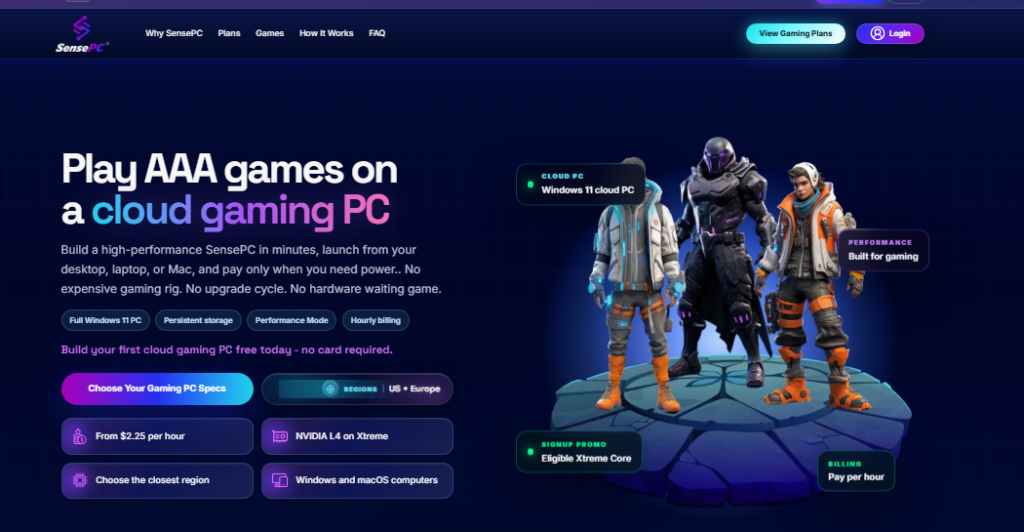
Services such as SensePC offer cloud-based computing environments that can support gaming and other resource-intensive use cases. By comparing available hardware, pricing, connectivity, and features, users can find a cloud computing setup that matches their requirements.
Cloud gaming is continuing to evolve, and cloud based PCs are becoming another option alongside traditional gaming desktops. For gamers who value flexibility, accessibility, and remote computing, the technology provides an alternative way to experience PC gaming without relying entirely on locally installed hardware.