
Introduction
Many homeowners become concerned about Vastu after purchasing a property, moving into a new apartment, or planning interior improvements. They may discover that the kitchen, bedroom, entrance, or prayer area does not match the traditional Vastu recommendations they have read about.
This often raises an important question: Can Vastu-related layout concerns be addressed without demolishing walls or making expensive structural changes?
A Vastu Shastra consultant can help homeowners examine their existing floor plan, understand traditional directional principles, and identify adjustments that may be possible within the property’s limitations.
The purpose of a practical consultation should not be to recommend unnecessary reconstruction. Instead, it should help homeowners understand their options and decide which changes are realistic.
What Are Layout Imbalances in Vastu Shastra?
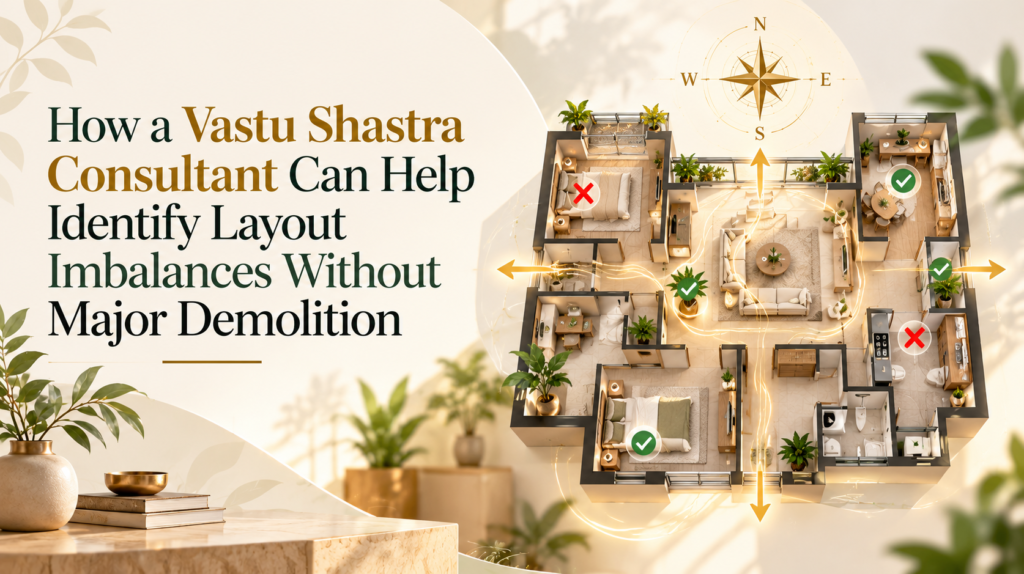
In traditional Vastu Shastra, different directions are associated with different spatial functions.
For example, the southeast is commonly associated with kitchens, the southwest with master bedrooms, and the northeast with prayer or meditation spaces.
A layout imbalance generally refers to an arrangement that differs from the principles followed by a particular Vastu practitioner.
However, these interpretations may vary between practitioners and traditions.
It is also important to understand that Vastu imbalances are traditional assessments, not scientifically established causes of financial, emotional, or health problems.
A responsible consultation should explain this distinction and avoid creating unnecessary fear.
How a Vastu Shastra Consultant Reviews an Existing Property
A consultation generally begins with understanding the property’s layout and the homeowner’s concerns.
The consultant may request a floor plan, measurements, photographs, and information about the building’s orientation.
The review can include the following areas:
- Main entrance and access
- Living room arrangement
- Kitchen location
- Bedroom placement
- Prayer or meditation area
- Bathrooms and utility spaces
- Staircase position
- Furniture and storage
- Open areas and balconies
An experienced vastu shastra consultant should also understand which elements can be adjusted and which are restricted by structural or practical requirements.
Identifying the Property’s Orientation
Direction is a fundamental consideration in traditional Vastu.
Before evaluating room placement, the consultant needs to establish the orientation of the property.
This provides a reference for understanding the relationship between different spaces.
Accurate measurements are important because incorrect orientation can affect the interpretation of the entire layout.
However, directional preferences should not override essential architectural requirements.
Reviewing the Main Entrance Without Relocation
The main entrance is an important element in Vastu planning.
In existing apartments and houses, relocating it may be impractical or prohibited.
A consultant may instead review how the entrance area is organized.
Possible non-structural adjustments include improving lighting, removing unnecessary obstructions, and reorganizing furniture near the doorway.
These changes can improve accessibility and usability regardless of traditional Vastu considerations.
Evaluating Kitchen Arrangements
Traditional Vastu commonly considers the southeast for kitchen placement.
However, moving an existing kitchen may require changes to plumbing, electrical systems, drainage, and ventilation.
A practical consultation should first examine the kitchen’s existing arrangement.
The consultant may discuss traditional preferences concerning the cooking area while recognizing the limitations of the property.
Homeowners can also consider practical improvements to storage, preparation space, lighting, and ventilation.
A kitchen should remain safe and convenient for everyday use.
Reviewing Bedroom Placement
Bedrooms are another important part of a residential Vastu assessment.
Traditional Vastu commonly associates the southwest with the master bedroom.
However, changing bedroom locations may not be practical in every house.
A vastu shastra consultant can review the current arrangement and discuss whether room usage or furniture placement offers flexibility.
The final decisions should also consider privacy, natural light, ventilation, and accessibility.
Considering Prayer and Meditation Spaces
Many households prefer a dedicated prayer area.
Traditional Vastu often associates the northeast with prayer or meditation.
However, smaller homes may not have a separate room available.
A consultant may help homeowners identify a suitable location for a compact prayer area without changing the structure.
The arrangement should remain accessible and should not obstruct circulation.
Furniture Placement as a Practical Adjustment
Furniture arrangements are often easier to change than structural elements.
Homeowners may be able to reposition beds, desks, sofas, cabinets, or other movable items.
Such changes can help accommodate certain traditional preferences.
They may also improve movement, storage, and the practical use of a room.
However, furniture should never block emergency exits, ventilation openings, or essential access routes.
Understanding Non-Demolition Vastu Remedies
Some Vastu practitioners recommend symbolic objects, decorative elements, or other non-structural remedies.
These practices belong to traditional belief systems, and their claimed effects on prosperity, health, or relationships are not scientifically established.
Homeowners should ask what a proposed remedy involves, why it is being recommended, and whether it has any practical limitations.
A responsible consultant should explain the nature of the recommendation without guaranteeing outcomes.
When Structural Changes May Be Unnecessary
Major structural changes are not always necessary when homeowners want to incorporate Vastu preferences.
A consultant may identify alternative arrangements that preserve the existing building.
For example, a household might use a spare room differently, reorganize furniture, or create a compact prayer space.
The goal should be to explore feasible options before considering expensive modifications.
When Professional Architectural Advice Is Essential
Any proposed change involving load-bearing walls, columns, beams, staircases, plumbing, or electrical systems requires appropriate professional evaluation.
A Vastu consultation does not replace architectural or engineering expertise.
Structural safety and building regulations must remain priorities.
How to Choose the Right Consultant
When searching for the best vastu shastra consultant, homeowners should evaluate the professional’s approach rather than relying only on promotional claims.
Look for someone who explains recommendations clearly, considers the existing structure, and discusses practical alternatives.
It is also useful to ask whether the consultation includes a written assessment or follow-up guidance.
Conclusion
A vastu shastra consultant can help homeowners understand how their existing layout compares with traditional Vastu principles.
In many situations, the discussion may focus on room usage, furniture placement, interior organization, and other non-structural adjustments.
However, not every traditional recommendation can be accommodated within an existing property.
A practical consultation should respect architectural limitations, avoid fear-based claims, and prioritize safety and everyday functionality.
For homeowners who value Vastu, this approach provides an opportunity to consider traditional preferences without assuming that major demolition is necessary.