
Introduction
Modern organizations rarely store and process all their information in one location. Businesses increasingly use cloud platforms, enterprise applications, databases, APIs, remote infrastructure, SaaS services, and hybrid environments to support their operations.
This distributed approach provides flexibility and scalability, but it also creates new data security challenges. Sensitive information can move between different systems, applications, and infrastructure environments. Security teams must therefore maintain protection even when data crosses multiple technology boundaries.
Encryption provides an important layer of protection. Organizations can encrypt databases, cloud storage, application data, backups, and communications. However, encryption depends on cryptographic keys, and those keys require their own security controls.
This is why key management in cryptography plays an important role in distributed data protection.
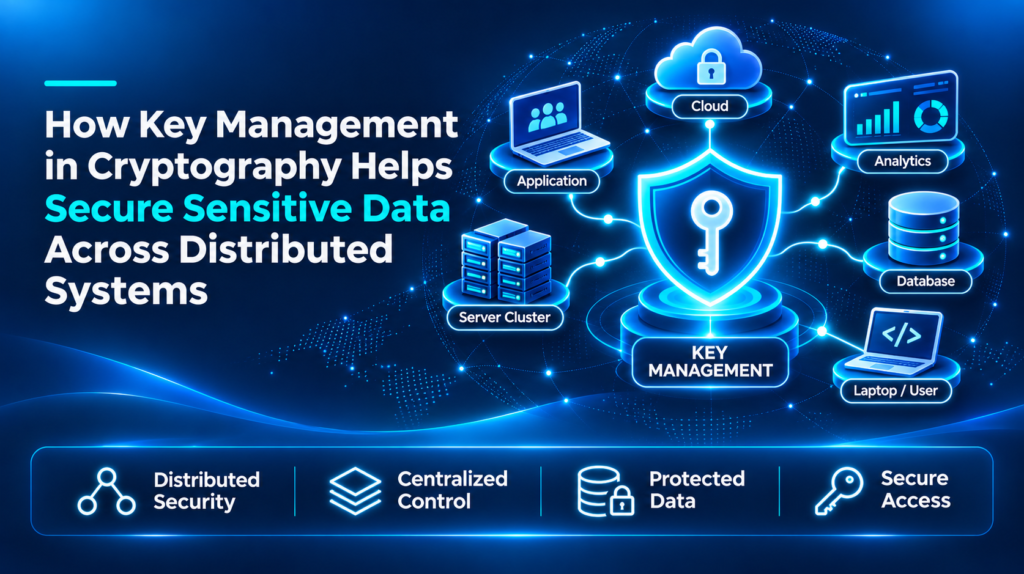
Effective Key management allows organizations to control cryptographic keys throughout their lifecycle and maintain better visibility into which keys protect specific data and systems.
Understanding Distributed Systems
A distributed system consists of multiple computing resources that work together to provide applications or services.
An enterprise environment may include:
- Cloud applications
- On-premises databases
- SaaS platforms
- APIs
- Microservices
- Backup infrastructure
- Data analytics platforms
- Remote systems
Sensitive information can move between these components.
For example, an organization may operate a customer-facing application in the cloud while storing customer records in a separate database environment. The application may also connect to payment services and analytics platforms through APIs.
Each connection can create additional security requirements.
Why Encryption Matters
Encryption converts readable information into a protected format that unauthorized parties cannot easily interpret.
Organizations use encryption to protect information:
- At rest
- In transit
- During specific application workflows
However, encryption cannot operate without cryptographic keys.
A key may control access to encrypted information, authenticate a service, or support a digital signature.
If an attacker gains unauthorized access to a sensitive key, the protection provided by encryption may be weakened.
Organizations therefore need to manage keys separately from the data they protect.
The Role of Key Management in Cryptography
Key management in cryptography covers the complete lifecycle of cryptographic keys.
A typical lifecycle includes:
- Key generation
- Key storage
- Key distribution
- Key access
- Key usage
- Key rotation
- Key backup
- Key recovery
- Key retirement
- Key destruction
Organizations should establish clear policies for every stage.
In distributed systems, lifecycle management becomes especially important because keys may support applications and data across several environments.
Maintaining a Centralized Key Inventory
Security teams need visibility into their cryptographic environment.
A key inventory should ideally identify:
- Key owner
- Key purpose
- Associated application
- Protected information
- Key location
- Access permissions
- Rotation schedule
- Lifecycle status
Without an accurate inventory, organizations may struggle to identify obsolete keys, excessive permissions, or unknown cryptographic assets.
Controlling Key Access
Distributed environments can contain many users, applications, and automated services.
Not every identity should have access to every cryptographic key.
Organizations should apply the principle of least privilege.
For example, a customer application may require access to a key used for customer data encryption. That application should not automatically receive access to keys protecting employee or financial systems.
Restricting access reduces unnecessary exposure.
Separating Keys From Protected Data
Organizations should avoid storing cryptographic keys in the same location as the information they protect.
For example, an encrypted database and its encryption keys should not depend on the same security boundary.
Separating these components creates additional protection.
It also allows security teams to manage keys independently from individual databases and applications.
Protecting Cloud and On-Premises Data
Many enterprises operate hybrid infrastructure.
They may store some information on-premises while running applications and services in the cloud.
A consistent Key management strategy helps organizations maintain control across both environments.
Security teams should understand where keys reside and how applications access them.
They should also ensure that cloud and on-premises systems follow appropriate enterprise policies.
Key Rotation
Organizations should establish policies for rotating cryptographic keys.
Rotation replaces an existing key with a new one according to defined requirements.
Businesses may rotate keys based on:
- Key age
- Data sensitivity
- Security policy
- Risk assessment
- Regulatory requirements
- Suspected compromise
Before rotating a key, security teams should identify all systems that depend on it.
Key Backup and Recovery
Distributed systems also require reliable key recovery procedures.
If an organization loses a critical encryption key, authorized users may lose access to protected information.
Businesses should therefore maintain secure backups and establish controlled recovery procedures.
Recovery access should remain restricted to authorized personnel.
Organizations should also test recovery procedures instead of assuming that backups will work when needed.
Protecting Application Keys
Modern applications may use cryptographic keys for:
- Data encryption
- Authentication
- API security
- Digital signatures
- Secure communication
Developers should avoid placing sensitive keys directly in application source code.
Applications should instead use controlled cryptographic services.
This approach reduces the number of locations where sensitive keys exist.
Monitoring Key Activity
Security teams should monitor important cryptographic events.
These may include:
- Key creation
- Key access
- Key rotation
- Failed access attempts
- Administrative changes
- Key retirement
Monitoring helps security teams identify unexpected activity and investigate potential security incidents.
Managing Key Sprawl
Distributed systems can produce key sprawl.
Different teams may create keys for individual applications, databases, cloud services, or projects.
Over time, organizations may accumulate keys that no longer have a clear purpose.
Regular inventory reviews can help identify:
- Unused keys
- Duplicate keys
- Unknown keys
- Keys with excessive permissions
- Keys associated with retired applications
Organizations should retire obsolete keys according to established policies.
Supporting Data Governance
Key management should align with data classification.
Organizations may classify information according to its sensitivity and business importance.
Highly sensitive information may require stronger encryption and stricter key controls.
This approach allows organizations to allocate security resources according to risk.
Common Challenges
Distributed environments can create several Key management challenges.
Fragmented Infrastructure
Different platforms may use different cryptographic mechanisms.
Limited Visibility
Security teams may not know where every key resides.
Inconsistent Policies
Different teams may follow different procedures.
Excessive Permissions
Applications may receive broader access than necessary.
Manual Processes
Manual rotation and recovery can create errors.
Best Practices
Organizations should:
- Maintain a complete cryptographic key inventory
- Assign clear ownership
- Apply least-privilege access
- Separate keys from protected data
- Establish rotation policies
- Protect key backups
- Test recovery procedures
- Monitor key activity
- Automate appropriate lifecycle activities
- Review permissions regularly
- Retire obsolete keys
- Integrate Key management with broader data security policies
Conclusion
Distributed systems provide organizations with flexibility and scalability, but they also make data protection more complex.
Sensitive information may move across cloud platforms, databases, applications, APIs, and on-premises infrastructure.
Encryption can protect this information, but cryptographic keys require dedicated security controls.
Key management in cryptography provides the lifecycle framework for managing these keys.
Effective Key management improves visibility, access control, rotation, recovery, monitoring, and governance.
By applying consistent key management practices across distributed systems, organizations can strengthen encryption security and maintain better control over the cryptographic assets protecting their sensitive information.