
Introduction
Encryption plays a central role in protecting sensitive information across modern enterprise environments. Organizations use encryption to protect customer records, financial information, employee data, intellectual property, databases, cloud storage, backups, and application information.
However, encryption cannot operate without cryptographic keys.
A key determines how an encryption process protects or decrypts information. This means organizations must protect the keys themselves and ensure that only authorized users, applications, and systems can access them.
One of the most important challenges involves distributing encryption keys securely.
If organizations distribute keys through insecure channels or give applications unnecessary access, attackers may gain opportunities to compromise protected information.
This makes Key management an essential component of enterprise encryption security.
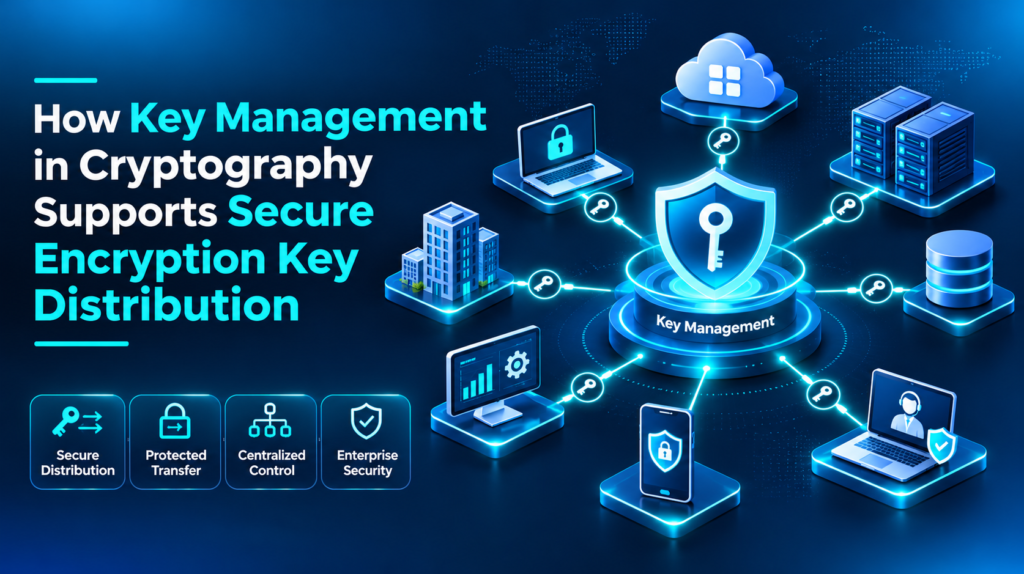
A structured approach to key management in cryptography helps organizations manage the complete key lifecycle, including secure generation, distribution, access, rotation, recovery, and retirement.
What Is Encryption Key Distribution?
Encryption key distribution refers to the process of making cryptographic keys available to authorized users, applications, services, or systems.
The objective is straightforward: an authorized entity should receive access to the key required for a legitimate cryptographic operation without exposing that key unnecessarily.
For example, an enterprise application may need a specific key to decrypt information stored in a database.
The application should receive only the required access rather than broad access to the organization’s entire collection of cryptographic keys.
Why Secure Key Distribution Matters
Encryption provides strong protection only when organizations also protect the keys associated with it.
Poor key distribution can create several risks.
These include:
- Unauthorized key access
- Key interception
- Excessive permissions
- Hard-coded credentials
- Untracked key copies
- Poor key visibility
- Difficulty revoking access
Organizations therefore need structured processes for distributing keys.
The Role of Key Management in Cryptography
Key management in cryptography provides a framework for controlling cryptographic keys throughout their lifecycle.
A typical lifecycle includes:
- Key generation
- Key storage
- Key distribution
- Key access
- Key usage
- Key rotation
- Key backup
- Key recovery
- Key expiration
- Key retirement
- Key destruction
Secure distribution represents one stage within this broader lifecycle.
Organizations should connect distribution policies with access control and identity management.
Secure Key Distribution and Identity
Before an organization provides access to a cryptographic key, it should determine who or what is requesting access.
The requesting entity may be:
- An employee
- An application
- An API
- A database
- A cloud workload
- A service account
- An automated process
Identity and authorization controls help determine whether the request should be approved.
This approach prevents organizations from treating every request as trusted.
Applying Least Privilege
Least privilege should apply to cryptographic key distribution.
An application should receive only the access required for its approved function.
For example, an application responsible for processing customer transactions may require access to a transaction encryption key. It should not automatically receive access to keys used by HR, finance, or unrelated business applications.
Limiting permissions reduces unnecessary exposure.
Avoiding Hard-Coded Encryption Keys
Developers sometimes store cryptographic keys directly in source code or configuration files.
This creates avoidable risks.
Source repositories, application packages, deployment systems, or configuration backups may expose the key.
Organizations should instead provide applications with controlled access to approved cryptographic services.
This approach keeps sensitive key material outside ordinary application code.
Secure Distribution Across Applications
Enterprise applications frequently communicate with databases, APIs, cloud services, and other applications.
These systems may require cryptographic keys to authenticate services, encrypt information, or create digital signatures.
Organizations should define which keys each application requires.
Security teams should also document:
- Application ownership
- Key purpose
- Access permissions
- Rotation requirements
- Expiration
- Revocation procedures
Key Distribution in Cloud Environments
Cloud environments create additional key distribution requirements.
An organization may operate workloads across several cloud platforms.
Applications may require access to encryption keys for:
- Cloud databases
- Storage
- Backups
- Application data
- APIs
- Secure communications
Security teams should maintain visibility into these relationships.
Centralized Key management can help establish consistent access policies across supported environments.
Key Distribution in Hybrid Infrastructure
Hybrid infrastructure combines cloud and on-premises systems.
For example, an application may operate in the cloud while its database remains on-premises.
The application may need access to cryptographic services supporting encrypted database information.
Organizations should control this access carefully.
They should avoid creating broad network or key permissions simply to make integration easier.
Key Distribution and Digital Certificates
Digital certificates depend on cryptographic keys.
Organizations use certificates for websites, APIs, applications, servers, devices, and internal services.
The associated private keys require strong protection.
Organizations should distribute certificates and manage private keys through controlled processes.
Private keys should never be exposed unnecessarily.
Key Rotation and Redistribution
When an organization rotates a key, dependent systems may need access to the replacement key.
This creates a relationship between key rotation and key distribution.
Before rotating a key, security teams should identify all systems that use it.
They should establish a controlled process for:
- Generating the replacement key
- Providing authorized systems with access
- Confirming successful integration
- Removing unnecessary access to the previous key
- Retiring the old key when appropriate
Key Backup and Recovery
Key distribution processes should also consider recovery.
If a critical key becomes unavailable, authorized systems may lose access to protected information.
Organizations should maintain secure key backups and establish controlled recovery procedures.
Recovery access should remain restricted and monitored.
Monitoring Key Distribution
Security teams should monitor key-related activities.
Important events include:
- Key requests
- Key access
- Key generation
- Key rotation
- Failed access attempts
- Administrative changes
- Key retirement
Monitoring can help organizations identify unusual activity and investigate potential security incidents.
Common Key Distribution Challenges
Excessive Access
Applications may receive broader key permissions than required.
Manual Processes
Manual distribution can create errors.
Poor Visibility
Organizations may not know which systems have access to specific keys.
Key Copies
Uncontrolled copies can increase exposure.
Legacy Systems
Older applications may require additional integration mechanisms.
Best Practices
Organizations should:
- Maintain a complete key inventory
- Identify key dependencies
- Apply least privilege
- Authenticate requesting systems
- Avoid hard-coded keys
- Separate keys from encrypted data
- Automate appropriate distribution processes
- Monitor key access
- Protect backups
- Test recovery
- Review permissions regularly
- Retire obsolete keys
Building a Secure Key Distribution Framework
A practical enterprise model can follow this sequence:
Identify → Authenticate → Authorize → Distribute → Monitor → Rotate → Revoke
This approach ensures that key distribution remains connected to broader security controls.
Organizations should also document responsibilities for application owners, security teams, and administrators.
Conclusion
Secure encryption key distribution forms an important part of enterprise cryptographic security.
Encryption protects sensitive information, but organizations must ensure that authorized systems can access the correct keys without exposing those keys unnecessarily.
Key management in cryptography provides the framework for controlling cryptographic keys throughout their lifecycle.
Effective Key management supports secure distribution, least-privilege access, rotation, monitoring, recovery, and retirement.
By integrating key distribution with identity management, access control, encryption, monitoring, and lifecycle policies, enterprises can strengthen the protection of sensitive information while maintaining reliable access to the cryptographic resources required by their business systems.