
Introduction
Identity and access management, commonly known as IAM, has become a critical component of enterprise cybersecurity. Organizations need to determine who can access business systems, what resources they can use, and which actions they are authorized to perform.
Modern IT environments have made this responsibility more complex. Employees, applications, APIs, devices, service accounts, cloud workloads, and automated systems may all require access to enterprise resources.
Cryptography supports many of the security mechanisms used within these environments. Organizations use cryptographic technologies for authentication, encryption, digital signatures, certificates, secure communications, and credential protection.
However, these technologies depend on cryptographic keys.
If organizations fail to protect and manage those keys properly, attackers may gain opportunities to bypass or weaken important security controls.
This makes Key management an important part of modern identity and access security.
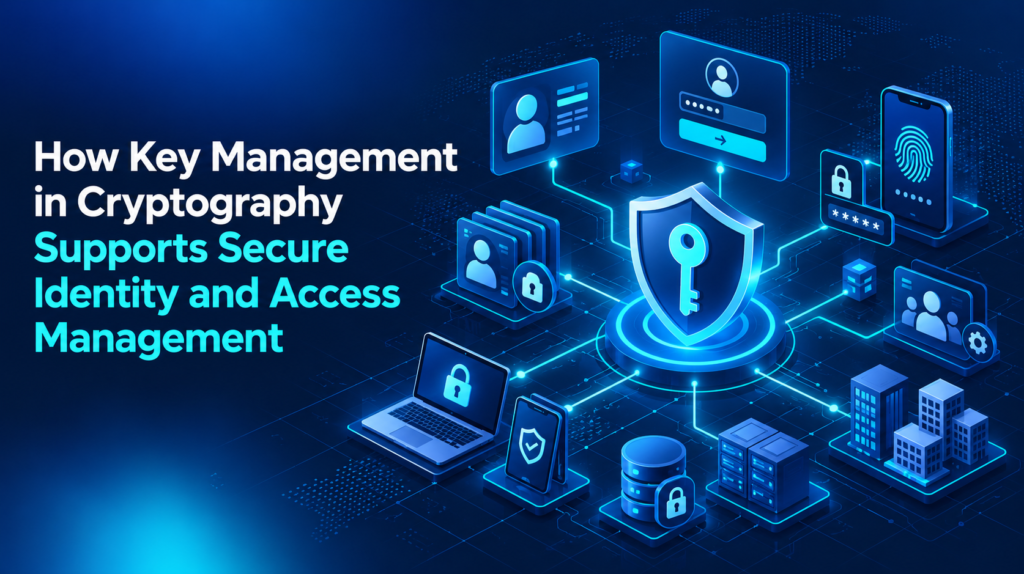
A structured approach to key management in cryptography helps organizations control cryptographic keys throughout their lifecycle while supporting authentication, authorization, encryption, and secure communication.
Understanding Identity and Access Management
Identity and access management establishes controls around digital identities.
An identity can represent:
- An employee
- An administrator
- An application
- A service
- An API
- A device
- An automated workload
IAM systems determine whether an identity should receive access to a particular resource.
Organizations typically use authentication to verify identity and authorization to determine what that identity can access.
Cryptographic technologies can support both processes.
Why Cryptography Matters to IAM
Secure authentication often relies on cryptographic mechanisms.
Digital certificates, public-key cryptography, signed credentials, and secure communication protocols can help establish trust between systems.
Encryption also protects sensitive identity information while it moves between applications and services.
Cryptographic keys enable these mechanisms.
Therefore, protecting the keys becomes an important part of protecting identity infrastructure.
The Role of Key Management in Cryptography
Key management in cryptography refers to the processes and controls used to manage cryptographic keys throughout their lifecycle.
A typical lifecycle includes:
- Key generation
- Key storage
- Key distribution
- Key access
- Key usage
- Key rotation
- Key backup
- Key recovery
- Key retirement
- Key destruction
Organizations should establish security policies for each stage.
Protecting Authentication Keys
Applications and services may use cryptographic keys to authenticate one another.
For example, an internal application may use a certificate and corresponding private key when establishing a secure connection with another service.
The private key requires strong protection.
If unauthorized users obtain the private key, they may potentially impersonate the associated service.
Effective Key management helps organizations control access to such cryptographic assets.
Protecting Digital Certificates
Digital certificates play an important role in enterprise identity systems.
Organizations use certificates for:
- Websites
- APIs
- Applications
- Servers
- Devices
- Internal services
Every certificate has a lifecycle.
Organizations need to track certificate ownership, expiration, renewal, replacement, and associated private keys.
Key management helps bring these cryptographic assets into a structured lifecycle.
Applying Least Privilege
Least privilege represents a fundamental security principle.
Organizations should provide users and applications only the access they require.
The same principle should apply to cryptographic keys.
An application that requires one authentication key should not automatically receive access to unrelated encryption keys.
Restricting key permissions can reduce unnecessary exposure.
Key Management for Service Accounts
Service accounts allow applications and automated workloads to perform tasks without direct human interaction.
These accounts may require cryptographic credentials.
Organizations should manage these credentials carefully.
Security teams should define:
- Account ownership
- Key ownership
- Access permissions
- Rotation requirements
- Expiration
- Revocation procedures
This creates better control over non-human identities.
Protecting API Credentials
APIs frequently connect internal applications, customer services, and third-party platforms.
They may use certificates, signing keys, or other cryptographic credentials.
Organizations should avoid storing sensitive credentials directly in application source code.
Instead, applications should access approved cryptographic services through controlled mechanisms.
Key Rotation and Identity Security
Cryptographic keys should not remain active indefinitely without review.
Organizations can establish rotation policies based on:
- Key age
- Security requirements
- Data sensitivity
- Application architecture
- Risk
- Suspected compromise
Rotation can reduce the amount of time a particular key remains active.
Organizations should test rotation processes before implementing them across critical systems.
Key Revocation
When a user, application, device, or service no longer requires access, associated cryptographic credentials may also need to be revoked.
For example, an organization may retire an application and remove its associated certificates and keys.
Key management policies should define how organizations handle these situations.
Cloud IAM and Key Management
Cloud environments create additional identity requirements.
Organizations may manage identities across multiple cloud providers and on-premises infrastructure.
Cloud applications may use cryptographic keys for:
- Encryption
- Authentication
- API security
- Secure communications
- Digital signatures
Centralized Key management can help security teams maintain consistent policies across these environments.
Key Management and Zero Trust
Zero Trust security requires organizations to verify access instead of automatically trusting users or systems.
Cryptographic keys can support this approach.
Applications and services can use cryptographic credentials to establish identity and secure communication.
Key management helps control these credentials and ensures that access remains limited to authorized entities.
Monitoring Cryptographic Access
Security teams should monitor activity involving important cryptographic keys.
Relevant events include:
- Key access
- Key creation
- Key rotation
- Failed access attempts
- Administrative changes
- Key retirement
Monitoring helps organizations identify unexpected activity and investigate potential security incidents.
Protecting Key Backups
IAM infrastructure may depend on critical cryptographic keys.
If an organization loses those keys, authorized applications or users may lose access to protected services.
Businesses should maintain secure key backups and establish controlled recovery procedures.
Recovery operations should require appropriate authorization.
Common Challenges
Excessive Key Permissions
Applications may receive broader permissions than necessary.
Expired Credentials
Organizations may fail to track certificate and key expiration dates.
Hard-Coded Secrets
Developers may accidentally expose cryptographic credentials in source code.
Key Sprawl
Organizations may accumulate keys across multiple applications and platforms.
Poor Visibility
Security teams may not know which keys support specific identities or services.
Best Practices
Organizations should:
- Maintain a complete inventory of identity-related cryptographic keys
- Assign ownership
- Apply least privilege
- Protect private keys
- Avoid hard-coded credentials
- Establish key rotation policies
- Monitor cryptographic access
- Protect key backups
- Test recovery procedures
- Retire obsolete credentials
- Review permissions regularly
- Integrate Key management with IAM policies
Conclusion
Identity and access management depends on more than usernames and passwords.
Modern enterprises rely on cryptographic technologies to authenticate identities, secure communication, protect credentials, and establish trust between applications and services.
Key management in cryptography provides the framework for managing the keys behind these technologies.
Effective Key management helps organizations control cryptographic credentials, enforce least privilege, manage rotation, protect private keys, and monitor key usage.
By integrating Key management with IAM, Zero Trust, cloud security, and application security practices, enterprises can establish stronger control over digital identities and the resources they access.