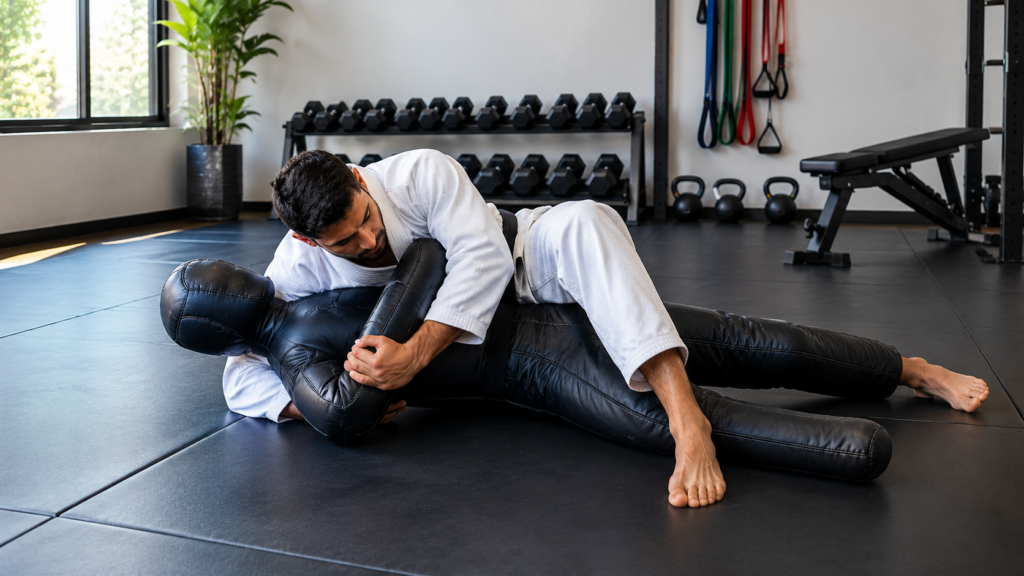

Training Brazilian Jiu-Jitsu at home can be a useful way to reinforce techniques learned during regular academy sessions. While live partner training remains essential, having suitable equipment can make solo practice more structured and convenient.
One of the most useful pieces of equipment for grappling-focused home training is a grappling dummy. It provides a human-shaped training target that can be used for selected positional drills, transitions, and technique repetitions.
However, not every grappling dummy is designed in the same way. Size, position, material, filling, construction, and intended use can all affect how useful a dummy will be for a particular athlete.
Understanding these differences can make it easier to choose equipment that matches your training goals.
What Is a BJJ Grappling Dummy?
A BJJ grappling dummy is a training tool designed to replicate some of the basic positioning and shape of a human training partner.
Unlike a punching bag, a grappling dummy is designed around grappling movements rather than primarily striking. Depending on the model, it may have articulated arms and legs or a shape that allows practitioners to work through ground-based positions.
A dummy can be placed in positions such as mount, guard, side control, or other grappling configurations.
It is particularly useful for repetition. A practitioner can perform a movement, reset the dummy, and repeat the sequence without needing another person to participate in every repetition.
Start With Your Training Goals
Before choosing a dummy, consider what you actually want to practice.
Someone primarily interested in Brazilian Jiu-Jitsu may want a model that works well for ground positions and submission drills. A practitioner interested in MMA or wrestling may want a design that also supports standing entries, takedown practice, or clinch movements.
Your training goals can influence the size and style of dummy that makes sense.
Think about questions such as:
- Do you mainly practice ground BJJ?
- Do you want to work on takedown entries?
- Will you practice MMA techniques?
- Are submission drills important to you?
- Do you have enough space for a large dummy?
- Will you need to store the dummy after training?
Answering these questions first can prevent you from buying equipment that does not match your actual routine.
Choosing the Right Size
Size is one of the most important considerations.
A larger dummy can provide dimensions that feel closer to working with an adult training partner. However, a larger model also requires more floor space and may be more difficult to move or store.
Smaller dummies can be easier to handle, especially in limited home training areas.
The right choice depends on your own size, training goals, available space, and the type of techniques you plan to practice.
If the dummy is intended primarily for young athletes, smaller dimensions may be more appropriate. Adults working on realistic positional drills may prefer a larger model.
Ground Training or Standing Practice?
Another important factor is the position of the dummy.
Some models are designed primarily for ground grappling. These can be useful for practicing positions such as guard, mount, side control, and back control.
Other models can be positioned upright and may be more suitable for takedown entries, clinch work, and standing grappling.
If your training is focused mainly on Brazilian Jiu-Jitsu, a ground-oriented dummy may provide the features you need.
If you want to combine BJJ with wrestling or MMA practice, a more versatile model may be worth considering.
Consider the Material
Grappling dummies are made from different materials, including synthetic leather, canvas, nylon, polyester, and other durable fabrics.
The material can influence the feel, durability, cleaning requirements, and overall construction of the equipment.
A dummy used frequently should be made from materials appropriate for repeated contact and movement.
Before purchasing, check the manufacturer’s specifications and care instructions. Regular cleaning and proper storage can also help maintain training equipment over time.
Filled or Unfilled?
Some grappling dummies are supplied empty, while others arrive filled.
An unfilled dummy can offer greater flexibility because the owner can determine how much filling material is added. This can make it easier to adjust the overall weight according to personal preferences.
A filled dummy is generally more convenient because it can be used with less preparation.
When comparing models, check whether the listed price includes filling. An apparently inexpensive model may require additional materials before it is ready for training.
Think About Storage
Home training equipment needs a practical storage solution.
A large grappling dummy can take up considerable space, especially in smaller rooms or apartments. If the training area also contains dumbbells, kettlebells, resistance bands, a bench, or other equipment, storage can quickly become an issue.
Consider where the dummy will be kept between sessions.
If you need to move it after every workout, weight and portability become more important. If you have a dedicated training room, storage may be less of a concern.
What Can You Practice With a Dummy?
A grappling dummy can support a wide range of controlled drills.
Depending on its design, practitioners can use it to review:
- Guard positions
- Mount transitions
- Side-control movements
- Back-control positioning
- North-south transitions
- Guard-passing sequences
- Armbar movements
- Triangle positioning
- Kimura and Americana sequences
- Selected choke movements
- Takedown entries
- Clinch positioning
- Positional transitions
The purpose is not to recreate live rolling perfectly.
Instead, the dummy provides a stable target for learning movement patterns and repeating techniques.
Repetition Is More Important Than Speed
When practicing with a grappling dummy, it can be tempting to move as quickly as possible.
However, technical practice should generally begin at a controlled pace.
Slow repetitions allow practitioners to focus on details such as body positioning, balance, grips, hip movement, and transitions.
Once the sequence becomes familiar, the practitioner can gradually increase the speed while maintaining proper mechanics.
The objective should be quality repetition rather than simply counting how many times a technique is performed.
Use a Suitable Training Surface
A grappling dummy should be used on an appropriate training surface.
A hard floor can be uncomfortable during repeated ground movements and may make certain drills less practical.
A suitable training mat can provide a more appropriate surface for BJJ practice and help create a dedicated training area.
The amount of matting required depends on the type of training and available space. Practitioners should make sure the training area is clear of furniture and other obstacles before starting.
Combine Dummy Training With Solo Movement
A grappling dummy works best as part of a broader home BJJ routine.
Before using the dummy, practitioners can perform movement drills such as bridging, hip escapes, technical stand-ups, and other fundamental exercises.
After technical practice, they can add appropriate mobility or conditioning work.
For example, a simple session might include:
5 minutes: Warm-up and mobility
10 minutes: Solo movement drills
15 minutes: Grappling dummy technique practice
5–10 minutes: Conditioning or cooldown
The exact structure can be adjusted according to the athlete’s experience and overall training schedule.
Understand the Limitations
A grappling dummy can be useful, but it cannot replace a live training partner.
A dummy does not resist, escape, counter, change its weight, or respond to grips. It cannot teach timing in the same way as live rolling.
These limitations are particularly important for beginners.
Techniques should ideally be learned from a qualified instructor before being repeated extensively at home. Solo practice is most useful when it reinforces movements that have already been taught and corrected.
BJJ Dummy Training for Beginners
Beginners can benefit from keeping dummy training simple.
Instead of trying to practice advanced submissions immediately, start with basic positions and movements.
Learn how to establish mount, side control, guard, and other fundamental positions. Then practice moving between them.
Once the basic movements become familiar, selected submission sequences can be introduced according to the practitioner’s current level.
This gradual approach can make home practice easier to understand and more productive.
Building a Long-Term Home Training Routine
Buying equipment is only the first step.
The real benefit comes from using it consistently.
Set realistic training goals and decide when home sessions will take place. Some athletes may benefit from short sessions several times per week, while others may prefer longer sessions less frequently.
Keep the routine connected to academy training.
If a particular position or transition was difficult during class, make that movement a focus of the next home session. Then return to class and test the technique against appropriate resistance.
This creates a continuous learning cycle between home practice and live instruction.
Final Thoughts
Choosing a BJJ grappling dummy requires more than selecting the first model available. Consider your training goals, preferred positions, available space, dummy size, construction, filling, and storage requirements.
The right equipment can make solo practice more convenient and provide opportunities for repeating selected BJJ movements between classes.
For athletes researching different options for home practice, a grappling dummy for BJJ training can be one practical addition to a broader home training setup.
The most important point is to use the equipment as a supplement to regular instruction. Live partners and qualified coaches remain essential for developing timing, resistance, reactions, and practical application.