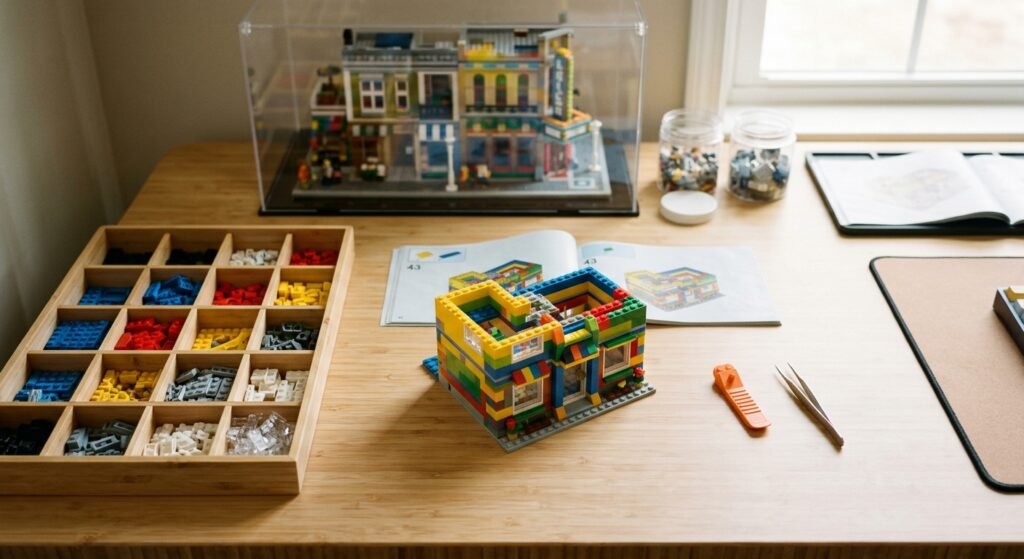

Anyone who has finished a LEGO® set knows the moment. The last piece clicks into place, the model looks great, and then a practical question appears: where does it go? There is also the pile of leftover bricks, the stray minifigure, and the half-built project that has to be cleared away before dinner.
That is where LEGO® accessories come in. The right extras do not change the bricks themselves. They change how comfortable the hobby feels. They protect finished models from dust, keep small pieces easy to find, and make building more enjoyable for kids and adults alike. This guide walks through the main types of LEGO® accessories, what each one actually solves, and how to choose without buying things you will never use.
What Counts as a LEGO® Accessory?
In everyday use, the phrase covers anything that supports building, displaying, or storing LEGO® sets without being a set itself. Some items are made by the LEGO Group, such as baseplates, while many others come from third-party companies. That difference matters, because fit, finish, and quality can vary from one maker to another.
Most accessories fall into four simple groups:
- Display: cases, stands, risers, and lighting.
- Storage and sorting: trays, drawers, bags, and play mats.
- Building tools: brick separators, tweezers, and sorting scoops.
- Scene and minifigure extras: baseplates, small props, and figure stands.
Thinking in these groups helps you find your real problem first. If your finished models collect dust, you need display help. If you spend ten minutes hunting for a single 1×2 plate, you need better sorting. Buying without that clarity is how drawers fill up with accessories that never get used.
Display Accessories: Showing Off Finished Builds
A finished model deserves better than a crowded shelf corner. Display accessories are usually the first category people explore, because the problem is so visible.
Display Cases
Clear cases are the most common answer to dust. Dust is a genuine enemy of LEGO® models, since the studs, grilles, and small gaps catch it easily and it can be tedious to clean. A case keeps models tidy and also protects them from curious hands and pets. When comparing cases, look at how the lid or panels come off. A case that is hard to open tends to stop you from rearranging your collection, which defeats half the fun.
Size is the other thing to check. Measure the model first, including parts that stick out such as wings, antennas, or flags, and leave a little breathing room. A model that touches the walls of a case looks cramped and can get damaged when you lift the lid.
Stands and Risers
Stands tilt a model so it can be seen from its best angle, which suits vehicles, spaceships, and anything meant to look like it is in motion. Risers are simpler: they lift one model above another so a shelf can hold a layered display instead of a single row. Both are small additions that can make a shelf look curated instead of cluttered.
Lighting
Lighting kits are popular for good reason. Small LEDs placed inside buildings, vehicles, or street scenes can make a model feel alive, especially in a dim room. If you try them, pay attention to how the wiring is routed and how the battery pack is accessed. A kit that forces you to take half the model apart every time the batteries die is likely to get abandoned.
Storage and Sorting: Keeping the Chaos Under Control
Storage is where LEGO® accessories pay for themselves the fastest. A growing collection can turn into a mixed heap in a surprisingly short time, and a heap is slow to build from.
There are two common approaches, and they suit different kinds of builders:
- Sort by color. This is easy to start and easy for children to follow. It works well for free building, where you are looking for a certain look more than a certain piece.
- Sort by type. Plates, bricks, slopes, tiles, and specialty parts each get their own container. This takes longer to set up but saves time later if you build large or detailed models.
Many experienced builders mix the two, using shallow trays for small parts and larger bins for bulk bricks. Shallow, divided trays are especially useful because they let you see everything at once instead of digging through a deep box.
For active projects, a play mat or building tray is worth considering. It gives you a surface that catches loose pieces, and you can gather it up and move it when the table is needed. For families, that single item can end many arguments about where the bricks are allowed to live.
If you are storing sets with instruction booklets, keep the booklet with the bag of pieces or in a labeled folder. Rebuilding a set months later is much easier when the instructions have not wandered off.
Building Tools: Small Items That Save Fingertips
Some of the most useful LEGO® accessories are also the cheapest. A brick separator is the obvious example. It lets you pull pieces apart without prying with fingernails or damaging a model, and it is a simple way to avoid frustration with tightly fitted parts.
Other helpful tools include:
- Tweezers or small tongs for placing tiny pieces and stickers precisely.
- A sorting scoop or small sieve for separating small parts from bulk bricks.
- A good light over the building area, because many parts are small and similar in color.
None of these will transform your hobby by themselves, but together they make building feel smoother, especially for longer sessions.
Scene and Minifigure Extras
Minifigures often end up being the personality of a collection, and they are easy to lose or knock over. Small figure stands and display plates keep them upright and visible instead of rolling around in a drawer.
Baseplates are another quiet workhorse. They give a model a stable foundation, let you build a whole scene, and make it simple to move a display without it falling apart. Many builders use them for city layouts, train scenes, or small dioramas. Paired with props and small details, a baseplate turns a collection of separate models into a story.
For children, these extras also encourage a different kind of play. A scene with a clear setting gives them something to act out, and a stand for a favorite minifigure gives it a proper place when playtime is over.
How to Choose LEGO® Accessories Without Overspending
It is easy to buy accessories because they look useful. A better approach is to let your own habits decide.
- Start with the biggest annoyance. Dust, mess, lost pieces, or lack of space will each point you to a different category.
- Measure before buying. Cases, shelves, and stands only help if your models actually fit.
- Check how it opens, locks, or attaches. Accessories you can use easily are accessories you will keep using.
- Be careful with unbranded or unclear products. Read descriptions and reviews, and avoid anything that requires modifying your bricks.
- Think about who will use it. What works for an adult collector may not suit a young builder, and the reverse is also true.
If you are also adding new sets to your collection, it helps to plan accessories alongside them instead of afterward. Browsing a store that carries both, such as bamgoodbricks, makes it easier to match display and storage ideas to the sets you actually own.
Common Mistakes to Avoid
Buying storage before sorting. If you do not know how you build, you may buy containers that do not fit your system. Try a simple sort first.
Ignoring sunlight. Strong direct light can fade colors over time, so a display spot away from a sunny window is a wise choice no matter how good your case is.
Overcrowding shelves. Packing models closely together makes dusting harder and increases the chance of knocking something over.
Skipping the small stuff. A few simple tools can improve your building experience more than an expensive display item.
Frequently Asked Questions
Are LEGO® accessories only for collectors? Not at all. Families with young builders often benefit the most, since sorting trays, mats, and storage bins make cleanup much easier.
Do I need official LEGO® accessories? No. Many useful accessories come from other brands. The key is checking quality, size, and fit before you buy.
How do I keep finished models dust-free? A display case is the most reliable option. If you prefer open shelves, regular gentle dusting with a soft brush helps.
What is the best first accessory to buy? For most people, it is whichever one solves their biggest daily annoyance: a brick separator for tough pieces, a sorting tray for lost parts, or a case for dusty models.
Final Thoughts
LEGO® accessories are not about adding more things to a hobby. They are about removing the small frustrations around it. A good display keeps your finished work looking its best, smart storage keeps pieces within reach, and a few simple tools make every build session smoother.
Start with the one problem you notice most, solve it well, and build from there. A tidy, thoughtful setup makes it easier to focus on the best part of the hobby, which is building something you are proud of.
LEGO® is a trademark of the LEGO Group, which does not sponsor, authorize, or endorse this article.