
Every office produces paper it shouldn’t throw away casually. Client files, invoices, employee records, contracts, tenant applications and old financial reports all carry information that someone else could misuse. Yet in many workplaces, confidential paper ends up in the same recycling bin as takeout menus, or piles up in a storage room because nobody wants to deal with it.
A simple, repeatable shredding routine fixes both problems. It protects the people whose information you hold, reduces clutter and gives you something to point to if anyone ever asks how you handle confidential records. This guide walks through how to set one up, from deciding what needs destroying to choosing between service types and verifying the job was done. If you’re comparing shred services in Vancouver for your business, start here.
Why Offices Need a Shredding Routine
Privacy obligations. Businesses that collect personal information are expected to protect it, including at the end of its life. In British Columbia, privacy legislation such as the Personal Information Protection Act sets expectations for how private-sector organizations safeguard personal information, and federal rules apply in some cases. Requirements differ by sector and situation, so confirm what applies to you with your legal advisor or industry regulator.
Client and employee trust. People hand over sensitive details expecting them to be handled responsibly. A careless disposal habit can damage that trust quickly.
Risk reduction. Intact paper in a bin or dumpster is easy to retrieve. Properly destroyed paper isn’t.
Space and efficiency. Years of accumulated files take up room that could be used for something else.
Proof. If a client, auditor or regulator asks how you destroy records, a documented process is a much stronger answer than “we think someone shredded it.”
Step 1: Decide What Needs to Be Destroyed
Start by sorting your paper into three groups.
Keep. Records you’re required to retain for legal, tax or operational reasons. Retention periods vary by industry and record type. For example, the Canada Revenue Agency generally expects income tax records to be kept for six years from the end of the tax year they relate to. Check your own obligations with your accountant, lawyer or regulator.
Destroy securely. Anything containing personal, financial or confidential business information that’s past its retention period or no longer needed. Typical examples:
- Client and customer files
- Invoices, purchase orders and financial reports
- Employee records, applications and payroll information
- Expired contracts and agreements
- Tenant files, lease agreements and application forms
- Patient or case records
- Internal memos, draft proposals and strategy documents
Recycle normally. Truly non-sensitive paper such as flyers, packaging and public brochures.
When you’re unsure about an item, treat it as confidential until you’ve checked. It’s far easier to shred something harmless than to explain a leak.
Step 2: Pick the Right Service Type
Professional shredding is usually offered in a few formats, so you can match the service to how your office generates paper.
Scheduled shredding
Best for offices that create confidential paper every week. Secure containers are placed in the workplace, staff drop documents in as they go and the provider empties them on a regular schedule. Container options typically include a desk-side executive console for individual workstations and larger wheeled toters in sizes such as 68 gallons and 95 gallons for shared areas. This approach keeps paper out of general waste from the start, since nothing needs to be saved up and sorted later.
One-time purge
Best for office moves, closures, audits, estate clearances or the annual clean-out of a storage room. A single visit handles a large volume, and it’s a simple way to clear years of accumulated records.
On-site shredding
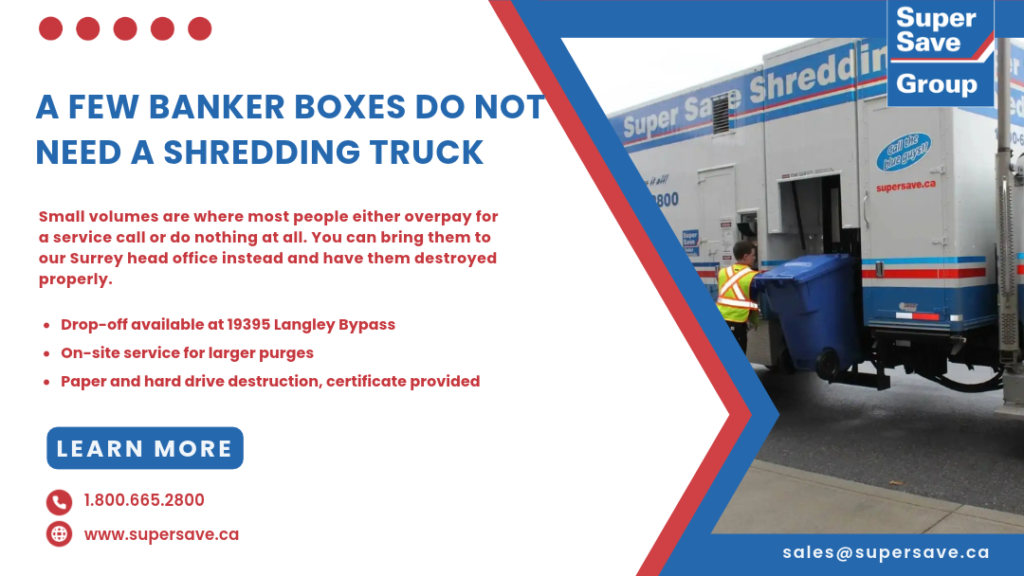
With on-site shredding in Vancouver, a mobile unit comes to your location and destroys documents there. Many organizations prefer this when records are highly sensitive, because nothing leaves the premises before it’s destroyed and staff can watch the process.
Which one should you pick?
| Your situation | Likely fit |
|---|---|
| Steady daily or weekly paper flow | Scheduled shredding with secure containers |
| One big backlog or a move | One-time purge |
| Highly sensitive records, want to see destruction | On-site shredding |
| Mix of ongoing and backlog needs | Scheduled program plus a one-time purge |
Step 3: Set Up Collection in the Office
A good service only works if staff actually use it. A few practical steps make a big difference:
- Place containers where paper is created, such as near printers, copiers, reception and filing areas.
- Use locked containers so documents can’t be taken back out.
- Label them clearly so everyone knows what goes in. A short list of examples helps.
- Keep a desk-side console for staff who handle especially sensitive material.
- Make the rule simple: when in doubt, shred it.
- Brief new employees during onboarding, and refresh the message once a year.
The goal is to make the right choice the easy choice. If the shredding container is across the building and the recycling bin is next to the desk, the recycling bin wins.
Step 4: Check the Provider’s Credentials
Not every shredding company operates to the same standard, and the paperwork matters as much as the truck. Ask about:
- Certification. NAID AAA certification indicates a company follows strict information security procedures from collection through to destruction.
- Certificate of destruction. After the job, you should receive documentation confirming your records were destroyed. Keep it with your business records as proof for audits, compliance reviews and client questions.
- Chain of custody. How documents are handled between pickup and destruction.
- Environmental practices. Responsible providers recycle shredded paper into new paper products.
A provider who answers these questions clearly and offers documentation is far more reassuring than one who simply promises that “everything is taken care of.”
Step 5: Document Your Process
A written policy turns good habits into a defensible process. It doesn’t need to be long. A one-page document can cover:
- What gets destroyed, with examples relevant to your business.
- Who is responsible, such as the office manager or privacy officer.
- How it’s collected, including container locations and rules.
- Who provides the service and how often.
- How records are verified, meaning where certificates of destruction are filed.
- How staff are trained, and how often.
- When the policy is reviewed.
If a client asks how you handle their records, or an auditor wants to see your procedures, this document is what you hand over.
Industry Notes: Where Shredding Matters Most
Any business holding private information benefits from a routine, but some sectors face particular pressure.
- Healthcare offices manage patient records and medical paperwork that must be protected.
- Legal firms handle case files, client records and contracts covered by confidentiality obligations.
- Financial services, including accountants, advisors and banks, work with sensitive financial details daily.
- Property managers accumulate tenant files, lease agreements and application forms containing personal data.
- Small businesses and home offices often skip formal processes, which makes a simple scheduled service especially valuable.
Don’t Forget Residential and Home-Office Needs
Business owners who work from home, and families clearing out old paperwork, can also use professional help. Residential shredding in Vancouver gives homeowners a straightforward way to dispose of bank statements, tax records, bills and old contracts without spending a weekend feeding paper into a home shredder. A professional service is faster, handles larger volumes and gives you a documented result.
Common Mistakes to Avoid
- Saving up paper “for later.” Piles in a storage room are a risk and a clutter problem.
- Relying on a small office shredder for everything. Home and desk models are slow, overheat on big jobs and can’t handle backlogs.
- Mixing confidential paper with regular recycling. Once it’s in the bin, you’ve lost control of it.
- Skipping documentation. Without a certificate or a written process, you can’t demonstrate what happened.
- Destroying records too early. Check retention requirements before you shred something you might legally need to keep.
- Forgetting digital media. Old drives, discs and other storage devices may also hold confidential data and need proper data destruction. Ask your provider what they handle.
Choosing a Provider You Can Rely On
A short checklist:
- Recognized certification, such as NAID AAA
- Certificates of destruction after every job
- Flexible service types: scheduled, one-time and on-site
- Container options that suit your office size
- Clear quotes based on volume and service type
- Local coverage: make sure they serve your area, such as Burnaby, Richmond, Surrey, Langley, Coquitlam and the North Shore
- A strong reputation and responsive customer service
Super Save Group, a Canadian-owned company serving communities since 1977, offers shred services in Vancouver with NAID AAA certified processes, certificates of destruction, on-site shredding, scheduled programs and one-time cleanouts. It also provides waste, propane, fence and toilet rental services for businesses that prefer to work with one supplier.
Frequently Asked Questions
How often should an office schedule shredding?
It depends on how much confidential paper you generate. Offices with steady daily output usually choose a regular schedule, while others do a periodic purge. A provider can recommend a frequency after learning your volume.
What’s the difference between on-site and off-site shredding?
On-site shredding destroys documents at your location in a mobile unit, so you can watch it happen. Off-site shredding collects documents and destroys them at a facility. Both can be secure when the provider follows proper procedures.
Do I get proof that my documents were destroyed?
Reputable providers issue a certificate of destruction after the service. Keep it with your records.
What container sizes are available?
Options typically include a desk-side executive console and larger wheeled toters in sizes such as 68 gallons and 95 gallons.
Is shredding worth it for a small business or home office?
Yes. Even a modest amount of paper can contain enough personal or financial detail to create risk, and a scheduled service saves time.
Is shredded paper recycled?
Many providers recycle shredded paper into new paper products, which is a better outcome than sending confidential waste to landfill.
Final Thoughts
A good shredding routine is simple: decide what to destroy, choose a service that fits how your office works, make collection easy, verify the provider’s credentials and keep your proof. The reward is less clutter, lower risk and a clear answer when someone asks how you handle confidential records.
For offices, clinics, law firms, property managers and home businesses, dependable shred services in Vancouver turn a nagging chore into a quiet, reliable part of daily operations.