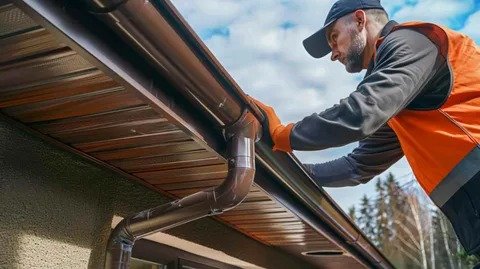

Every Columbia homeowner learns the same lesson eventually: a July thunderstorm can dump an inch of rain in twenty minutes, and whatever your roof can’t shed ends up at your foundation. We’re WW Gutters, and we’ve spent enough time on ladders around the Midlands to know that the right gutter company makes that problem disappear quietly, while the wrong one leaves you with a sagging run of aluminum by next spring.
Gutters are easy to ignore until water finds its way into a crawl space. By then, the repair bill is usually bigger than the gutters ever cost.
What Professional Gutter Installation Actually Involves
A gutter looks like a simple trough, but the job is really about moving a huge volume of water off your roof and away from your house without anything failing along the way. A half-inch of rain on a 2,000-square-foot roof footprint produces roughly 600 gallons of runoff. Every joint, hanger, and downspout has to handle that load.
Quality gutter installation services cover far more than hanging metal. The crew sets the slope, usually about a quarter inch of drop for every ten feet, and fastens hidden hangers into solid fascia every two to three feet. They seal the corners and place each downspout where water can leave cleanly.
Most Columbia homes end up with seamless aluminum, which is rolled on site to your exact lengths so a long run has few joints to leak. Steel stands up to falling limbs better but rusts once the finish scratches. Vinyl tends to crack after a few hard summers. Size matters too: standard 5-inch K-style gutters suit most roofs, while larger or steeper roof planes often need 6-inch troughs.
In Columbia, we’ve noticed that most homeowners blame the gutters when the real culprit is a downspout dumping water beside the slab. The trough does its job, and then the water pools right where it exits.
The Real Challenge in Columbia: Pines, Clay, and Sudden Downpours
The Midlands gets roughly 45 inches of rain a year, and much of it arrives in short, heavy bursts. Summer thunderstorms and the leftovers of tropical systems moving inland from the coast do most of the damage. Loblolly pines shed needles, sweetgum trees drop their spiky balls, oaks add leaves, and every spring a yellow coat of pollen settles over everything. Rain gutter systems in Columbia, SC here get tested constantly.
Then there’s the ground. Much of the area sits on red clay, which drains slowly and sheds surface water instead of absorbing it. Water that lands near a foundation tends to sit, soften the soil, and look for cracks.
A client in Columbia reached out when they noticed mulch washing out from one corner of the house after every storm. From the driveway, the gutters looked fine. Up close, a mat of pine needles had backed water behind the gutter apron and rotted about eight feet of fascia, and the downspout emptied onto packed clay a foot from the foundation. We replaced the board, re-pitched the run, and sent the downspout six feet out, and the mulch stayed put.
Here’s the question most people want answered but few installers raise: won’t new gutters clog just the same? Eventually, yes. Any open trough will. Guards cut the frequency, but pine needles and shingle grit still collect on top, and cheap screens bend under a fallen limb. Budgeting for an annual cleaning, even with guards, costs far less than pretending maintenance isn’t part of the deal.
How WW Gutters Approaches It Differently
We start at the roof, not the gutter line. Before a hanger goes up, we measure the roof’s drainage area, look at the valleys where water concentrates, and press a screwdriver into the fascia to find soft spots. Gutters hung on rotten wood fail within a season, so repairs come first.
From there, sizing follows the roof. A large, steep roof plane sends water off fast enough to overshoot a standard 5-inch gutter. On those sections we often step up to 6-inch troughs with larger downspouts, and we add a downspout near the valley instead of relying on one at the far corner.
The step most gutter content skips is the discharge plan. Where a downspout empties matters as much as the gutter itself, especially on clay. We run extensions at least four to six feet from the foundation, or tie into buried drain lines where the lot slopes toward the house. That adds a little to the estimate and saves a lot in foundation and crawl-space repairs.
Practical Tips: What to Know Before You Decide
A few questions will tell you more about a contractor than any sales pitch:
- Ask for an itemized quote. It should list linear footage, aluminum thickness (.027 is common, .032 is heavier), number of downspouts, and haul-away of the old gutters.
- Ask how rotten fascia is handled. If the price for repairing it isn’t spelled out before work begins, expect a surprise on the day.
- Ask where each downspout will discharge. A vague answer usually means nobody planned it.
- Confirm insurance in writing. Request a current certificate of liability and workers’ compensation coverage, not a verbal assurance.
Working with clients in Columbia, our team found that calls spike after the first big tropical rain in late summer, when everyone discovers the same leak at once. Installers book out for weeks. Scheduling outside that rush, say late winter into spring, usually gets you an earlier install date and more time to compare quotes.
One local tip: many Columbia-area HOAs require approval for gutter color and style, and approvals can take a few weeks. Submit the paperwork before you schedule, not after the materials arrive.
Compare the whole rain gutter systems package rather than the per-foot rate alone. A cheaper quote that skips fascia repair, downspout extensions, or haul-away often ends up costing about the same once those items get added back.
Conclusion
The simplest test costs nothing. During the next heavy rain, watch where every downspout empties and whether water spills over the front edge. If something looks off, WW Gutters can inspect the problem and quote gutter installation and repair for homes across Columbia, SC. Bring a photo of the trouble spot and the age of your roof to the first conversation, and you’ll get a straighter answer faster. Either way, fix the drainage before the next storm, not after.
FAQs
How much does gutter installation cost in Columbia, SC?
Most Columbia homeowners pay roughly $6 to $12 per linear foot for seamless aluminum, which puts a typical house between about $1,200 and $3,500. Steeper roofs, second stories, larger downspouts, and fascia repair push the number up. Ask whether gutter installation services include haul-away and downspout extensions, since those lines vary between quotes.
How do I know a gutter contractor is legitimate?
Ask for proof instead of taking anyone’s word. A legitimate contractor shows a current certificate of liability insurance and workers’ compensation, gives a written estimate with linear footage and materials, and has local job photos and reviews. Check licensing status with the South Carolina Department of Labor, Licensing and Regulation where it applies.
How often should gutters be cleaned around Columbia’s pine and oak trees?
Plan on at least twice a year, typically late spring once pollen season winds down and again in late fall after the leaves finish. Homes under mature pines or oaks often need a third pass. If you see water spilling over the edge during a storm or plants sprouting from the trough, you’ve waited too long.
Are gutter guards worth it?
They help, but they aren’t maintenance-free. Fine-mesh guards block most leaves and pine needles, yet shingle grit and pollen still build up on top and need a brushing or rinse once or twice a year. Skip cheap snap-in screens that bend under limbs, and have an installer confirm they fit your gutter size.
Should I repair or replace my gutters?
Repair works for a loose hanger, a failed seam, or a short sagging section. Replace when gutters are rusted through, pulling away from the fascia in several spots, or pitched wrong along the whole run. If the fascia behind them is soft, fix that first, because new gutters won’t hold on rotten wood.