
Choosing the right college is one of the most important decisions for students who wish to build a successful career in forensic science. With growing awareness of scientific crime investigation, forensic laboratories, and evidence-based research, this field is attracting students from different educational backgrounds. However, selecting a suitable institution requires careful consideration of several factors, including academic quality, practical training, laboratory facilities, experienced faculty, and career opportunities.
Before applying to a college, students should understand what the course offers and how it can help them develop the knowledge and skills required for the forensic science industry.
1. Understand the Course Curriculum
The first thing students should examine is the course curriculum. A good forensic science programme should provide knowledge of scientific principles used in crime investigation and evidence analysis.
Students may learn subjects such as:
- Criminalistics
- Forensic Biology
- Forensic Chemistry
- Forensic Toxicology
- Fingerprint Analysis
- Crime Scene Investigation
- Forensic Psychology
- Digital Forensics
A well-structured curriculum helps students understand how scientific techniques are applied to investigate different types of criminal cases.
2. Check the College’s Academic Reputation
The reputation of an institution is another important factor when selecting a college. Students should research the institution’s academic background, teaching standards, infrastructure, and student support services.
Those searching for the Best Forensic Science College in Tamilnadu should compare institutions based on their educational facilities, practical learning opportunities, faculty experience, and overall academic environment. Rather than choosing a college based only on advertisements, students should gather reliable information before making their decision.
3. Give Importance to Practical Laboratory Training
Forensic science is a practical field where theoretical knowledge alone is not sufficient. Students need opportunities to understand scientific equipment, laboratory procedures, evidence handling, and analytical methods.
A quality educational institution should encourage practical learning through laboratory sessions, demonstrations, experiments, and project-based activities.
Practical exposure helps students develop observation skills, analytical thinking, attention to detail, and scientific problem-solving abilities. These skills are essential when working with physical, biological, chemical, and digital evidence.
4. Understand the Eligibility and Admission Requirements
Before applying, students should understand the eligibility criteria and admission requirements. Many undergraduate forensic science programmes accept students who have completed their higher secondary education, subject to the institution’s admission rules.
Students interested in a Forensic Science Course in Tamilnadu should check the course duration, eligibility, admission procedure, fee structure, and subjects offered by the institution. Understanding these details in advance helps students select a programme that matches their academic interests and future goals.
5. Evaluate Faculty Experience and Teaching Methods
Experienced faculty members play an important role in shaping students’ academic knowledge and professional skills. Teachers with relevant subject knowledge can explain scientific concepts through practical examples and encourage students to develop investigative thinking.
Students should look for institutions that provide interactive teaching methods, individual guidance, practical demonstrations, seminars, and academic support.
A supportive learning environment helps students understand complex forensic concepts and prepares them to handle academic and professional challenges.
6. Explore Career Opportunities After Graduation
Understanding career opportunities is essential before selecting a degree programme. Forensic science graduates can explore different career paths depending on their qualifications, specialisation, additional training, and recruitment requirements.
Some possible career areas include:
- Forensic laboratory assistance
- Crime scene investigation support
- Fingerprint analysis
- Forensic biology
- Forensic chemistry
- Toxicology laboratories
- Digital forensic investigation
- Research and academic support
Students should also understand that certain government forensic positions and specialist roles may require postgraduate qualifications, competitive examinations, or specific eligibility conditions.
7. Compare Course Duration and Degree Recognition
Students should verify whether the degree is offered by a recognised university or an appropriately authorised institution. They should also check the programme’s duration, academic structure, examination pattern, and certification details.
Those looking for a BSc Forensic Science College in India should carefully compare institutions before taking admission. Degree recognition and academic credibility are important considerations for students who wish to pursue higher education or apply for employment opportunities in the future.
8. Consider the Course After Completing 12th
Students who have completed Class 12 often look for career-oriented degree programmes beyond traditional academic options. Forensic science can be an interesting choice for students who enjoy biology, chemistry, scientific research, and investigative problem-solving.
A Forensic Science course After 12th introduces students to scientific methods used in examining evidence and understanding criminal investigations. It can provide a foundation for further studies and career development in forensic science and related disciplines.
Students should review the eligibility requirements, available specialisations, and academic opportunities before choosing their undergraduate programme.
9. Look for Career Guidance and Student Support
Career guidance is another factor worth considering when selecting a college. Students benefit from institutions that provide academic mentoring, communication development, career awareness programmes, project guidance, and information about higher education opportunities.
Personality development and professional skill-building activities can also help students improve their confidence and prepare for future responsibilities.
10. Consider Infrastructure and Learning Environment
A good college should provide a positive academic atmosphere with suitable classrooms, laboratory facilities, learning resources, and student support systems.
Students should check whether the institution encourages research activities, group discussions, practical demonstrations, and academic projects. These learning experiences can help students gain a broader understanding of forensic science.
Conclusion
Choosing the right forensic science college requires more than comparing fees or selecting an institution based on its location. Students should consider curriculum quality, laboratory facilities, faculty experience, practical exposure, degree recognition, and future academic opportunities.
Forensic science offers an interesting educational pathway for students who are passionate about scientific investigation and evidence analysis. By selecting the right institution and developing strong technical and analytical skills, students can build a meaningful foundation for their future.
Begin Your Forensic Science Journey with VMN Institute of Allied Health Sciences
VMN Institute of Allied Health Sciences, Madurai, provides educational opportunities for students interested in building careers in healthcare and allied science fields, including forensic science.
With a focus on academic learning, practical exposure, and student development, the institution aims to help students strengthen their subject knowledge and prepare for future opportunities.
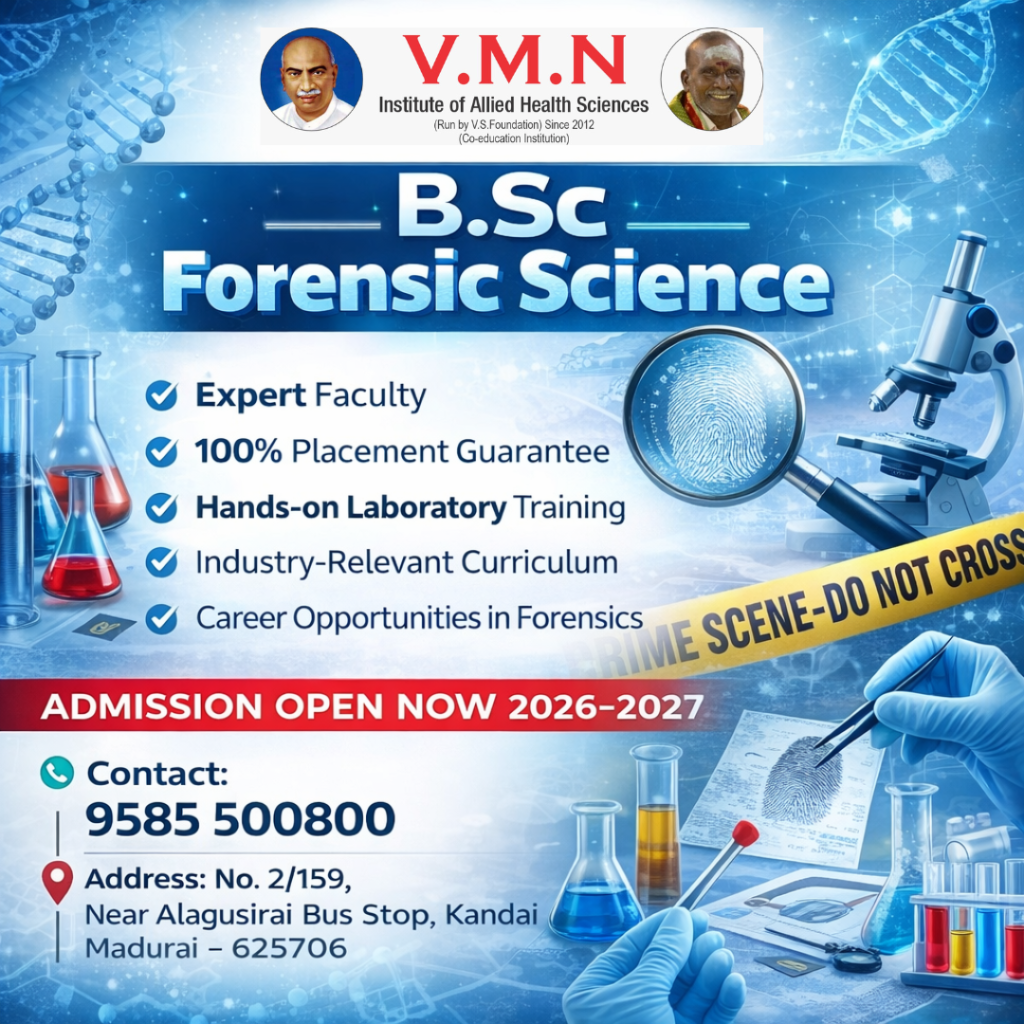
Students interested in pursuing forensic science can explore the B.Sc Forensic Science programme at VMN Institute of Allied Health Sciences and learn more about the admission process.
Website: www.vmninstitutions.com
Mobile Number : 9585 500800