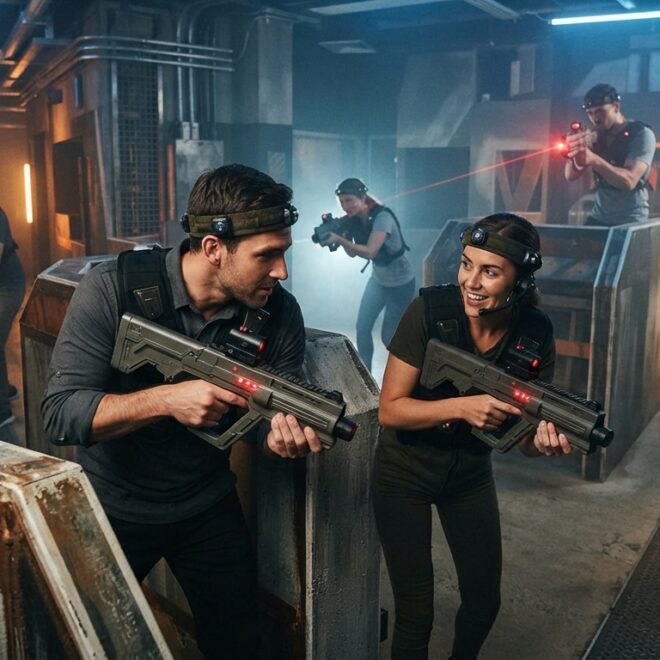

Family entertainment centers often struggle to generate revenue after school hours, leaving valuable floor space underutilized during prime evening slots. Upgrading to heavy-duty commercial laser tag systems allows operators to reposition their indoor arenas as tactical simulation hubs that draw consistent adult leagues, corporate bookings, and weekend nightlife crowds.
While traditional youth parties generate modest ticket revenues, an adult booking yields substantially higher margins through extended playtime, craft concessions, and private lounge rentals. Capturing this demographic requires moving away from neon plastic toys toward authentic weapon dynamics, realistic tagger weight and recoil, and objective-based mission structures.
The Financial Impact of Tapping the Adult Demographic
Adult guests spend money differently than parents booking a two-hour child party. Operators who tailor their schedules and packages to mature players unlock several high-margin revenue streams:
-
Monetizing late-night operational hours. Adult groups routinely book slots between 7 PM and 11 PM on weekdays, turning dead arena downtime into profitable operating windows.
-
Substantial food and beverage cross-selling. Adult players drive significant arena craft beer and dining revenue, purchasing appetizers, craft beer flights, and entree platters between combat sessions.
-
Repeat corporate team sponsorships. Regional companies buy corporate laser tag packages on a quarterly basis, booking full facility buyouts to run inter-departmental tournaments during slower Tuesday and Wednesday evenings.
-
Higher ticket elasticity. Adult birthday and bachelor parties gladly pay premium deposits for private floor access, custom mission playlists, and dedicated referee marshals.
This demographic diversification stabilizes cash flow across all four quarters. Venues that balance daytime family traffic with high-margin evening foot traffic maintain profitable balance sheets even during off-peak school periods.
What Distinguishes Tactical Gaming from Childrens Arcades
Adults quickly lose interest in traditional laser tag arenas that feature blacklights, day-glo wall paint, and chaotic free-for-all scoring. Creating successful adult entertainment center attractions requires delivering a realistic, video-game-style experience on the physical field:
-
Authentic ergonomics. Adults reject toy blasters in favor of realistic tagger weight and recoil that mimic actual modern sporting rifles and tactical carbines.
-
Tactical weapon reloading mechanics. Requiring physical button sequences or magazine eject actions creates authentic pressure, eliminating thoughtless spray-and-pray playstyles.
-
Military simulation acoustics. Directional muzzle audio, authentic suppressed cycling, and heavy caliber firing sounds create psychological tension impossible to achieve with 8-bit arcade beeps.
-
Tactical objective-driven combat. Grown players prefer search-and-destroy, VIP extraction, and domination missions that reward methodical teamwork over frantic playground chasing.
Adding these operational parameters transforms an arcade into an authentic first-person shooter real-life simulation. Players treat the attraction as low-impact active recreation rather than children’s amusement.
Kids Arcade Arenas vs Adult Tactical Facilities
Designing an arena for older demographics shifts your equipment specifications, food offerings, and scheduling architecture. The operational breakdown below contrasts traditional family setups against dedicated adult tactical facilities.
| Operational Metric | Classic Kids Arcade Setup | Adult Tactical Arena |
| Peak Operational Window | Saturday and Sunday afternoons | Weekday evenings and weekend nights |
| Average Spend per Head | $15–$22 (Ticket only) | $45–$75 (Game tickets plus food and beverage) |
| Equipment Expectation | Lightweight plastic phasers | Heavy composite metal-feel taggers |
| Game Pacing | Fast running and respawn chaos | Strategic corner-clearing and role coordination |
| Primary Booking Driver | 7th to 10th birthday parties | Corporate retreats, bachelor parties, and leagues |
| Facility Atmosphere | Blacklights, neon paint, pop music | Low tactical lighting, smoke, soundscapes |
| Secondary Profit Engine | Ticket redemption arcade games | Full kitchen bar and lounge seating |
Running a dual-identity facility allows operators to maximize return on invested capital. Centers can service youth parties on weekend mornings, then adjust ambient lighting and software profiles to host competitive indoor tactical games by nightfall.
Engineering Requirements for Competitive Indoor Tactical Games
Adult tactical laser tag demands hardware that withstands aggressive movement and delivers pinpoint accuracy across long corridors. Commercial laser tag systems engineered for adults utilize precision optical collimators that focus infrared beams into tight, realistic projectile cones.
Tight optical focus prevents the sloppy, wide-beam hits typical of toy gear. When an adult steps behind a structural barrier, their exposed shoulder or rifle barrel remains a valid target, rewarding marksmanship while eliminating false hits.
Radio-frequency mesh networks sync hit data across the arena within milliseconds. When a player takes a hit, the blaster vibrates forcefully, disables trigger actuation, and updates lobby scoreboards instantly without network lag or dropped packets.
Turning Casual Adult Gamers into Competitive League Members
Building long-term customer lifetime value requires converting one-time weekend visitors into recurring weekly league competitors. Competitive tournament ladders create community loyalty and guarantee consistent weekday venue utilization.
Operators can build thriving league ecosystems by implementing clear operational steps:
-
Scheduling dedicated league nights. Hosting structured eight-week tournament brackets on Wednesday evenings fills arena capacity during traditionally slow operational slots.
-
Integrating mobile stat tracking. Modern software platforms allow players to create personal digital profiles that track headshot accuracy, win-loss records, and kill-death ratios on their phones.
-
Awarding tangible sponsor prizes. Partnering with local craft breweries and sporting goods retailers provides compelling prizes for championship teams, increasing local media buzz.
-
Balancing player roles. Software-driven class loadouts—such as medics, snipers, and heavy support gunners—force teams to develop sophisticated squad strategies rather than relying on individual speed.
When players view your venue as a competitive sport rather than a party venue, customer churn drops significantly. Regular league members recruit colleagues and friends, generating free word-of-mouth client acquisition.
Food, Beverage, and Hospitality Integration
Adults expect quality hospitality alongside active entertainment. Centers that rely on soda dispensers and frozen pizza miss out on substantial auxiliary profit margins that often exceed ticket revenue.
Installing a dedicated craft bar adjacent to the briefing area encourages guests to socialize before and after matches. A player sipping a local IPA while reviewing match analytics on digital lounge displays stays in your building longer and spends more money.
High-end catering menus also appeal to corporate event organizers. Offering plated dinner packages and private meeting rooms turns tactical laser tag for adults into an all-inclusive corporate destination.
Frequently Asked Questions About Adult Tactical Laser Tag
Why Do Adults Prefer Tactical Laser Tag Over Real Paintball
Adults prefer optical simulation because it eliminates physical pain, bruising, welt marks, and messy clothing stains. Office workers and corporate executives cannot risk bruised faces, sprained fingers, or ruined clothes before Monday morning client meetings.
Optical combat delivers realistic tactical tension and team strategy without requiring hot, fogging face masks or painful physical impacts.
What Is the Optimal Group Size for Corporate Adult Matches
The ideal match size ranges between 10 and 20 active combatants on the arena floor at one time. Groups of 12 to 16 players allow for balanced five-on-five or eight-on-eight objective missions that require tactical communication without overcrowding corridors.
For enterprise events with 50 to 100 employees, marshals run structured round-robin brackets, rotating fresh teams through eight-minute heats while spectating squads socialize in the lounge.
Can Venues Host Kids by Day and Adults by Night Using the Same Gear
Commercial management software allows operators to reconfigure hardware settings in seconds from an administrative tablet. During afternoon birthday parties, staff configure blasters with unlimited ammunition, wide beam spreads, and arcade sound effects.
When evening adult groups arrive, operators switch gear profiles to tactical simulation modes featuring limited magazine capacities, realistic recoil audio, and realistic reload cycles.
How Important Is Arena Lighting for the Adult Demographic
Atmosphere directly influences how mature audiences perceive the attraction. Adults dislike garish blacklights, glow-in-the-dark fluorescent murals, and chaotic strobe lights that scream children’s play center.
Adults respond better to muted tactical lighting, industrial metal walls, focused directional spotlights, and theatrical fog effects that feel like an authentic abandoned compound or urban combat zone.
Capturing the Lucrative Adult Entertainment Market
Expanding into tactical laser tag for adults offers commercial entertainment operators an effective method for boosting revenue per square foot. By introducing realistic equipment, objective game modes, and adult hospitality services, venues capture corporate budgets and vibrant evening traffic that traditional arcades cannot reach.
Investing in commercial laser tag systems built for durability and optical precision ensures that your attraction delivers tournament-grade fairness and immersion. Balancing energetic daytime birthday bookings with high-margin evening tactical events maximizes facility capacity, cuts customer acquisition costs, and builds a resilient, highly profitable entertainment business.