


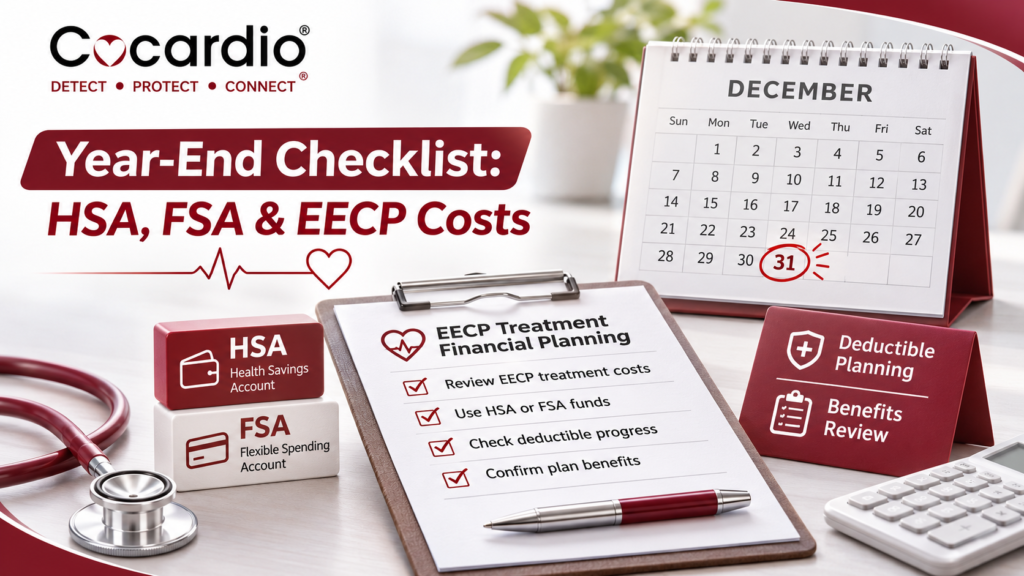

As December 31 approaches, many Americans review their health insurance deductibles, flexible spending account balances, and remaining medical expenses before the new year begins. For patients exploring cardiovascular treatment options, understanding EECP therapy cost is an important part of planning ahead without making assumptions about insurance coverage or tax benefits. Enhanced external counterpulsation may be considered for selected individuals with chronic angina, but treatment eligibility and payment arrangements require separate conversations. A practical year-end checklist can help patients organize financial questions, confirm benefit deadlines, and make informed decisions without rushing into unnecessary medical services.
At CoCardio®, patients receive individualized screening before discussing an appropriate ECP/EECP® treatment course. The Encinitas, California, practice operates on a cash-pay basis and does not bill insurance for consultations, ECP sessions, or preventive cardiovascular wellness services. Eligible HSA and FSA payments may be accepted, depending on the patient’s plan and the applicable rules. This guide explains what to check before December 31, 2026, including deductible status, HSA contributions, FSA deadlines, treatment estimates, and planning for 2027.
EECP Therapy Cost and What to Check Before December 31
Year-end financial planning should begin by separating three different questions: what the treatment costs, whether insurance provides any coverage, and whether tax-advantaged account funds may be used. These questions are related, but the answers do not necessarily affect one another. Reaching an annual health insurance deductible does not automatically make an otherwise uncovered or cash-pay service eligible for reimbursement. Patients should confirm the financial arrangements directly with the provider and their insurer or benefits administrator before making commitments.
Why December 31 Matters
Many health insurance plans operate on a calendar-year basis, meaning deductibles and certain out-of-pocket accumulators reset on January 1. However, some employer plans follow different benefit years, and not all medical services count toward a deductible. Health FSAs may also have year-end spending deadlines, subject to any permitted carryover or grace-period provisions. Reviewing the actual plan documents is therefore more reliable than assuming every account follows the same deadline.
1. Check Your 2026 Health Insurance Deductible
A deductible is the amount an insured person may need to pay for certain covered healthcare services before the insurer begins paying according to the plan’s terms. The amount varies by policy, and some services may have different cost-sharing arrangements. Patients can review their insurer’s website, benefits portal, or recent Explanation of Benefits statements to understand their current deductible status. However, an EOB is not a price quote or a guarantee of payment for future services.
Understand What Happens After Meeting Your Deductible
Meeting a deductible does not necessarily mean that all subsequent care is free. Copayments, coinsurance, network restrictions, medical necessity requirements, and exclusions may still apply. Some services are not covered at all, regardless of the patient’s deductible status. Patients should obtain written or documented confirmation when they are uncertain about how a particular service is handled.
Do Not Assume Deductible Savings Apply at CoCardio®
CoCardio® does not submit insurance claims for its consultations, ECP/EECP® sessions, or preventive wellness offerings. Therefore, reaching a deductible or out-of-pocket maximum should not be interpreted as reducing the price of treatment at CoCardio®. Patients remain responsible for the agreed cash-pay charges regardless of their insurance accumulators. Separate medical services obtained through other providers may have their own coverage and deductible rules.
2. Review Your Health Savings Account Balance
A Health Savings Account, or HSA, is a tax-advantaged account that eligible individuals can use to pay or reimburse qualifying medical expenses. Unlike a typical health FSA, unused HSA funds generally remain available in future years rather than expiring on December 31. This makes an HSA useful for longer-term healthcare planning when the account holder meets the applicable eligibility and tax requirements. However, possessing an HSA does not automatically establish that every cardiovascular wellness service is a qualified medical expense.
Understand the 2026 HSA Contribution Limits
For 2026, the IRS established an HSA contribution limit of $4,400 for eligible individuals with self-only coverage and $8,750 for eligible individuals with family coverage. Eligible account holders who are at least 55 years old may generally make an additional $1,000 catch-up contribution. Actual contribution eligibility and limits can depend on qualifying coverage, enrollment periods, employer contributions, and other circumstances. Patients should confirm their permitted contributions with their HSA administrator or tax professional before adding funds.
Know That HSA Contributions May Continue Into 2027
Eligible taxpayers generally have until April 15, 2027, to make contributions designated for the 2026 tax year, subject to applicable rules and exceptions. This means December 31, 2026, is not automatically the final opportunity to contribute for 2026. However, payroll arrangements and individual eligibility may introduce additional considerations. Patients should distinguish the contribution deadline from the separate question of whether a particular treatment expense qualifies for tax-free payment.
Confirm Whether EECP Expenses Qualify
IRS rules generally permit tax-free HSA distributions for qualified medical expenses that meet the applicable statutory requirements. Expenses for general health or wellness do not automatically qualify simply because a healthcare business offers the service. The treatment’s medical purpose, documentation, account rules, and individual circumstances may affect eligibility. Patients should seek confirmation from their HSA administrator or qualified tax professional before assuming a proposed payment will receive favorable tax treatment.
3. Check Your Flexible Spending Account Deadline
A health Flexible Spending Account, or FSA, generally allows eligible employees to use designated pretax funds for qualifying medical expenses. Unlike an HSA, the account usually operates under a use-it-or-lose-it rule unless the employer’s plan offers an approved exception. Some plans permit a limited carryover into the following plan year, while others provide a grace period for incurring additional expenses. A plan cannot generally offer both the health FSA carryover and grace-period options for the same plan year.
Find Your Actual FSA Spending Deadline
Start by reviewing the benefits documentation provided by your employer or FSA administrator. Determine whether the plan ends on December 31 and whether it includes a carryover or grace period. Also check the claims submission deadline, which may extend beyond the final date on which an eligible expense can be incurred. These two deadlines are not necessarily the same.
Check Carryover and Grace-Period Rules
For plans beginning in 2026, the maximum permitted health FSA carryover is $680 when the employer adopts the applicable carryover provision. An employer may choose a lower limit or provide no carryover at all. A qualifying plan may instead offer a grace period of up to two and a half months after the plan year ends. Employees should not assume that the maximum IRS allowance is automatically included in their benefits.
Avoid Rushed Medical Decisions
Unused FSA funds can create pressure to schedule services before the year ends. However, financial deadlines should not determine whether a patient receives a cardiovascular treatment that has not been clinically recommended. Consultation, screening, and appropriate medical oversight remain essential before beginning a treatment course. Patients can use the deadline to organize questions and confirm eligibility without assuming that immediate treatment is necessary.
4. Request a Written Estimate for the Full EECP Course
Understanding EECP therapy cost requires more than asking about the price of a single appointment. Patients should clarify whether the estimate includes an initial consultation, screening, the recommended number of sessions, and any separately charged services. A complete treatment course can involve multiple visits over several weeks, making scheduling and total expense important considerations. Written estimates help patients evaluate the commitment before deciding whether to proceed.
What Should the Estimate Include?
Ask whether screening is included in the quoted amount and how the treatment course is structured. Confirm the expected session schedule, cancellation policies, payment arrangements, and any additional fees that may apply. The provider should explain what happens if treatment is not recommended after screening or if the patient cannot complete the course. These details support informed financial consent without promising a particular clinical result.
Why Treatment Duration Matters
A commonly studied EECP course involves approximately 35 one-hour sessions over about seven weeks. However, the recommended arrangement depends on the patient’s clinical circumstances and the treating provider’s evaluation. Multiple visits can create practical costs involving transportation, missed work, or caregiver assistance. Patients should consider these indirect expenses when developing a realistic budget.
5. Understand When EECP May Be Clinically Appropriate
EECP is a noninvasive treatment in which inflatable cuffs around the lower body apply pressure synchronized with the cardiac cycle. The therapy may be considered for certain patients with refractory chronic angina after appropriate clinical evaluation. It is not an emergency treatment for a heart attack and does not replace medications or indicated cardiac procedures. Patients should discuss symptoms, medical history, and safety considerations with qualified healthcare professionals before proceeding.
Angina and Treatment Eligibility
Evidence-based recommendations recognize a possible role for eecp therapy for angina in selected individuals with refractory symptoms who have no other treatment options. However, symptom improvement varies, and the treatment is not appropriate for every cardiovascular condition. Screening may identify concerns involving circulation, heart rhythm, valve disease, or other medical factors. Financial preparation should follow, not replace, an appropriate assessment of clinical suitability.
Why Treatment Should Never Be Rushed
A year-end spending deadline is not a reason to delay emergency assessment or discontinue established medical care. New or worsening chest pain, symptoms at rest, or discomfort accompanied by concerning warning signs may indicate an acute cardiac emergency. If a heart attack is possible, call 911 immediately rather than arranging an outpatient treatment consultation. Elective cardiovascular services should be considered only when urgent conditions have been appropriately addressed.
6. Compare Local EECP Providers Carefully
Patients searching for EECP therapy near me may find providers with different screening procedures, treatment arrangements, and payment policies. A useful comparison should address medical oversight, experience, equipment, treatment schedules, and realistic expectations. Price matters, but it should not be evaluated separately from safety and clinical suitability. Patients should avoid providers promising guaranteed relief or claiming that EECP removes coronary plaque.
Questions to Ask Before Choosing a Center
Ask who evaluates medical eligibility and how the treatment team coordinates with existing cardiology care. Confirm whether the expected course involves multiple weekly sessions and whether follow-up appointments are included. Request information about treatment limitations, possible adverse effects, and the circumstances under which treatment may need to stop. Transparent answers are more valuable than promotional claims about universal outcomes.
Planning for 2027 Appointments
Someone searching for ECP therapy near me late in December may be considering treatment during the following year. Booking arrangements should reflect medical readiness, appointment availability, transportation needs, and the individual’s financial circumstances. Starting before December 31 is not necessarily beneficial when the recommended course extends into January or February. Patients should confirm which expenses belong to which benefit year before relying on FSA reimbursement assumptions.
7. Understand the Difference Between ECP and EECP Terminology
The terms ECP and EECP are frequently used when discussing external counterpulsation. The treatment involves sequential compression of the lower extremities to influence circulation during the cardiac cycle. People researching ecp therapy should focus on the actual treatment protocol, clinical indications, provider qualifications, and available evidence rather than terminology alone. The provider should explain the equipment being used and the intended role of treatment in the patient’s care.
What Patients Should Verify
Ask whether the provider offers the type of counterpulsation treatment being considered and how treatment eligibility is determined. Determine whether the proposed course follows established clinical protocols relevant to the patient’s condition. Review the provider’s approach to monitoring, patient comfort, and communication with treating clinicians. A clear explanation should avoid portraying ECP/EECP® as a cure for coronary artery disease.
8. Build a Year-End Heart Care Budget
A useful healthcare budget separates covered insurance expenses, cash-pay services, and potentially eligible HSA or FSA expenses. This prevents patients from confusing insurance reimbursement with tax-advantaged payment arrangements. Patients should also consider deductibles, copayments, ongoing prescriptions, and necessary follow-up care when planning their finances. A written budget can help identify which questions require confirmation before an appointment is scheduled.
A Practical Budget Worksheet
Expense or question
Amount or status to confirm
Remaining 2026 insurance deductible
Check insurer portal
2026 out-of-pocket maximum status
Confirm eligible covered expenses
Available HSA balance
Check account administrator
FSA balance and spending deadline
Review employer plan
Initial consultation charge
Request provider estimate
Recommended course and session charges
Confirm after screening
Transportation and time commitments
Estimate personally
Eligibility for HSA/FSA payment
Confirm with administrator
Planned 2027 medical expenses
Include in next-year budget
This worksheet is intended for financial organization rather than medical decision-making. A patient may have available HSA funds but still need confirmation that a particular service qualifies for tax-advantaged payment. Similarly, meeting an insurance deductible does not establish coverage for a cash-pay treatment. Keeping these distinctions clear can help prevent avoidable financial misunderstandings.
9. Your December 31 Health Benefits Checklist
Before the end of 2026, review your actual insurance and benefits documents rather than relying on general assumptions. Contact the relevant administrators when a deadline, reimbursement rule, or expense classification remains unclear. If you are considering elective cardiovascular treatment, obtain appropriate clinical advice before committing to a course. Use the following checklist to organize the remaining tasks.
Year-End Action Checklist
Confirm whether your health insurance benefit year ends December 31.
Check your remaining deductible and out-of-pocket maximum.
Verify which services are covered and which are excluded.
Review your current HSA balance and contribution eligibility.
Check the 2026 HSA contribution deadline.
Confirm your FSA’s final expense date and claim submission deadline.
Determine whether your FSA permits a carryover or grace period.
Verify HSA/FSA eligibility for any proposed cardiovascular service.
Request a written treatment estimate before making payment commitments.
Discuss medical suitability with an appropriate healthcare professional.
Plan transportation and appointment availability for any recommended course.
Retain relevant receipts and documentation for benefits administration.
Completing these checks can improve financial clarity without creating unnecessary pressure to schedule treatment. Not every patient will need every item, particularly those without employer-sponsored benefits or tax-advantaged accounts. The most important decisions depend on medical necessity, individual eligibility, and documented payment terms. Patients should keep copies of relevant confirmations for their records.
10. Educational Resources for Planning Your Next Steps
Patients may benefit from understanding treatment procedures and preparing questions before contacting a provider. Educational resources can explain typical appointment schedules, treatment sensations, screening requirements, and realistic outcomes. However, general patient guides cannot determine whether a service is clinically appropriate or financially eligible for an individual. They should support conversations with healthcare professionals and benefits administrators.
Prepare for a Treatment Consultation
CoCardio® provides a patient-oriented resource addressing what to expect before, during, and after an EECP course. It can help readers understand common appointment procedures and questions they may want to raise during consultation. Download the Free EECP Treatment Patient Guide for a general overview of the treatment process. The guide is educational and does not establish insurance coverage, HSA/FSA eligibility, or an individualized treatment recommendation.
Plan for the New Year
The ECP Therapy Near Me – 2027 Patient Planner can be used as a reference when organizing provider questions, scheduling requirements, and treatment-related expenses. Patients should verify all financial information with their own plan administrators and the provider offering care. Any planned medical treatment should remain subject to appropriate screening and clinical recommendations. Planning tools are most useful when they help patients prepare rather than encourage premature treatment decisions.
Frequently Asked Questions
Does Meeting My 2026 Deductible Make EECP Free?
No, reaching a deductible does not automatically make a service free or eligible for coverage. Insurance plans may still apply coinsurance, copayments, exclusions, and other requirements. CoCardio® does not bill insurance for its consultations, ECP sessions, or preventive wellness services. Patients should obtain a cash-pay estimate directly from the practice.
Can I Use HSA Funds for EECP?
HSA funds may be used tax-free for qualified medical expenses under applicable IRS rules. Whether a specific EECP service qualifies depends on the expense’s medical purpose and relevant circumstances. CoCardio® may accept eligible HSA payments, but acceptance alone does not establish tax eligibility. Patients should confirm the rules with their HSA administrator or qualified tax professional.
Do Unused HSA Funds Expire on December 31?
No, unused HSA balances generally remain in the account for future qualified medical expenses. Eligibility for making new contributions is separate from the ability to use an existing balance. The IRS generally allows eligible contributions for a tax year until the following year’s federal tax filing deadline, without extensions. Patients should verify their individual eligibility and applicable contribution limits.
Will I Lose My FSA Balance After December 31?
That depends on the employer’s plan and its applicable plan-year dates. Some health FSAs offer a permitted carryover or grace period, while others require expenses to be incurred by the end of the plan year. The deadline for submitting reimbursement claims may differ from the deadline for incurring expenses. Contact your FSA administrator for the exact rules.
Should I Start EECP Before the Year Ends to Use My Benefits?
Not solely for financial reasons. Treatment should follow appropriate medical evaluation and a discussion of expected benefits, limitations, and possible risks. The expense must also qualify under the relevant account rules before favorable tax treatment can be assumed. A year-end deadline should never override clinical suitability or patient safety.
Conclusion
Year-end healthcare planning can help patients understand their deductible status, preserve appropriate financial records, and review HSA or FSA options before December 31. However, EECP therapy cost must be evaluated separately from insurance coverage, especially when considering a cash-pay provider such as CoCardio®. Available tax-advantaged funds do not guarantee that a service qualifies for reimbursement, and unused HSA balances generally remain available beyond the calendar year. The most useful plan combines clear financial information, realistic treatment expectations, and a medical evaluation before any commitment.
CoCardio® provides ECP/EECP® services and preventive cardiovascular wellness consultations for appropriately screened individuals in Encinitas, California. The practice emphasizes individualized care, coordination with existing medical providers, and transparent discussion of treatment limitations. Patients planning for 2027 can contact the team to clarify screening requirements, scheduling, and applicable cash-pay charges. For nonemergency inquiries, visit CoCardio® or call (858) 500-1399.
Medical Disclaimer
This article is provided for general educational purposes and does not constitute medical, insurance, legal, or tax advice. ECP/EECP® is not appropriate for everyone, does not cure coronary artery disease or remove plaque, and must not replace prescribed medication, indicated procedures, cardiac rehabilitation, or emergency treatment. If you develop new, severe, persistent, or worsening chest discomfort or symptoms suggesting a heart attack, call 911 immediately rather than seeking an outpatient consultation. CoCardio® operates as a cash-pay practice and does not bill insurance for consultations, ECP sessions, or preventive wellness services. HSA/FSA eligibility depends on applicable tax rules, the patient’s individual circumstances, and plan administration requirements; patients should obtain professional guidance before relying on any reimbursement or tax treatment.


