
Introduction
A team needs 45 runs off the last three overs, with seven wickets in hand. Is that easy, or is it impossible? The answer depends on the maths: the required run rate, the wickets in hand, and who is bowling.
This guide explains how T20 teams plan a chase, from the first ball to the last. It covers the required run rate, wickets in hand, the three phases of a chase, and the roles of the anchor and the aggressor. Fans who follow the game with a SkyExchange ID will find it easier to follow a T20 match when they know how a chase is planned.
The Equation: Runs, Balls and Wickets
Every chase starts with an equation: runs needed, balls left, and wickets in hand. If a team needs 180 runs in 20 overs, the required run rate is nine runs per over. If it scores slower, the required run rate goes up.
The Required Run Rate: Runs Needed Divided by Overs Left
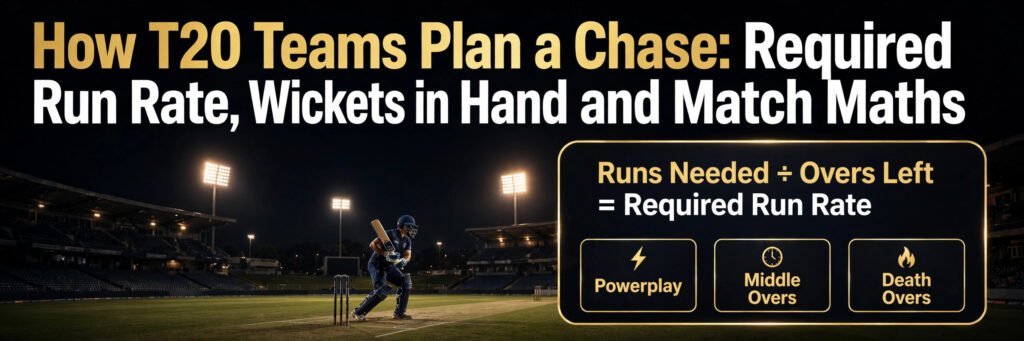
The required run rate is runs needed divided by overs remaining. If a team needs 45 runs off 18 balls, the required run rate is 15 runs per over. If a team needs 30 runs off 30 balls, the required run rate is six. If a team needs 12 runs off six balls, the required run rate is 12.
The required run rate changes after every ball. A boundary lowers it. A dot ball raises it. A wicket raises it, because a new batter takes time to get set. That is why fans watch it so closely in the last few overs: it is the number that decides the match.
Wickets in hand are the other half of the equation. A team with eight wickets in hand and 10 overs left has more resources than a team with three wickets in hand and 10 overs left. A team with wickets in hand can take risks, while a team with few wickets left must protect its batters.
The Three Phases: Powerplay, Middle Overs and Death Overs
A chase has three phases, and each one has a different job. The powerplay, overs one to six, is for scoring fast, because only two fielders are outside the 30-yard circle. The middle overs, overs seven to 15, are for building the chase and targeting the weaker bowlers. The death overs, overs 16 to 20, are for finishing.
The Powerplay: Score Fast, Lose No Wickets
In the powerplay, the chasing team tries to score fast without losing wickets. It knows that only two fielders are outside the circle, so it hits over the infield and through the gaps. But losing wickets in the powerplay is costly, because a new batter takes time to get set.
The best example was in Wellington, on 27 October 2026, against New Zealand. India were chasing 199, and Abhishek Sharma scored 113 off 38 balls, with a hundred in 35 balls. He and Vaibhav Sooryavanshi, who scored 45 off 19 balls, put on 133 runs for the first wicket in seven overs. India scored 118 for no wicket in the powerplay, a record for India, and they won by six wickets in 13.2 overs.
The Middle Overs: Rotate, Target, Build
In the middle overs, the chasing team rotates the strike, targets the weaker bowlers, and builds the chase. It does not try to hit every ball for six, because the field is spread out and the boundaries are protected. It takes singles and twos, hits the bad balls for four, and keeps the required run rate under control.
The middle overs are also where teams target bowlers. If a team has a weak fifth bowler, the chasing team will attack him, scoring 15 or 20 runs off his over. If a team has a strong bowler, like Jasprit Bumrah, the chasing team will play him out instead.
The Death Overs: Boundaries, Nerve and the Last Over
In the death overs, the chasing team needs boundaries, nerve, and a plan for the last over. It knows that the bowling team will bowl yorkers, slower balls, and wide yorkers. The best chases finish in the death overs with wickets in hand.
The 2026 T20 World Cup semi-final is the best example of a chase that failed in the death overs. England needed 254 to win, after India scored 253 for seven. Jacob Bethell scored 105 off 48 balls, and England needed 45 runs off the last three overs. Bumrah bowled the 18th over for six runs, with three pinpoint yorkers, which left England needing 39 runs off two overs, at a required run rate of 19.5. Hardik bowled the 19th over for nine runs, which left England needing 30 runs off the final over. England scored 246 for seven, and India won by seven runs.
Wickets in Hand: The Resource That Matters Most
Wickets in hand are the resource that matters most in a chase, because they give a team freedom. A team with eight wickets in hand can take risks, hit boundaries, and recover from a bad over. A team with three wickets in hand cannot take risks. That is why teams protect their wickets in a chase, even if it means scoring slowly for a few overs.
The value of wickets in hand is clearest in the last few overs. A team that needs 30 runs off the last over, with eight wickets in hand, can hit every ball for six. A team that needs 30 runs off the last over, with two wickets in hand, cannot.
Wickets in hand also matter for net run rate. A team that chases a target quickly, with wickets in hand, improves its net run rate, because it scores the same runs in fewer overs.
The Anchor and the Aggressor: Two Roles in a Chase
Every successful chase has two roles: the anchor and the aggressor. The anchor stays in, rotates the strike, and holds the innings together. The aggressor attacks, hits boundaries, and scores fast. Together, they make a partnership that wins matches.
The best example was the WPL 2026 final, on 5 February 2026, at Vadodara. Delhi Capitals scored 203 for four, and Royal Challengers Bengaluru needed 204 to win. Smriti Mandhana scored 87 off 41 balls, and Georgia Voll scored 79 off 54 balls, and they put on 165 runs together. Mandhana was the aggressor, while Voll was the anchor. RCB won by six wickets in 19.4 overs, with 204 for four, the highest successful chase in WPL history.
In the 2026 semi-final, Samson was the anchor for India, scoring 89 off 42 balls, while Dube and Kishan were the aggressors around him. In the chase, Bethell was the aggressor for England, scoring 105 off 48 balls, but he had no anchor.
Why Teams Prefer to Chase
Most T20 teams prefer to chase, and they usually choose to bowl first when they win the toss. When you chase, you know the target: how many runs you need, how many overs you have, and what required run rate you must score at. When you bat first, you do not know what a good total is.
Dew is the other reason. In evening matches in India, dew settles on the outfield after about 8:30 pm, which makes the ball wet and hard to grip. The bowling team struggles to grip the ball, and the batting team finds it easier to hit boundaries. That is why teams that chase in the evening have an advantage.
When a Chase Goes Wrong
A chase goes wrong in three ways. The first is losing wickets in the powerplay. A team that loses three wickets in the powerplay has lost its best batters, and it must rebuild in the middle overs. The required run rate climbs while the new batters get set. The second is scoring slowly in the middle overs, which leaves too many runs for the death overs. The third is panicking in the death overs, trying to hit every ball for six, losing wickets, and being bowled out with overs to spare.
The 2024 T20 World Cup final is the best example of a chase that went wrong. India scored 176 for seven, and South Africa needed 177 to win. South Africa were well placed, but they lost wickets in the death overs, and Hardik Pandya defended 16 runs in the final over. South Africa scored 169 for eight, and India won by seven runs.
A chase also goes wrong when a team does not plan. A team that does not know its required run rate, does not know which bowlers to target, and does not know who its anchor is, will lose matches. A team that plans its chase, in phases, with roles, and with wickets in hand, will win matches.
How Fans Followed a Chase With a SkyExchange ID
A chase is the part of a T20 match that fans watch most closely, because it decides the match. A fan who checks in after the chase has missed the most important part.
A SkyExchange ID online is one way fans kept up with the live scorecard and the key moments in each match. Live updates mattered in a T20 match, when the score changed every ball and the required run rate changed every over.
A SkyExchange login is the step fans use to access their account and check the latest match information. Once logged in, they could see the teams, the score, and the updates that mattered. Fans should only use official platforms and keep their account details private.
Using a SkyExchange ID Online to Follow Live Matches
Fans can follow a match from anywhere, whether they are at home, travelling, or watching with friends. In a T20 match, that matters most in a chase, when the score changes every ball and the required run rate changes every over. Live updates helped them catch the key moments: a big over, a wicket, or a last over that decided the match.
SkyExchange Login: Checking Scores, Squads and Updates
It is a simple, familiar process for people who follow cricket online regularly. For each game, that meant checking the playing eleven before the toss, following the live scorecard, and reading the match summary afterwards.
The Verdict: A Chase Is Maths, Not Magic
So, how do T20 teams plan a chase? They start with the equation: runs needed, balls left, and wickets in hand. They calculate the required run rate, and they keep it under control. They plan in three phases: score fast in the powerplay, build in the middle overs, and finish in the death overs. They keep wickets in hand, and they share the job between an anchor and an aggressor.
A chase is maths, not magic. A team that does the maths wins matches. In Wellington, India did the maths, scored 118 for no wicket in the powerplay, and won in 13.2 overs. In the 2026 semi-final, England needed 45 runs off the last three overs, and lost by seven runs.
FAQs
What is required run rate in a chase?
Required run rate is runs needed divided by overs remaining. If a team needs 45 runs off 18 balls, the required run rate is 15 runs per over. It changes after every ball.
Why do wickets in hand matter in a chase?
Wickets in hand give a team freedom to take risks. A team with eight wickets in hand can hit boundaries and recover from a bad over, while a team with three wickets in hand must protect its batters.
What are the three phases of a T20 chase?
The three phases are the powerplay (overs one to six), when the team scores fast because only two fielders are outside the circle; the middle overs (overs seven to 15), when the team rotates the strike and targets weaker bowlers; and the death overs (overs 16 to 20), when the team needs boundaries to finish.
What is the anchor and the aggressor in a chase?
The anchor is the batter who stays in, rotates the strike, and holds the innings together. The aggressor is the batter who attacks, hits boundaries, and scores fast. Together, they make a partnership that wins matches, like Mandhana and Voll’s 165-run stand.
How did fans follow a chase and live scores online?
Many fans followed live scores on their phones. A SkyExchange ID online helped supporters check the live scorecard and key moments in one place, while a SkyExchange login gave them access to follow updates during the match.
Conclusion
How T20 teams plan a chase is simple: start with the equation, calculate the required run rate, keep wickets in hand, and plan in three phases. Score fast in the powerplay, build in the middle overs, and finish in the death overs. Share the job between an anchor and an aggressor.
A chase is maths, not magic. A team that does the maths, like India in Wellington, wins in 13.2 overs. A team that does not, like England in the 2026 semi-final, loses by seven runs. Fans will be watching the next T20 match, following live updates with a SkyExchange ID, and checking the required run rate after every ball.