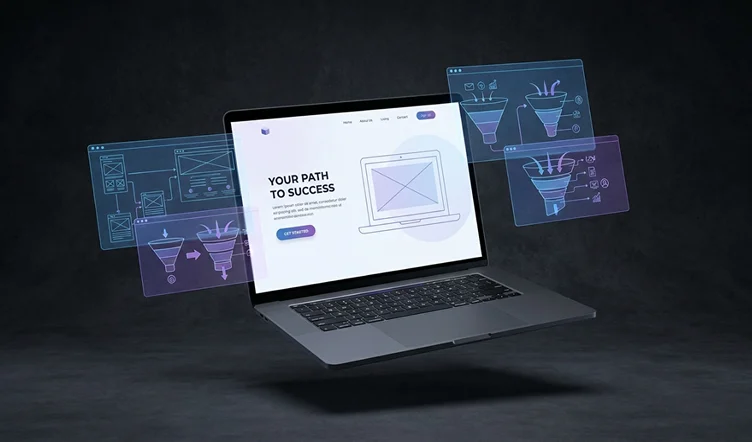

Getting people to your website is honestly the easy half. If they show up and leave without calling, filling out a form, booking a consultation, or requesting a quote — that marketing budget’s just gone, essentially wasted. This trips up a lot of businesses running Google Ads, social campaigns, or SEO work.
Lead generation landing pages Saudi Arabia businesses build give visitors a focused page built around one specific action. Get the offer, message, form, trust signals, and mobile experience right, and suddenly targeted traffic actually turns into real leads instead of just bouncing off.
What Actually Is a Lead Generation Landing Page?
It’s a dedicated page built to get visitors to share their contact info, or take some other valuable next step.
Unlike a normal website page, a landing page usually zeroes in on one goal. Could be promoting:
- A free consultation
- A service quote
- A product demo
- A downloadable guide
- A limited-time offer
- A free assessment
- An appointment
- A callback request
A Saudi IT company running Google Ads for cybersecurity services, for example, could send visitors to a page specifically about cybersecurity assessments. Instead of asking people to hunt through the whole site, the page explains the service, shows real proof it works, and offers a simple form to request the assessment.
That kind of focus cuts distractions and makes the next step obvious.
Why This Actually Matters for Saudi Businesses
A lot of businesses just send paid traffic straight to the homepage. Homepages are fine for general browsing, sure — but they’re rarely the right destination for a specific campaign.
Someone searching “business automation services in Riyadh” has a very specific need in mind. If the ad promises a business automation consultation and then dumps them on a generic homepage, they’re stuck hunting for the actual service they clicked for.
A dedicated landing page matches that intent a lot more closely.
Lead generation landing pages Saudi Arabia tend to work especially well for:
- Digital marketing agencies
- IT service providers
- Real estate companies
- B2B service companies
- Healthcare providers
- Education businesses
- Financial service companies
- Consultants
- Local professional services
A Jeddah real estate company, for example, could build separate landing pages for buyers, investors, and commercial clients — each speaking to a different audience instead of one generic message trying to cover everyone at once.
What Actually Makes a Landing Page Convert
A good landing page doesn’t need a dozen fancy design elements. It needs the right information, in the right order.
A Headline That’s Actually Clear
The headline should tell visitors instantly what they’re getting.
Skip:
“Welcome to Our Company”
Go with something specific instead:
“Request a Free Website Performance Assessment”
People should understand the offer without reading past the first line.
Copy That Actually Supports the Offer
Explain the problem you solve and what visitors can actually expect. Keep paragraphs short, focus on real benefits — not vague, unsupported claims that sound nice but say nothing.
A CTA That Actually Says Something
Use something clear:
- Request a Free Consultation
- Get Your Quote
- Book an Appointment
- Request a Demo
- Talk to an Expert
Skip vague buttons like “Submit” when a more descriptive action would genuinely help conversion.
A Form That’s Actually Simple
Only ask for what you genuinely need. A form asking for name, phone, email, company, job title, address, industry, budget, and five other fields discourages people from ever finishing it.
For a basic consultation, you probably just need:
- Name
- Business email or phone
- Service needed
- Optional message
Ideal form length really depends on how valuable the offer is and what quality of lead you’re actually after.
Trust Signals People Actually Believe
People hesitate to hand over contact info if they don’t trust the business behind the page.
Useful trust elements:
- Customer testimonials
- Case studies
- Relevant certifications
- Client logos, with actual permission
- Clear contact information
- Privacy information
- Real business experience
- Specific service details
Skip fake reviews or exaggerated claims entirely. Trust signals work best when visitors can actually verify them — real ones, not ones that just sound impressive.
Optimizing Landing Pages for Actual Saudi Customers
A landing page should genuinely reflect the audience it’s built for.
If you’re targeting Saudi customers, think through language, location, customer expectations, and your actual service area — not just a generic template.
A business serving both Arabic and English audiences, for instance, might build proper language-specific versions rather than forcing everyone onto one page that doesn’t quite fit either group.
Location matters too. A business serving Jeddah might build a page specifically for Jeddah customers when the service genuinely differs by location — not just for the sake of having more pages.
Mobile optimization matters just as much, honestly. Most people are browsing on their phones now, so check:
- Page loading speed
- Font readability
- Button size
- Form usability
- Image performance
- Navigation
- Mobile spacing
Actually test the whole conversion flow on a real phone. A form that looks fine on a desktop monitor can turn into a nightmare on a smaller screen — this gets missed constantly.
Landing Pages Across SEO, PPC, and Social Media
Landing pages support several channels, but each one needs a slightly different approach.
SEO landing pages. Should satisfy search intent with genuinely useful info. Don’t build dozens of nearly identical location pages just to chase keywords — that hurts more than it helps.
A strong SEO landing page has a clear purpose, useful content, descriptive headings, relevant internal links, and a structure that actually makes sense.
PPC landing pages. Paid search visitors usually have strong intent already. The page should closely match the ad and the keyword that got them there.
If an ad promotes “PPC management services in Saudi Arabia,” the landing page should get straight to that service — not make visitors dig through unrelated content to find it.
Social media landing pages. Visitors here might be earlier in their decision-making. The page probably needs stronger visuals, a concise offer, social proof, and a simple path to converting.
The core idea across all of this is message match. Whatever the ad or social post promised should carry through naturally on the landing page — break that thread, and people bounce.
Measuring Whether the Landing Page Actually Works
Launching the page isn’t the finish line. You need to actually track how people interact with it.
Worth tracking:
- Landing page conversion rate
- Number of qualified leads
- Cost per lead
- Form completion rate
- Traffic source
- Bounce or engagement signals
- Click-through rate
- Lead-to-customer rate
A page can generate tons of leads and still perform badly if those leads aren’t actually relevant.
Say a campaign generates 100 inquiries but only 5 are qualified. Another generates 40 inquiries with 15 genuinely qualified. That second campaign’s probably worth more, even with fewer total leads on paper.
Test one meaningful change at a time where you can. Headlines, offers, CTA wording, form length, supporting proof — isolate what you’re changing so you actually know what moved the needle.
Common Mistakes That Quietly Kill Conversions
Even well-designed pages lose leads over simple stuff that’s easy to overlook.
Watch out for:
- Multiple competing CTAs pulling attention in different directions
- Hiding important info too far down the page
- Forms that are unnecessarily long
- Generic headlines that say nothing specific
- Sending every campaign to the homepage instead of a dedicated page
- Ignoring mobile users entirely
- Making promises you can’t actually back up
- Slow or oversized images dragging down load time
- Never actually testing the forms yourself
- Forgetting to track conversions properly
Also worth double-checking — make sure your privacy and data collection practices actually fit your business and whatever regulations apply.
FAQs
What actually makes a landing page good for lead generation?
A clear offer, relevant message, focused CTA, simple form, real trust signals, fast load times, and a mobile experience that actually works well.
How many fields should a lead form actually have?
No universal number here. Only ask for what genuinely helps you qualify or follow up with the lead. Test shorter and longer versions based on your own sales process.
Are landing pages actually useful for Google Ads?
Yes, genuinely. A dedicated page matches the person’s search, the ad, and the offer much more closely than dumping everyone on a generic homepage.
Should landing pages include SEO keywords?
Use them naturally where they genuinely help people understand the page. Don’t repeat the same phrase awkwardly just to hit a count — search intent and real usefulness come first.
How often should a landing page get updated?
Review performance regularly, and update whenever your offer, audience, services, proof, or campaign strategy shifts. Conversion data usually shows you exactly where improvement’s needed.
Conclusion
Effective lead generation landing pages Saudi Arabia businesses build turn targeted traffic into inquiries that actually matter. The strongest pages focus on one audience, one offer, one clear action — combining relevant messaging with a simple form, credible proof, fast performance, real mobile usability, and accurate tracking.
Before launching anything, ask yourself a simple question: can a visitor understand what you’re offering and what to do next within a few seconds? If the answer’s no, simplify the page until it is.
If your business wants more qualified leads through SEO, PPC, or social media, NextGen Solutions can help plan and build conversion-focused landing pages around your actual audience, offer, and business goals.